The Trusted Hand
Music for the moment someone realizes the person they trusted was the one who betrayed them.
The moment
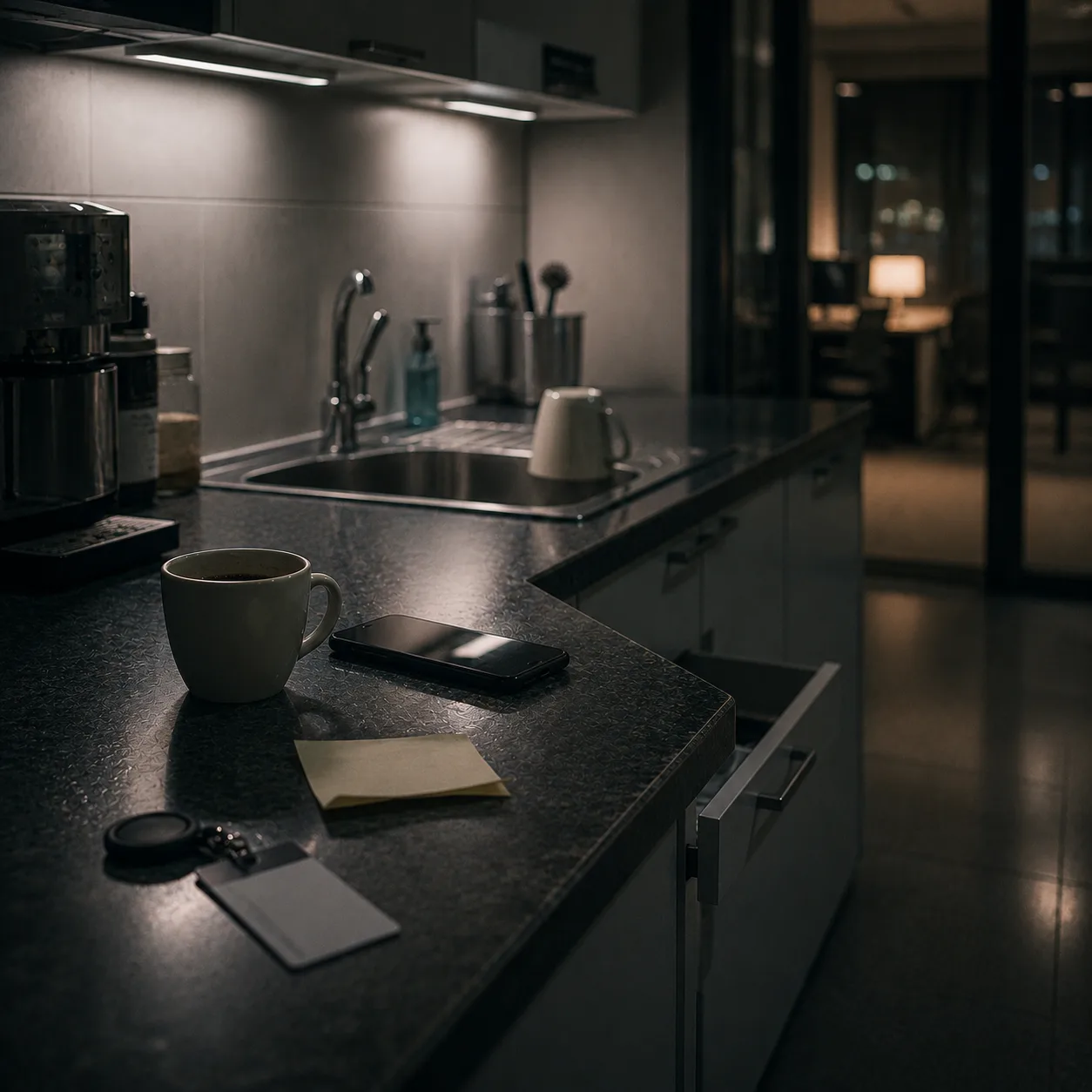
A desk under quiet office light, two coffee cups, a face-down phone, a familiar handwritten note. Nothing in the room moves, and the same familiar phrase is suddenly less safe — the body understands that consequence entered through the trusted doorway.
Narrative function: Underscore for the quiet collapse of trust through recognition — access becoming consequence, without villain, sting or revenge.
Emotional subtext: Warm-familiar but unstable, quiet, calm, the second before emotion — recognition before reaction, before blame
Scene fit:
- recognizing familiar handwriting or a trusted detail
- a trusted colleague linked to a hidden decision
- an internal leak traced to someone close
- documentary about trust, access and internal breach
- personal or corporate story of betrayal without spectacle
What this music should do
Pick for the exact second trust becomes the route consequence entered — recognition before reaction; neutral V2 palette (baritone texture + upright piano + dark electric keys + deep bass). NOT a betrayal sting, villain, revenge or romantic pain.
What it must not do:
- a reveal sting or betrayal twist
- a theatrical villain or revenge
- romantic pain or a love wound
- a loud discovery, immediate anger or a threatening room
- recognition turned into spectacle or deciding what to do next
Creator fit
Use for:
- documentary on trust, access and internal breach
- legal, political and corporate-accountability storytelling
- family-business or institutional-failure narratives
- YouTube essays on trust, power and systems
- true-story podcast scenes of quiet recognition
Avoid for:
- reveal sting / betrayal twist
- villain or revenge scoring
- romantic pain / love wound
- loud discovery or anger
- thriller / true-crime
- trailer climax
Preview & download
Behind the track
Scene ideas, musical character and editing guidance from the original MCM54 track documents.
In the edit
- Notes for editor
Series D V2. This scores the quiet collapse of trust through recognition — not a reveal sting, a villain, revenge, or romantic pain. The emotion is harmonic and low-register; NO genre-character instruments (no Wurlitzer-lounge, flugelhorn, trumpet, bass clarinet, blues guitar, noir lead, cello). It uniquely OPENS with baritone guitar texture (the body before the mind). Keep it under the second before reaction, not the confrontation. The ending holds — the deep bass holds the final irreversible recognition while the room stays ordinary. Do not make the discovery loud or name a villain. Correct level under narration: -24 to -28 LUFS.
- Best for
a person recognizing familiar handwriting
a trusted colleague linked to a hidden decision
a phone or note changing meaning
an internal leak traced to someone close
a business partner becoming impossible to trust
a political story where betrayal comes from inside the circle
a private office moment before accusation
an institutional-failure or family-business breach
- Works after
a desk establishing shot — two cups, a face-down phone, a handwritten note
a hand resting near an object that suddenly means something else
narration introducing access, trust or an internal connection
a held shot of recognizable handwriting
- Works before
the accusation or confrontation (this scores the second before)
a cut to the consequence the breach set in motion
a reflection on how trust left a door open
the redrawing of who was safe and who was not
- Loop friendly
No
- Intro friendly
Yes
- Ending friendly
Yes
- Voiceover friendly 1 5
5
- Dialogue friendly 1 5
5
Musical character
- Genre
Serious Institutional Consequence Score
- Subgenre
Power & Consequence (V2) — person vs. trusted access
- Main instruments
baritone electric guitar texture (the body noticing before the mind names it — opens alone, low, restrained, texture only)
low dry upright piano (the object becoming evidence — familiar details placed into new order)
dark electric keys (the familiar room — calm office light, ordinary surface, quiet instability)
deep sustained bass (irreversible recognition — trust giving way, new floor beneath the room)
subtle paper texture (handwritten note, page edge, small material proof)
distant metal resonance (phone edge, desk, drawer handle — quiet surface detail)
low analog room pressure (controlled air — a familiar room becoming harder to trust)
- Texture
Asymmetric, low-register, familiar-on-top. An ordinary office (dark electric keys as calm light) over a collapsing map of trust: baritone guitar texture as bodily recognition, low dry piano reordering familiar details into evidence, deep sustained bass as irreversible recognition. The drama is harmonic — a familiar figure returns with one altered inner note while the surface stays ordinary. Silence is procedural, not relational.
- Mix character
Dry, close, low, controlled, expensive, serious — not cinematic-wide, not trailer-polished, not emotional. Low end is irreversible consequence; midrange is reordered evidence; high end restrained and not shiny. Soft transients, minimal compression, transparent midrange for narration. Paper and metal details sparse, physical and controlled.
- Time signature
free / rubato — slow, measured, no metered pulse
Emotional arc
- Primary emotion
Redrawn certainty
- Secondary emotion
Quiet collapse of trust — recognition before reaction, before blame, before language
- Story position
The private second when the mind connects two things it had kept separate, and the trusted object becomes evidence against the trusted person
- Emotional arc
Familiar trust → Redrawn certainty. The piece does not resolve or accuse. Baritone guitar texture is the body noticing before the mind names it; low dry piano reorders familiar details into evidence; dark electric keys hold the familiar room; deep sustained bass arrives as irreversible recognition; a familiar figure returns with one altered inner note; the deep bass holds the final recognition while the room stays ordinary.
- Power relationship
Person vs. trusted access — the danger came through the permitted door. Asymmetric: nothing in the room moves, yet the internal map of trust collapses.
Original arrangement brief
Original creative intent. Timings, tonal targets and mix instructions describe the written brief; individual audio takes may differ.
- Emotional profile
- Primary
Redrawn certainty
- Secondary
Quiet collapse of trust — recognition before reaction, before blame, before language
- Arc type
Asymmetric power-and-consequence arc carried by harmony. Baritone guitar texture is the body noticing before the mind names it; low dry piano reorders familiar details into evidence; dark electric keys hold the familiar room; deep sustained bass arrives as irreversible recognition; a familiar figure returns with one altered inner note; the deep bass holds the final recognition while the room stays ordinary.
- Listener journey
Familiar trust → Redrawn certainty
- Emotional temperature
Warm-familiar but unstable. The temperature of an ordinary office where nothing has moved and yet everything now belongs to a different story — calm, recognizable, quietly impossible to explain away. Not threatening, not sad, not dramatic; the moment before emotion, when the internal map of trust collapses.
- Arrangement stages
- Stage
1
- Name
The Body Notices First
- Duration approx
0:00–0:40
- Description
Baritone electric guitar texture alone. Low, close, restrained. A bodily signal before thought becomes language.
- Instrumentation active
baritone electric guitar texture
- Density
near-zero
- Stage
2
- Name
Familiar Details, New Order
- Duration approx
0:40–1:25
- Description
Low dry upright piano enters with short measured notes. Familiar details are placed into a new order. The room remains calm.
- Instrumentation active
baritone electric guitar texture
low dry upright piano
- Density
sparse
- Stage
3
- Name
The Same Room, Less Trustworthy
- Duration approx
1:25–2:15
- Description
Dark electric keys enter softly. Office light settles over the desk. The same room begins to feel less trustworthy through small harmonic shifts.
- Instrumentation active
baritone electric guitar texture
low dry upright piano
dark electric keys
- Density
sparse
- Stage
4
- Name
One Altered Inner Note
- Duration approx
2:15–3:05
- Description
Paper texture appears briefly as the handwritten note or page edge. Distant metal resonance appears once. Piano repeats a familiar figure with one altered inner note.
- Instrumentation active
baritone electric guitar texture
low dry upright piano
dark electric keys
paper texture (brief)
metal resonance (once)
- Density
moderate-sparse
- Stage
5
- Name
Recognition Becomes Irreversible
- Duration approx
3:05–3:45
- Description
Deep sustained bass enters as irreversible recognition. Harmony moves through added seconds, added ninths, suspended inner notes and slow downward bass motion. The upper layer stays familiar while the lower register becomes heavier.
- Instrumentation active
baritone electric guitar texture
low dry upright piano
dark electric keys
deep sustained bass
- Density
moderate-sparse
- Stage
6
- Name
Nothing in the Room Has Moved
- Duration approx
3:45–4:20
- Description
Piano stops after an incomplete reordered phrase. Electric keys remain briefly as the same office light. Paper texture appears once, as if the note is still on the desk. Baritone texture thins but remains. Deep bass holds the final recognition.
- Instrumentation active
low dry upright piano (stops, incomplete)
dark electric keys (remain briefly)
paper texture (once)
baritone electric guitar texture (thins but remains)
deep sustained bass (holds final recognition)
- Density
near-zero to silence
- Instrumentation roles
- Bodily recognition
- Instrument
Baritone electric guitar texture
- Role
The body noticing before the mind names it — bodily recognition before language. Opens the piece alone; thins but remains at the end (the body still knows).
- Priority
opens the piece, thins but remains in stage 6
- Melodic content
Low restrained texture — held low notes, faint pressure; never a riff, never a lead line, never a melody.
- Forbidden
Blues riff, rock, western noir, lead melody, whiskey-bar mood, genre color
- Reordered evidence
- Instrument
Low dry upright piano
- Role
The object becoming evidence — familiar details placed into a new order; a familiar figure returning with one altered inner note. Stops after an incomplete reordered phrase at the end.
- Priority
enters stage 2, stops unfinished in stage 6
- Melodic content
Short measured notes; a familiar figure that returns with one altered inner note; an incomplete reordered fragment at the close.
- Forbidden
Emotional/lyrical piano, sad piano, reveal flourish, felted intimacy, dramatic wound
- Familiar room
- Instrument
Dark electric keys
- Role
The familiar room — calm office light, ordinary surface, quiet instability underneath. Remains briefly at the end as the same office light.
- Priority
enters stage 3, remains briefly in stage 6
- Melodic content
Sustained ordinary surface that begins to feel less trustworthy through small harmonic shifts; never a melody.
- Forbidden
Lounge, jazz club, vintage bar, blues, nostalgia, sentimental warmth, becoming a lead, romantic color
- Irreversible recognition
- Instrument
Deep sustained bass
- Role
Irreversible recognition — trust giving way, the new floor beneath the room. Holds the final recognition.
- Priority
enters stage 5, holds the final recognition in stage 6
- Melodic content
Slow sustained low weight; downward motion; one final held low weight at the close. No rhythm.
- Forbidden
Walking bass, jazz groove, suspense pulse, rhythmic movement, dramatic build, reveal hit
- Material proof
- Instrument
Subtle paper texture
- Role
Handwritten note, page edge, document surface, small material proof — and at the end, the note still on the desk. Environmental detail only.
- Priority
rare, brief in stage 4; once in stage 6
- Melodic content
n/a
- Forbidden
Ticking, percussion loop, crime pulse, rhythm, becoming a beat
- Object detail
- Instrument
Distant metal resonance
- Role
Phone edge, desk, drawer handle, office object — quiet surface detail. The object that suddenly means something else. Restrained and dry.
- Priority
once in stage 4
- Melodic content
n/a
- Forbidden
Cinematic hit, trailer impact, sting, reveal resonance, becoming dramatic or magical
- Room
- Instrument
Low analog room pressure
- Role
Controlled air — a familiar room becoming harder to trust.
- Priority
constant and very subtle
- Melodic content
n/a
- Forbidden
Haunted atmosphere, conspiracy fog, threatening drone, supernatural weight, large/theatrical space
- Absent instruments
- Instrument
NONE — genre-character instruments are deliberately absent
- Role
Per Series D V2, no bass clarinet, trumpet, flugelhorn, saxophone, brass lead, jazz brushes, lounge electric piano, blues guitar, noir lead, or cello. The relationship is person vs. trusted access, carried by the neutral V2 palette.
- Priority
absent
- Melodic content
n/a
- Forbidden
Any of the above genre/character instruments, any solo cello, any string pad as emotion
- Harmonic philosophy
- Key center
G minor
- Modal inflections
Slow minor harmony where the drama comes from harmony itself. A familiar figure returns with one altered inner note; the upper surface stays ordinary while the lower register becomes heavier. No genre inflection (no blues turnaround, no jazz voicing as identity).
- Arc
The baritone establishes a low Gm pressure. The piano states a familiar figure; the electric keys hold the ordinary room. The figure returns with one altered inner note — the same phrase, less safe — while the deep bass lowers the floor. Nothing resolves; the piece ends on an incomplete reordered phrase over a held low weight.
- Chord movement
Slow and downward. Gm, Gm(add9), Gm(add2), Gm sus2/sus4, low pedal G, a familiar figure returning with one altered inner note, slow downward bass (G–F–Eb as floor), unresolved extensions, a major chord placed where it is lawful but not just. No functional cadence drive; cadences are withheld.
- Resolution policy
Never resolve, and never resolve what to do next. No perfect authentic cadence — trust has collapsed but no decision is made. The ending lands on an incomplete reordered phrase over a held low weight, not a tonic resolution.
- Forbidden intervals
Bright major-key lift (would imply relief, reconciliation, or that trust survives)
Perfect authentic cadence D–Gm with full resolution (implies the matter settled or a decision made)
A reveal sting or dramatic diminished hit on the altered note
Blues turnaround or jazz voicing used as genre identity
Sentimental or romantic resolution that turns the breach into a love wound
- Preferred intervals
A familiar figure returning with ONE altered inner note (the same phrase, less safe)
Added 2nd / added 9th over a minor triad (ordinary surface, unsettled inside)
Suspended inner notes (trust held, certainty redrawn)
Slow downward bass motion (the new floor of irreversible recognition)
A major chord in a morally wrong place (lawful but not just)
- Key production note
G minor here must read as redrawn certainty — recognition before reaction — not a betrayal sting, revenge, romance or threat. A dramatic G minor makes a reveal; a romantic G minor makes a love wound; a threatening G minor makes the room dangerous; a resolving G minor decides what to do next. The correct G minor says: the room is still familiar, nothing has moved, and the same phrase is suddenly less safe.
- Mix philosophy
- Stereo field
Dry and controlled, low-register focus, intimate. Baritone guitar texture low and close; low dry piano central; dark electric keys an ordinary surface around it; deep bass centered and low; paper and metal details rare and physical. An office desk, not a hall, not a trailer-wide space.
- Reverb character
Short and dry — 0.4 to 0.9 seconds — a controlled office acoustic. No archival haze, no conspiracy ambience, nothing cinematic or supernatural.
- Frequency balance
Low end is irreversible consequence; midrange is reordered evidence; high end restrained and not shiny. Low body on the baritone texture; dry transient clarity on the piano; ordinary-warm surface on the electric keys; weighted, restrained low end on the deep bass. Transparent midrange reserved for narration.
- Dynamic range
Controlled and restrained. The music deepens but never swells; tempo and volume hold while harmony carries the drama and the discovery stays quiet. Loudness target: -18 LUFS integrated. Under narration: -24 to -28 LUFS. The procedural silences and the final held low weight must remain genuinely quiet.
- Headroom for narration
Maximum. This track underlays serious documentary narration about trust, access and internal breach — voice must always lead. The music holds the redrawing of trust; it never competes with or manipulates the words.
- Dynamics philosophy
- Overall level
Quiet, controlled and intimate throughout. Never loud, never building to a climax. The discovery stays quiet; the dynamics deepen rather than rise.
- Movement type
Slow, measured recognition and downward bass motion. Movement comes from a familiar figure returning altered, harmonic pressure, spacing and slow repetition — no beat that calls attention to itself, no sting.
- Peak policy
No peaks and no climax. Stage 4 (the altered note) and stage 5 (irreversible recognition) are the deepest moments and must stay restrained. If the altered note lands as a reveal sting or the music swells, the recognition-not-spectacle truth is broken — reject.
- Silence policy
Procedural, not relational — the silence of an ordinary room the mind has just re-read. Silence does not comfort; it records the collapse of trust. The space around the returning figure and the final silence under the held low weight are active material.
- Compression policy
Minimal. No limiting. Preserve the low body of the baritone texture, the dry transients of the upright piano, the ordinary surface of the electric keys, and the weight of the deep bass. No artificial loudness evening, no glossy polish.
- Listener outcome
- Intended feeling
The exact second when trust stops being a place of safety and becomes the route through which consequence entered — redrawn certainty, recognition before reaction. Nothing in the room has moved; the trusted hand has changed everything.
- Not intended
A reveal sting, a betrayal twist, or a villain
Revenge or romantic pain
A loud discovery, immediate anger, a magical object, or a threatening room
Recognition turned into spectacle, or deciding what to do next
Any feeling produced by darkness/texture alone rather than by harmony
- Best descriptor
A desk under quiet office light, two coffee cups, a face-down phone, a familiar handwritten note; nothing moved, and the same phrase suddenly less safe — the danger came through the permitted door.
Creator note
# Creator Note — INST-036
# The Trusted Hand
This track is not about the drama of betrayal.
It is about the second before emotion arrives, when
one familiar detail suddenly rearranges the whole story.
I wanted the music to hold the collapse of trust
without turning anyone into a villain.
— Oshi, MCM54
License
Use any track in your videos, podcasts, films and narrated projects — including monetized ones. Credit MCM54 where your platform allows: video description, show notes, end credits or project credits. Do not resell, re-upload, or register the tracks with Content ID. Downloads you have already made keep their license even if these terms later change.
Credit line: Music: MCM54 — mcm54.com