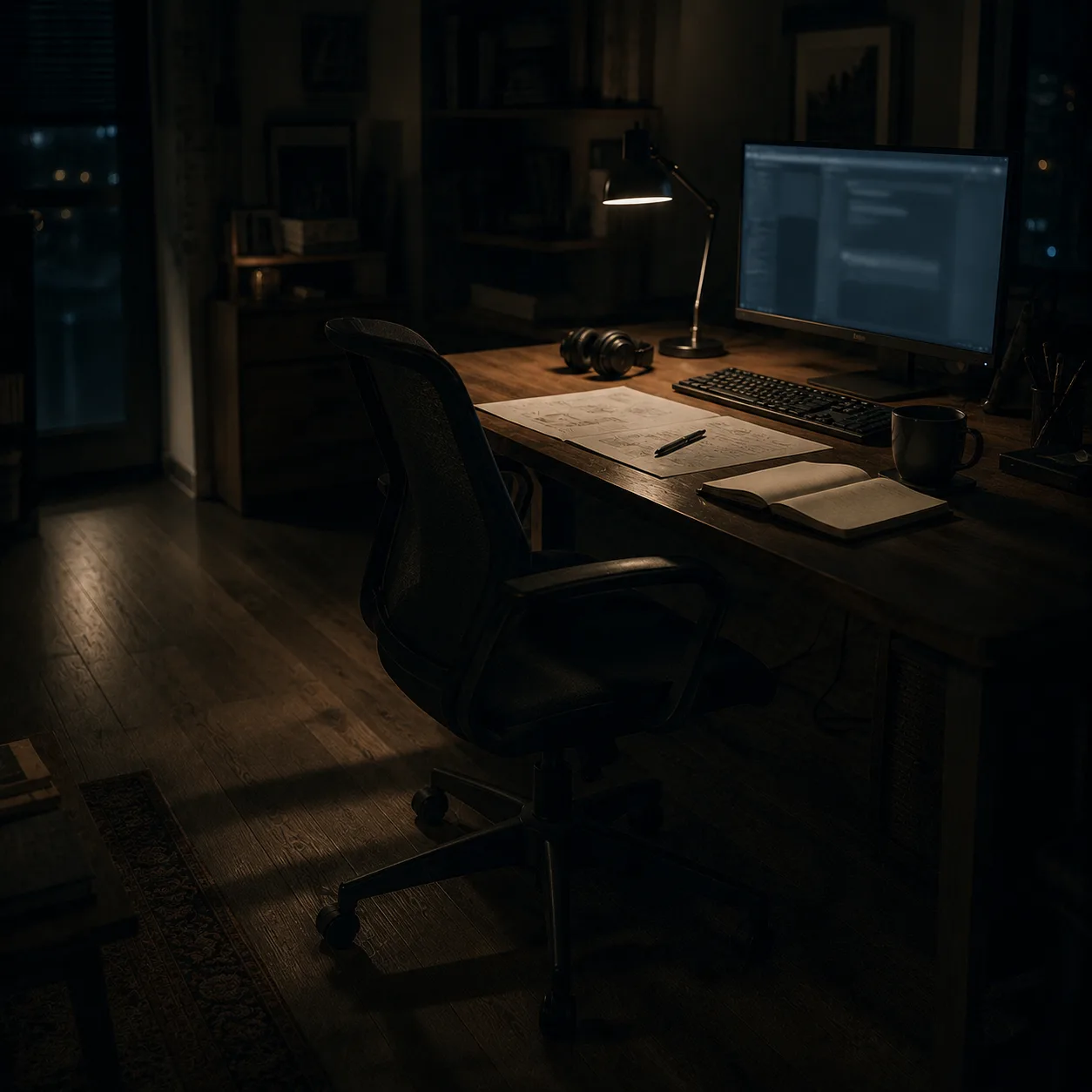
The Drift
Music for the moment the work begins to carry the person instead of the person carrying the work
The moment
The work begins to carry the person: agency softens inside repetition, and the difference between steering and being carried becomes uncertain while the person stays present.
Narrative function: Scene cue for controlled cognitive drift — a suspended middle state where a process the person built starts to move them, without ambient passivity or panic.
Emotional subtext: Drifting, displaced, present but softened, suspended, unresolved
Scene fit:
- following a thread without choosing each step
- a room that carries the person forward
- a portrait of being slightly displaced by the work
- narration on the difference between focus and drift
What this music should do
Pick for the drift state — present but no longer fully steering. It is the family's 'softened current' (keep it controlled, never ambient/trippy/weightless). Use 047 over 046 when the system starts to carry the person; use 048 when the glow starts to fade.
What it must not do:
- ambient / sleepy / spa drift
- trippy or cosmic psychedelia
- panic
- collapse
- weightlessness
Creator fit
Use for:
- documentary / essay on deep work, attention and creative drift
- someone still inside a system after clear intention has faded
- a process that now has momentum of its own
- psychology / founder-story portraits of being carried by one's own work
Avoid for:
- ambient wallpaper / sleepy / spa beds
- trippy / cosmic / psychedelic soundscapes
- panic / horror / collapse cues
- a beat / groove / loop
- warm, weightless or resolved scenes
Preview & download
Behind the track
Scene ideas, musical character and editing guidance from the original MCM54 track documents.
In the edit
- Notes for editor
Series E, Track 7. This scores controlled cognitive drift — the moment the work begins to carry the person instead of the person carrying the work; agency softens inside repetition while the person stays present. 047 is not bigger than 046; it is more DISPLACED — the operating procedure of 046 softened into a current. The special color is CONTROLLED COGNITIVE DRIFT: displacement, not dissolution; the room is still real, the body still there, the human hand never removed. Do NOT make it ambient drift, sleepy, spa, dreamy wallpaper, decorative/trippy/cosmic psychedelia, electronic chill, lo-fi, a groove, a beat, hypnosis, panic, horror, or a collapse cue; never make it weightless, never lose the room. The palette is the neutral Series E world. Do not make the work feel finished; the ending must not resolve or collapse — the person could stop, but the current continues a few seconds after him. Correct level under narration: -24 to -28 LUFS.
- Best for
a creator remaining inside a late-night system after the point of clear intention
a founder who keeps moving through a process that now has momentum of its own
a writer or builder following a thread without fully choosing each next step
a room that feels ordinary but carries the person forward
a narrator describing the difference between focus and drift
a portrait of someone still present but slightly displaced by the work
a suspended middle state where the machine-room does not attack, save, answer or collapse — it carries
- Works after
the room becoming a machine (the operating cycle already running)
a held shot of a late-night desk that has become a system — screen glowing with no drama, headphones sealing the room
narration about deep work, attention and creative drift
a scene where the person has stayed long enough for the work to acquire momentum of its own
- Works before
a consequence the drift moves toward
a scene where the person notices whether he is steering or being carried
a story about deep work, feedback loops, attention and system absorption
the rest of Series E — it is the seventh track
- Loop friendly
No
- Intro friendly
Yes
- Ending friendly
No
- Voiceover friendly 1 5
5
- Dialogue friendly 1 5
5
Musical character
- Genre
Close Mechanical Nocturne
- Subgenre
Private Voltage (Series E, V1) — the work carrying the person, with controlled cognitive drift
- Main instruments
low dry felted upright piano (remains central but its authority is less firm; the recognizable Series E cell now arrives slightly late, slightly early, slightly incomplete or slightly displaced by echo — drift through controlled displacement, never messy, never random; old wood, close microphones, hammer contact, pedal breath, keybed noise)
muted baritone electric guitar (the current under the body — low, thick, restrained, close to the floor; it does not push the music forward, it makes the floor itself seem to move slowly; no riff, no solo, no blues performance)
restrained sub bass (a low current, not a floor test — enters late, very few notes; a slow pull beneath the room; no groove, no lift)
short tape echo displacement (returns a piano or guitar fragment slightly late or altered so the person feels carried by his own thought — displacement, not decoration, not atmosphere)
softened analog process pulse (the room still running but no longer sharply — intermittent, uneven, barely procedural; softer than INST-046; not a beat)
thin upper halo (controlled air movement above the room — very low density; not psychedelic, not trippy, not cosmic)
narrow electric room tone (weaker than INST-046, remaining at the edges)
harmonium breath (once — a long low inhale that seems to move the room)
rare vibraphone orientation note (once near the end — a small orientation point, not a recognition; not jazz, not lounge)
- Texture
Close, mechanical and gently displaced — the operating procedure of INST-046 softened into a current. The piano cell stays recognizable but drifts through controlled displacement (late, early, incomplete, echo-displaced); the baritone guitar is the current under the body so the floor seems to move slowly; short tape echo displaces the source cell; a softened, uneven process pulse keeps the room barely running; a thin upper halo moves above the room; the restrained sub bass arrives late as a slow pull. The movement is displacement and delayed confirmation, not arrangement growth, never a beat, never weightless.
- Mix character
Dry close instrumental realism with hyper-intimate mechanical detail. Audible piano wood, felt, hammer, pedal, keybed noise, baritone string pressure, amp breath, low room electricity, short tape displacement and thin upper halo. Small room, low light, restrained dynamics. No glossy width, no large cinematic space, no ambient wash. The thin upper halo and narrow electric room tone stay minimal and at the edges, controlled air movement rather than psychedelic space; the room stays real and the sound never becomes weightless.
- Time signature
free / rubato — drift through controlled displacement, not a loop; a softened analog process pulse may appear intermittently and unevenly but must never become a beat
Emotional arc
- Primary emotion
Carried by the current
- Secondary emotion
Controlled cognitive drift — agency softening inside repetition while the person remains present
- Story position
The seventh track of Series E: the moment after the room became a machine, when the operating cycle keeps running and the room begins to carry attention forward without asking permission — the work starts to carry the person instead of the person carrying the work
- Emotional arc
Absorbed into the working system → Carried by the current. The piece does not resolve. The low dry felted upright piano remains central but its authority is less firm — the recognizable Series E cell now arrives slightly late, slightly early, slightly incomplete or slightly displaced by echo (drift through controlled displacement, never messy, never random); muted baritone electric guitar becomes the current under the body so the floor itself seems to move slowly (no push); short tape echo displacement returns a fragment slightly late or altered so the person feels carried by his own thought; a softened analog process pulse keeps the room running but no longer sharply (intermittent, uneven, barely procedural); a thin upper halo is controlled air movement above the room (not psychedelic, not trippy, not cosmic); a narrow electric room tone stays weaker at the edges; restrained sub bass enters late as a low current, a slow pull beneath the room; harmonium breath may appear once as a long low inhale that moves the room, and a rare vibraphone note once near the end as a small orientation point, not recognition; the ending does not resolve or collapse — the person could stop now, but the current would continue for a few seconds after him.
- Power relationship
Person and process, with the balance quietly tilting — not authority over the work and not the work against the person, but a system that has stopped fighting and begun to carry him gently forward. Intimate and unresolved: the person built the system, the system changed the room, and now the current underneath has become stronger than the decision to continue.
Original arrangement brief
Original creative intent. Timings, tonal targets and mix instructions describe the written brief; individual audio takes may differ.
- Emotional profile
- Primary
Carried by the current
- Secondary
Controlled cognitive drift — agency softening inside repetition while the person remains present
- Arc type
Asymmetric, unresolved drift arc carried by controlled displacement, delayed confirmation and echo. The piano cell stays recognizable but arrives slightly late, early, incomplete or echo-displaced; the baritone guitar becomes the current under the body so the floor seems to move slowly; a softened, uneven process pulse keeps the room barely running; short tape echo displaces the source cell; the sub bass arrives late as a slow pull; the ending does not resolve or collapse — the person could stop, but the current continues a few seconds after him.
- Listener journey
Absorbed into the working system → Carried by the current
- Emotional temperature
Close, dark and gently displaced — a late-night room still switched on, the operating cycle softened into a current. The person is still present, the room still real, the body still there, but intention is no longer sharp. Not ambient, not sleepy, not panic — controlled cognitive drift, private and suspended.
- Arrangement stages
- Stage
1
- Name
The Cell Begins To Displace
- Duration approx
0:00–0:45
- Description
Low dry felted upright piano alone. The short cell and close room are established. One return is allowed to feel slightly displaced, but kept human.
- Instrumentation active
low dry felted upright piano
- Density
sparse
- Stage
2
- Name
The Floor Becomes Slow Current
- Duration approx
0:45–1:30
- Description
Muted baritone electric guitar enters underneath. The body remains present while the floor begins to feel like slow current.
- Instrumentation active
low dry felted upright piano
muted baritone electric guitar
- Density
sparse-moderate
- Stage
3
- Name
The Room Runs But Not Sharply
- Duration approx
1:30–2:20
- Description
A softened analog process pulse and short tape echo displacement appear. The room still runs, but attention is no longer fully sharp.
- Instrumentation active
low dry felted upright piano
muted baritone electric guitar
softened analog process pulse
short tape echo displacement
- Density
moderate
- Stage
4
- Name
The Strongest Drift Point
- Duration approx
2:20–3:05
- Description
A thin upper halo and narrow electric room tone appear briefly and one late sub bass pull is placed. The strongest drift point, through displacement not volume. Harmonium breath once; rare vibraphone orientation note once near the end.
- Instrumentation active
low dry felted upright piano
muted baritone electric guitar
softened analog process pulse
short tape echo displacement
thin upper halo
narrow electric room tone
restrained sub bass
harmonium breath
rare vibraphone orientation note
- Density
moderate
- Stage
5
- Name
The Current Continues After Him
- Duration approx
3:05–3:55
- Description
Remove the pulse and upper layer. Return to piano, low guitar and one delayed tape fragment. End unresolved but clearly finished — the person may stop, but the current seems to continue after the final note.
- Instrumentation active
low dry felted upright piano
muted baritone electric guitar (remains low)
short tape echo displacement (one delayed fragment)
- Density
near-zero to unresolved landing
- Instrumentation roles
- Presence in the drift
- Instrument
Low dry felted upright piano
- Role
Human presence inside the drift — the recognizable Series E cell, its authority now less firm, arriving slightly late, early, incomplete or echo-displaced.
- Priority
opens the piece, returns last in stage 5
- Melodic content
A short recognizable cell drifting through controlled displacement — one changed detail per return (timing, spacing, echo position, register, silence length or one inner note); not a loop, no melodic development, no resolution.
- Forbidden
Pretty/lyrical piano, sentimental felt, cathartic phrasing, melody, messy or random displacement, becoming a loop
- Current under the body
- Instrument
Muted baritone electric guitar
- Role
The current under the body — low, thick, restrained, close to the floor; it does not push, it makes the floor itself seem to move slowly.
- Priority
enters stage 2, remains low in stage 5
- Melodic content
Held low current; carries no line, never a riff, never a lead.
- Forbidden
Blues riff, blues shuffle, rock, guitar solo heroics, lead melody, bar-band energy, pushing the music forward
- Room still running
- Instrument
Softened analog process pulse
- Role
The room still running but no longer sharply — intermittent, uneven, barely procedural; softer than INST-046. Must never become a beat.
- Priority
intermittent in stages 3–4, removed in stage 5
- Melodic content
n/a
- Forbidden
Drums, beat, groove, sharp procedure, chase rhythm, any attention-calling pulse
- Carried by own thought
- Instrument
Short tape echo displacement
- Role
A piano or guitar fragment returning slightly late or altered so the person feels carried by his own thought — displacement, not decoration.
- Priority
stages 3–4, one delayed fragment in stage 5
- Melodic content
n/a
- Forbidden
Decorative echo, atmosphere, psychedelic space as spectacle, wide ambience, becoming an effect show
- Controlled air movement
- Instrument
Thin upper halo
- Role
Controlled air movement above the room — very low density; controlled cognitive drift, not psychedelic style.
- Priority
briefly in stage 4, removed in stage 5
- Melodic content
A very low-density upper air; never a melody, never a lead.
- Forbidden
Psychedelic, trippy or cosmic movement, decorative shimmer, becoming an effect show, overwhelming the room
- Edge electricity
- Instrument
Narrow electric room tone
- Role
Low electricity at the edges — weaker than in INST-046.
- Priority
briefly in stage 4, removed in stage 5
- Melodic content
A thin electric air at the edges; never a synth pad, never a lead.
- Forbidden
Synth pad, futuristic tone, ambient pad wash, becoming a lead, moving to the center
- Slow pull
- Instrument
Restrained sub bass
- Role
A low current beneath the room — a slow pull, not a floor test; enters late, very few notes. Not support, not lift.
- Priority
one late pull in stage 4
- Melodic content
A late low pull; no rhythm, no groove.
- Forbidden
Lift, groove, walking bass, warm reassurance, becoming a beat, floor-test weight, descending-doom bass
- Room breath
- Instrument
Harmonium breath
- Role
A long low inhale that seems to move the room — once.
- Priority
once in stage 4
- Melodic content
One long low inhale; never a melody.
- Forbidden
Church, spiritual, folk, sentimentality, becoming a pad wash
- Orientation point
- Instrument
Rare vibraphone orientation note
- Role
A small orientation point near the end — not a recognition; once.
- Priority
optional, once near the end (stage 4 into 5)
- Melodic content
One note; never a phrase.
- Forbidden
Jazz, lounge, nostalgia, decoration, magical shimmer, melody, becoming a recognition motif
- Absent instruments
- Instrument
NONE — instruments-to-avoid are deliberately absent
- Role
Per Series E, no bass clarinet, contrabass clarinet, cello as core, nylon guitar as main warmth, conventional warm electric piano, obvious drums, lo-fi beat, ambient pad wash, or corporate synth polish.
- Priority
absent
- Melodic content
n/a
- Forbidden
Any of the above, any solo cello as human voice, any string pad as emotion
- Harmonic philosophy
- Key center
F sharp minor
- Modal inflections
Dark suspended minor harmony, minimal and softened. Incomplete chords, open fifths, unstable thirds, added seconds, added ninths, low pedal pressure. Harmonic motion comes from timing displacement, inner-note shifts, delayed bass pull and echo returns. No blues turnaround or jazz voicing as identity.
- Arc
The piano cell establishes F sharp minor as a place held under a softening center. Timing displacement and echo returns carry attention forward while the center loses its sharp edge; the sub bass arrives late as a slow pull. Nothing resolves; the ending removes the pulse and upper layer and returns to piano, low guitar and one delayed tape fragment — unresolved but clearly finished, the current continuing after the final note.
- Chord movement
Minimal and unresolved, developing through timing displacement and controlled variation. F#m, F#m(add9), F#m(add2), open fifths with unstable thirds, low pedal F#, altered inner notes, small timing and spacing shifts, delayed bass pull, echo returns, unresolved cadences. No functional cadence drive; no release.
- Resolution policy
Never resolve. No perfect authentic cadence — no release and no sense that the work is finished. The ending is unresolved but clearly finished: the person may stop, but the current continues a few seconds after the final note. Full resolution is reserved for a later Series E track about evidence after the state has passed, not this one.
- Forbidden intervals
Bright major-key lift or warm resolution (would imply the work is finished or the drift safe)
Perfect authentic cadence with full resolution (implies certainty / the session ended)
A groove or beat implied by the softened pulse or bass (the pulse is the room still running, the bass is a slow pull)
A swelling cinematic build, success montage or trailer close
Blues turnaround or jazz voicing used as genre identity
Trippy/cosmic psychedelic movement, decorative effect harmony, or a weightless ambient float
- Preferred intervals
A recognizable cell drifting through controlled displacement (late, early, incomplete, echo-displaced — not a loop)
Inner-note shifts and timing displacement that soften the center while keeping the room real
Open fifths with unstable thirds (incompleteness, agency softening)
Added 2nd / added 9th over a minor triad (a surface held, unsettled inside)
A sub bass arriving late as a slow pull (a low current beneath the room, not a floor test, not lift)
- Key production note
F sharp minor here must read as controlled cognitive drift — the work carrying the person gently forward, the person still present, the room still real — not ambient float, not sleep, not panic, not resolution. An ambient F sharp minor makes wallpaper; a sleepy F sharp minor makes spa music; a resolving F sharp minor makes the work feel finished. The correct F sharp minor says: the current underneath has become stronger than the decision to continue, and the difference between steering and being carried has become uncertain.
- Mix philosophy
- Stereo field
Dry close instrumental realism with hyper-intimate mechanical detail. Piano close and central but slightly displaced; baritone guitar low and slightly to one side as the current under the body; the thin upper halo and narrow electric room tone minimal and at the edges; sub bass centered and low; softened pulse, tape displacement, harmonium and vibraphone rare and physical. A small room, not a hall, not a trailer-wide space. The halo stays controlled and internal — air movement, not psychedelic space; the room stays real, never weightless.
- Reverb character
Short and dry — the intimate acoustic of a small private room. Short tape echo displaces fragments slightly late or altered (a thought returning to carry the person). The thin upper halo stays low-density and internal, never wide psychedelic space. Nothing cinematic, cosmic or dreamy.
- Frequency balance
Low end is a late-arriving slow pull (a low current, not lift); midrange is the displaced piano cell and the current under the body (baritone guitar); high end carries the thin upper halo and narrow electric room tone, restrained and at the edges, never shiny. Transparent midrange reserved for narration.
- Dynamic range
Controlled and restrained, drifting but never a swell or a beat; controlled displacement, timing shifts, echo returns and the late slow-pull sub bass carry the pressure. Loudness target: -18 LUFS integrated. Under narration: -24 to -28 LUFS. The real air in the intro and the unresolved ending must remain genuinely quiet, but the room must never become weightless.
- Headroom for narration
Maximum. This track underlays narration about deep work, attention, creative drift and the moment a person becomes carried by their own process — voice must always lead. The music holds the current; it never competes with, swells under, or manipulates the words, and never becomes ambient wallpaper.
- Dynamics philosophy
- Overall level
Quiet and drifting throughout. Never loud, never building to a climax, never releasing. The dynamics soften and carry rather than rise; more displaced than INST-046, not bigger.
- Movement type
Drifting but present. Movement comes from the piano cell displacing through timing, the softened uneven pulse, tape echo displacement, the thin upper halo and the late slow-pull sub bass — no beat that calls attention to itself, no groove, no swell.
- Peak policy
No peaks and no climax. Stage 4 (the strongest drift point) must stay restrained — strongest through displacement, not volume. If the music swells, resolves, grooves, becomes ambient wallpaper or weightless, the controlled-drift truth is broken — reject.
- Silence policy
Silence is an event — the suspended air of drift, and silence length itself can displace the cell. Real air remains; the unresolved final landing is active material because the current continues a few seconds after the person may stop.
- Compression policy
Minimal. No limiting. Preserve the mechanical noise and dry transients of the felted piano, the low body of the baritone guitar, the thin controlled upper halo, the short tape displacement, and the late slow pull of the sub bass. No artificial loudness evening, no glossy polish, no cinematic glue, no ambient smoothing.
- Listener outcome
- Intended feeling
That the work is now carrying the person gently forward — the person still present, the room still real, the body still there — with enough quiet force that the difference between steering and being carried becomes uncertain.
- Not intended
Ambient drift, sleepy atmosphere, spa music, dreamy wallpaper, electronic chill, or lo-fi
Decorative, trippy or cosmic psychedelia, a groove, a beat, or hypnosis
Panic, horror, or a collapse
Weightlessness, the loss of the room, or the removal of the human hand
Any feeling produced by a beat or genre color rather than by controlled displacement and echo
- Best descriptor
A late-night room still switched on — the desk a system, the screen glowing with no drama, the headphones sealing the room; the person is still there and the hand still knows where to go, but the current underneath has become stronger than the decision to continue, and the work has begun to carry him.
Creator note
# Creator Note — INST-047
# The Drift
This track is about the moment the work starts to carry you.
Not by force.
Not as collapse.
Not as sleep.
You are still there.
The room is still real.
The hand is still near the work.
But something in the process has begun moving on its own,
and for a moment you are not sure
whether you are steering it
or being carried by it.
— Oshi, MCM54
License
Use any track in your videos, podcasts, films and narrated projects — including monetized ones. Credit MCM54 where your platform allows: video description, show notes, end credits or project credits. Do not resell, re-upload, or register the tracks with Content ID. Downloads you have already made keep their license even if these terms later change.
Credit line: Music: MCM54 — mcm54.com