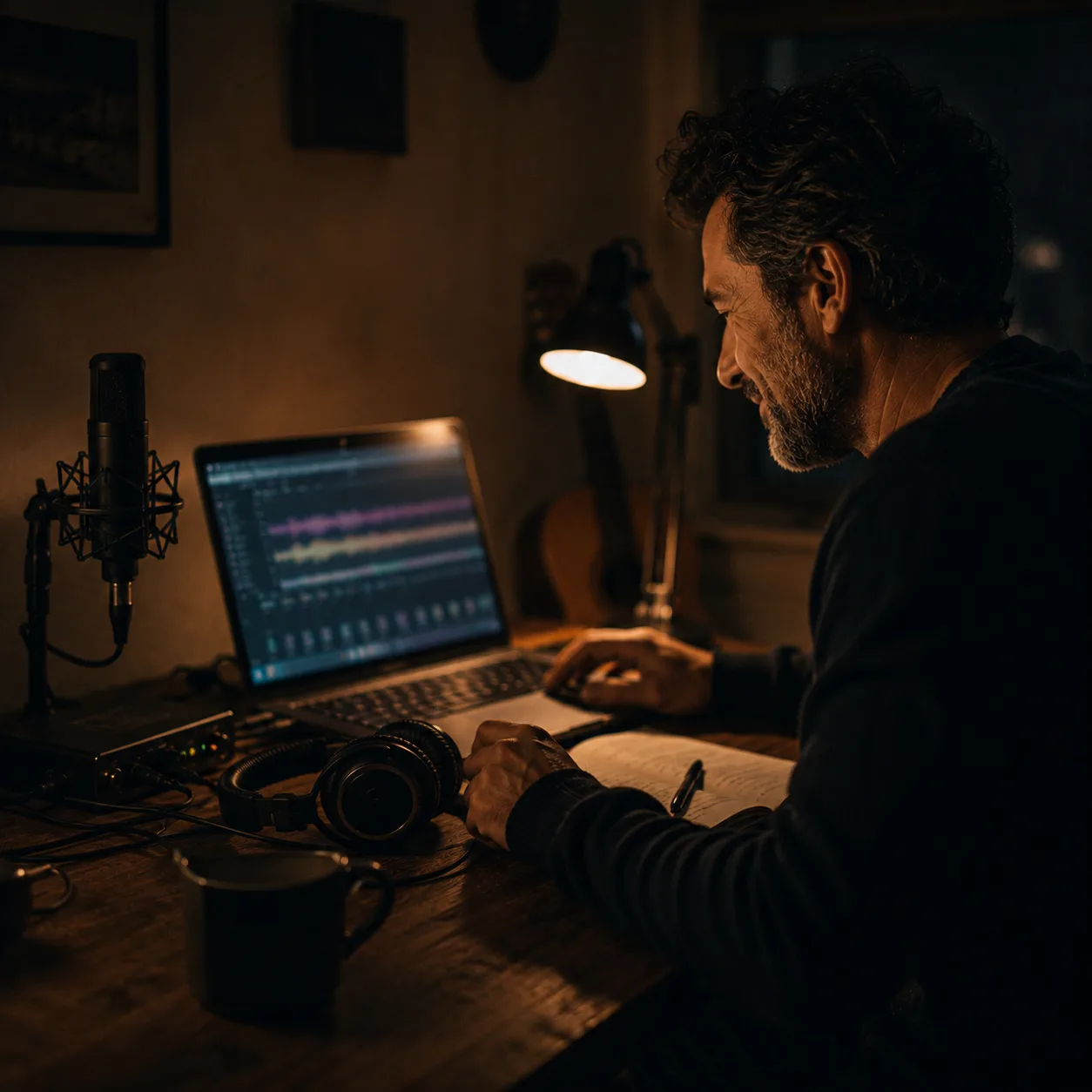
Podcast For One
Music for the moment the creator builds a private episode and hears the system support the voice that is not yet public
The moment
The system becomes a scoring environment: the creator builds a private podcast episode and hears the system support a voice that is not yet public, holding a space for the voice by knowing where to leave room. The answer is spatial — there is room here for a voice.
Narrative function: Fourth Series G cue — the first private episode; where 063 said 'I want to play with this again,' 064 says 'it can hold a voice': the system becoming narratively useful through restraint.
Emotional subtext: Warm, nocturnal, intimate and voiceover-aware; useful because it knows where not to enter; quietly magnetic, unresolved
Scene fit:
- a creator preparing a podcast alone
- a voiceover timeline opening before recording
- an editor testing music under narration
- a founder recording a first internal episode
What this music should do
Pick as the most VOICEOVER-AWARE Series G bed — built to hold a voice by leaving room; contains no voice and must not suggest spoken words. Choose 064 under private narration, pre-release voiceover or an editor testing music under speech; the value is in where the music does NOT enter, the midrange kept clear for a voice. Reject any take that becomes a jingle, a public intro, a news/corporate bed, a crime cue, a Latin genre or that fills the voice space. Intro_friendly, not ending_friendly; ends on open narrative space.
What it must not do:
- a podcast jingle, a public show intro, a news theme or a corporate voiceover bed
- a dramatic documentary cliche, a crime score, a thriller or an imitation of a specific work
- a Latin party, salsa, flamenco, bolero, tango, lounge or coffeehouse warmth
- sentimental piano, a crying cello, inspirational tech, product launch, sweetness, cuteness or a generated voice
Creator fit
Use for:
- private narration and pre-release voiceover — a creator preparing a podcast alone
- an editor testing music under narration, a voiceover timeline opening before recording
- a documentary showing a private rehearsal
- a system becoming narratively useful
Avoid for:
- podcast jingle / public show intro / news theme / corporate voiceover bed
- dramatic documentary cliche / crime score / thriller / imitation of a specific work
- Latin party / salsa / flamenco / bolero / tango / lounge / coffeehouse warmth
- sentimental piano / crying cello / inspirational tech / product launch / sweetness
Preview & download
Behind the track
Scene ideas, musical character and editing guidance from the original MCM54 track documents.
In the edit
- Notes for editor
Series G, Track 4. This scores voice held before release — the creator building a private podcast episode and hearing the system support an unreleased voice. 064 is VOICEOVER-AWARE from the first seconds and must LEAVE ROOM; it contains NO voice and must not suggest spoken words. The special color is VOICE HELD BEFORE RELEASE: the system becoming a scoring environment that holds a voice without exposing it too soon; the answer is SPATIAL (there is room here for a voice), not loud or impressive. The system supports not by adding more music but by knowing WHERE NOT TO ENTER. Do NOT make it a podcast jingle, a public show intro, a news theme, a corporate voiceover bed, a dramatic documentary cliché, a crime-show/thriller imitation, an imitation of any specific show/soundtrack/artist/ensemble, a Latin party/salsa/flamenco/bolero/tango, a lounge, coffeehouse warmth, sentimental piano, a crying cello, inspirational tech, product launch, sweet or cute; never contain or suggest voice; never suggest the system is human. Use the idea as transformation only (private podcast noir, restrained latin-noir warmth, voiceover-aware instrumental space, responsive chamber-latin precision). The palette: responsive felt piano (short thought phrases with space after each, like thought under narration), dry nylon guitar (restrained latin-noir pulse under the imagined voice, never strummed/genre), cello or viola (supports behind the imagined voice, not in front; low and warm), soft wood pulse (private timeline movement, never a beat), warm low bass (grounds only where narrative trust appears), tiny metallic edit mark / analog playback trace, quiet interface air. The ending leaves open narrative space — recorded nothing yet, but the room can hold the voice. Correct level under narration: -24 to -28 LUFS.
- Best for
a creator preparing a podcast alone
a voiceover timeline opening before recording
an editor testing music under narration
a documentary showing a private rehearsal
a founder recording a first internal episode
a reflective essay needing warm noir tension with space for speech
the moment a system becomes narratively useful
- Works after
the first quiet smile (063 — private delight with shadow)
a scene where a private tool has become compelling to use
narration about building a private episode before anyone hears it
a held shot of a desk with a microphone waiting, headphones near the keyboard, a timeline open
- Works before
a scene where the private episode is nearly ready but not released
a later Series G moment where the gift begins to turn toward being shared
a story about testing narrative privately before trusting it in the world
the rest of Series G — it is the fourth track
- Loop friendly
No
- Intro friendly
Yes
- Ending friendly
No
- Voiceover friendly 1 5
5
- Dialogue friendly 1 5
5
Musical character
- Genre
Private Podcast Noir
- Subgenre
The Private Instrument (Series G, V1) — voice held before release, with restrained chamber-latin response and voiceover-aware space
- Main instruments
responsive felt piano (short thought phrases with space after each — close, sparse, placed; behaves like thought under narration; not sad, not sweet, not confession, not a full melody)
dry nylon guitar with restrained latin-noir memory (a small pulse under the imagined voice — small syncopations, finger contact, warm tension; present enough to create pulse but never song, dance or genre; no strumming, no salsa, no flamenco, no bolero, no tango)
warm cello or viola (supports behind the imagined voice, not in front — enters late, stays low and warm, supports the emotional floor; not crying, not romantic strings, not sentimental swell, not grief, not drama)
soft wood pulse (private timeline movement — muted hand contact, irregular timing, like an editor feeling the seconds pass; not drums, not groove, never a beat)
warm low bass (grounds narrative trust — sparing long tones, only where narrative trust appears; no drive, no trailer weight)
tiny metallic edit mark (an edit mark / private confirmation — appears once)
analog playback trace (returns a phrase shorter and more placed)
quiet interface air (the private podcast room field — soft room electricity and silence)
- Texture
Warm, close, nocturnal and voiceover-aware — a private podcast room that holds an unreleased voice. Short piano thoughts leave room as if for speech; a dry nylon guitar is a hidden restrained latin-noir pulse under the imagined voice; a soft wood pulse marks timeline movement; a cello or viola sits behind the sentence as an emotional floor; a warm low bass grounds narrative trust; a tiny edit mark confirms once. The music is disciplined enough not to steal the scene and alive enough to support a private voice; the value is in where it leaves space, not what it fills.
- Mix character
Close warm analog private room with voiceover-aware space, restrained latin-noir pulse, chamber warmth, dry nylon tension and responsive silence. Audible piano hammer softness, nylon string contact, cello or viola body low and warm, tiny wood pulse, warm low bass, a small metallic edit mark, soft room electricity, analog playback trace and silence. Not glossy, not huge, not a news/corporate bed, not a crime score, not mechanical pressure, not open desert distance. Transparent midrange deliberately kept clear for an imagined voice.
- Time signature
free / rubato — no beat; short piano thoughts with space for an imagined voice; a hidden restrained latin-noir pulse and a soft timeline pulse that never become a beat
Emotional arc
- Primary emotion
Voice held before release
- Secondary emotion
Narrative trust — the system learning to hold a space where a voice could exist, without exposing it too soon
- Story position
The fourth track of Series G: after first playback (061), accurate return (062) and the first quiet smile (063), the system becomes a scoring environment; the creator builds a private podcast episode and hears the system support a voice that is not yet public
- Emotional arc
Private delight with shadow → narrative trust. The piece does not resolve. It opens in a private podcast room with quiet interface air and one short piano thought that leaves room as if for speech; a dry nylon guitar gives a small restrained latin-noir pulse under the imagined voice (never genre); a soft wood pulse marks private timeline movement (never a beat); a cello or viola enters like a shadow behind the sentence to support the emotional floor (not grief, not drama); the piano phrase returns shorter and more placed over a warm low bass that grounds narrative trust; a tiny metallic edit mark or analog playback trace confirms once; the ending does not resolve — piano, air and open narrative space, as if the creator has recorded nothing yet but knows the room can hold the voice.
- Power relationship
Creator and the private instrument he built — not broadcasting to an audience and not a person answering, but rehearsing with the world he built to hear whether the system can hold narrative. Unresolved: the system is not human; it supports the creator not by adding more music but by knowing where to leave space — holding a voice that has not been released, useful because it knows where not to enter.
Original arrangement brief
Original creative intent. Timings, tonal targets and mix instructions describe the written brief; individual audio takes may differ.
- Emotional profile
- Primary
Voice held before release
- Secondary
Narrative trust — the system learning to hold a space where a voice could exist, without exposing it too soon
- Arc type
Asymmetric, unresolved voiceover-aware arc carried by restraint, timing and silence, never a beat. A private podcast room opens with one short piano thought that leaves room for speech; a dry nylon guitar gives a hidden restrained latin-noir pulse; a soft wood pulse marks timeline movement; a cello or viola supports behind the sentence; the piano returns shorter and more placed over a warm low bass grounding narrative trust; a tiny edit mark confirms once; the ending leaves open narrative space — recorded nothing yet, but the room can hold the voice.
- Listener journey
Private delight with shadow → Narrative trust
- Emotional temperature
Warm, nocturnal, intimate and voiceover-aware — a private podcast room, a microphone waiting, a timeline open, room left for a voice that has not been released. Not a jingle, not a public intro, not a crime score; the value is in where the music leaves space.
- Arrangement stages
- Stage
1
- Name
The Private Podcast Room
- Duration approx
0:00–0:40
- Description
Quiet interface air and one short piano thought. Room is left as if for speech from the first seconds.
- Instrumentation active
quiet interface air
responsive felt piano (one short thought)
- Density
sparse
- Stage
2
- Name
Hidden Pulse Under The Voice
- Duration approx
0:40–1:25
- Description
Dry nylon guitar contact enters as a hidden restrained latin-noir pulse under the imagined voice.
- Instrumentation active
quiet interface air
responsive felt piano
dry nylon guitar (hidden pulse)
- Density
sparse
- Stage
3
- Name
Timeline Movement
- Duration approx
1:25–2:05
- Description
A soft wood pulse marks private timeline movement, like an editor feeling the seconds pass. It must not become a beat.
- Instrumentation active
quiet interface air
responsive felt piano
dry nylon guitar (hidden pulse)
soft wood pulse (irregular)
- Density
sparse
- Stage
4
- Name
Support Behind The Sentence
- Duration approx
2:05–2:50
- Description
A cello or viola enters behind the imagined voice — low, warm, supporting the emotional floor, not in front.
- Instrumentation active
quiet interface air
responsive felt piano
dry nylon guitar (hidden pulse)
warm cello or viola (support behind the voice)
- Density
sparse-moderate
- Stage
5
- Name
Grounded Narrative Space, Recorded Nothing Yet
- Duration approx
2:50–3:45
- Description
The piano returns shorter and more placed over a warm low bass grounding narrative trust; a tiny edit mark confirms once; end with open narrative space.
- Instrumentation active
quiet interface air
responsive felt piano (shorter, more placed)
warm low bass (grounds narrative trust)
tiny metallic edit mark / analog playback trace
- Density
sparse-moderate to open narrative space
- Instrumentation roles
- Thought under narration
- Instrument
Responsive felt piano
- Role
Short thought phrases with space after each — behaves like thought under narration; returns shorter and more placed.
- Priority
central from stage 1, shorter/more placed in stage 5
- Melodic content
Short thought phrases that stop before becoming too melodic, leaving voice space; never a full melody, never a climax.
- Forbidden
Sad piano, sweet piano, confession, full melody, sentimental loop, becoming a song structure
- Hidden pulse
- Instrument
Dry nylon guitar with restrained latin-noir memory
- Role
A hidden restrained latin-noir pulse under the imagined voice — small syncopations, finger contact, warm tension.
- Priority
stage 2 onward, hidden
- Melodic content
Small dry syncopated contact and warm tension below the voice; never a phrase, never strummed; present enough to create pulse but never genre.
- Forbidden
Strumming, salsa, flamenco, bolero, tango, Spanish postcard, dance, imitation of any specific work, becoming a beat, song or genre
- Support behind voice
- Instrument
Warm cello or viola
- Role
Supports behind the imagined voice, not in front — low and warm, the emotional floor.
- Priority
stage 4, behind the voice
- Melodic content
Low warm support arriving late behind the sentence; not a lead, not a swell.
- Forbidden
Crying cello, romantic strings, sentimental swell, grief, drama, entering in front of the voice
- Timeline movement
- Instrument
Soft wood pulse
- Role
Private timeline movement — muted hand contact, irregular timing, like an editor feeling the seconds pass.
- Priority
barely there in stage 3
- Melodic content
n/a — irregular soft contact, never a groove.
- Forbidden
Drums, groove, percussion feature, lo-fi beat, dance pulse, becoming a beat
- Narrative ground
- Instrument
Warm low bass
- Role
Grounds narrative trust — sparing long tones, only where narrative trust appears.
- Priority
sparing in stage 5
- Melodic content
Long soft low tones; no rhythm, no groove.
- Forbidden
Drive, trailer weight, walking bass, pop groove, becoming a beat or a lift
- Edit mark
- Instrument
Tiny metallic edit mark / analog playback trace
- Role
A private confirmation — an edit mark once, and one phrase returning shorter and more placed (response as evidence).
- Priority
once in stage 5
- Melodic content
One tiny bright point, or one shorter/more-placed phrase return; never decoration.
- Forbidden
Sparkle, magic, cute, jazz lounge, psychedelic, retro gimmick, nostalgia
- Private room field
- Instrument
Quiet interface air
- Role
The private podcast room field — soft room electricity and silence; transparent midrange kept clear for an imagined voice.
- Priority
constant, subtle throughout
- Melodic content
n/a
- Forbidden
Sci-fi, futuristic, tech spectacle, computer noise, digital spectacle
- Absent instruments
- Instrument
NONE from the forbidden set — deliberately absent (including any voice)
- Role
Per Series G, no obvious drums, beat, groove, lo-fi beat, dance pulse, big drums, claps, salsa, flamenco, bolero, tango, Spanish postcard, crime/thriller/cartel/spy-lounge cues, podcast jingle, public show intro, news theme, corporate voiceover bed, choir, generated voice, cinematic swell, trailer build, glossy stock polish, Piano Guys sweetness, sugary chamber-pop, pop-classical uplift, crying cello, sentimental strings, lounge, or coffeehouse warmth.
- Priority
absent
- Melodic content
n/a
- Forbidden
Any of the above, any vocal or generated-voice texture, any spoken-word implication, any system-as-human suggestion, any imitation of a specific show/soundtrack/artist/ensemble
- Harmonic philosophy
- Key center
E minor
- Modal inflections
E minor center with warm extensions — added sixths, added ninths, suspended seconds; gentle chromatic passing tones, small deceptive motions, bittersweet modal mixture; piano phrases that leave voice space, a cello/viola that supports behind the harmony, and nylon-guitar body color and warm tension. Soft unresolved cadences; warm color as support, never optimism, never a jingle hook.
- Arc
Short piano thoughts place E minor as a private podcast room and leave voice space. The nylon-guitar pulse and the cello/viola support reframe the harmony from behind; the piano returns shorter and more placed over a warm bass grounding narrative trust while the center stays unresolved. Nothing resolves; the ending is open narrative space.
- Chord movement
Minimal and voiceover-aware, developing through shorter, more-placed phrases and behind-the-voice support rather than progression. Em, Em(add9), Em(add6), sus2 color, gentle chromatic passing tones, small deceptive motions, soft unresolved cadences. No functional cadence drive, no release, no jingle hook, no song structure — the harmony leaves room for a voice.
- Resolution policy
Do not resolve. No perfect authentic cadence, no final resolution, no public conclusion — the cue ends on open narrative space. Full resolution is withheld across Series G; voice held before release is a held space, not a conclusion.
- Forbidden intervals
A hook or jingle cadence, or a bright resolution used as a public intro or corporate optimism
Perfect authentic cadence with full resolution (implies a finished, published statement)
A cinematic swell, trailer build or triumphant close
A groove, beat or driving bass line (there is no beat; movement is timeline pulse and space)
Salsa / flamenco / bolero / tango / dance harmonic motion used as genre
Crime / thriller harmonic cliché, or imitation of a specific work
- Preferred intervals
Minor with added 6th / added 9th / suspended 2nd (warm, unresolved, voiceover-aware)
Short piano phrases that stop early and leave voice space
A cello or viola supporting behind the harmony (the emotional floor, not a lead)
Gentle chromatic passing tones and small deceptive motions (warm tension, not drama)
Nylon guitar body color and warm tension under the voice (a hidden pulse, not a genre)
- Key production note
E minor here must read as voice held before release — a private podcast room that holds an unreleased voice through restraint — not a jingle, not a public intro, not a news/corporate bed, not a crime score, not a Latin genre, not sentimentality. A hook-y E minor makes a jingle; a bright E minor makes a public intro; a dramatic E minor makes a crime cue. The correct E minor says: there is room here for a voice — warm, unresolved, spatial, leaving space rather than filling it.
- Mix philosophy
- Stereo field
Close warm analog private room with voiceover-aware space, restrained latin-noir pulse, chamber warmth, dry nylon tension and responsive silence. The responsive felt piano close and to one side, the dry nylon guitar low and hidden underneath, the cello or viola low and warm behind the center, the warm bass centered and quiet, a tiny edit mark far and small, quiet interface air across the room. The center-front is deliberately kept open for an imagined voice.
- Reverb character
Warm, close analog room with a nocturnal edge — the acoustic of a private podcast/workroom, not a hall, not a broadcast studio, not a crime-score space. Quiet interface air and soft room electricity are the room field; the analog playback trace returns one phrase shorter and more placed; no glossy reverb, no news-bed sheen.
- Frequency balance
Low end is the warm bass (soft, sparing ground, only where narrative trust appears); midrange is deliberately transparent and reserved for an imagined voice, with piano, hidden nylon-guitar body and low cello/viola warmth kept restrained around it; high end is the tiny edit mark, string contact, soft room electricity and analog trace, gentle and never shiny.
- Dynamic range
Warm and restrained; short phrases, timeline pulse and left space carry the motion, never a swell, a beat or a build. Loudness target: -18 LUFS integrated. Under narration: -24 to -28 LUFS. The room left for an imagined voice must remain genuinely open and quiet; the value is in where the music does not enter, and the ending stays open narrative space.
- Headroom for narration
Maximum — this is the defining requirement of the track. It underlays (and is built for) narration about private narration, pre-release voiceover and a system holding story; voice must always lead, and here there is deliberately no music generated in the voice's place. The music holds the room; it never competes with, swells under, or manipulates the words.
- Dynamics philosophy
- Overall level
Warm, close and quiet, voiceover-aware. Never loud, never building to a climax, never a public reveal. The dynamics leave space and support rather than rise; the answer is spatial, not loud or impressive.
- Movement type
Warm and voiceover-aware, developing through shorter more-placed phrases, a hidden pulse and timeline movement. Movement comes from short piano thoughts, the dry nylon-guitar pulse, the soft wood pulse, the behind-the-voice cello/viola and the sparing warm bass — no beat, no groove, no swell.
- Peak policy
No peaks and no climax. The grounded narrative space in stage 5 is trust appearing, not a peak. If the music swells, resolves, becomes a jingle, a public intro, a crime cue, a Latin genre or fills the voice space, the voice-held-before-release truth is broken — reject.
- Silence policy
Silence is the point — the room left for an imagined voice. Restraint is musical; the value is in where the music does not enter. The ending leaves open narrative space, as if nothing has been recorded yet but the room can hold the voice.
- Compression policy
Minimal. No limiting. Preserve piano hammer softness, nylon string contact, low cello/viola body, tiny wood pulse, warm bass, a small edit mark, soft room electricity, analog playback trace and silence. No artificial loudness evening, no glossy polish, no news-bed glue.
- Listener outcome
- Intended feeling
That the listener is inside a private podcast room before publication — warm, restrained, nocturnal, voiceover-aware and quietly magnetic — with room left for an imagined voice that is never generated; the system feels useful because it knows where not to enter.
- Not intended
A podcast jingle, a public show intro, a news theme, or a corporate voiceover bed
A dramatic documentary cliché, a crime score, a thriller, or an imitation of a specific show/soundtrack/artist/ensemble
A Latin party, salsa, flamenco, bolero, tango, lounge, or coffeehouse warmth
Sentimental piano, a crying cello, inspirational tech, product launch, sweetness, cuteness, or a voice
Any support produced by filling the space rather than by restraint and left room
- Best descriptor
A private podcast room at night — a microphone waiting, headphones near the keyboard, a timeline open, no audience yet; the music enters under an imagined sentence and then pulls back, leaving room, a piano giving a thought and stopping before it becomes too melodic, a nylon guitar a small pulse underneath, a cello a shadow behind the sentence — the system doing something new: holding a space where the voice could exist.
Creator note
Creator Note — INST-064
Podcast For One
The microphone waited.
The voice was not public yet.
So the system did
the first useful thing:
it left room.
— Oshi, MCM54
License
Use any track in your videos, podcasts, films and narrated projects — including monetized ones. Credit MCM54 where your platform allows: video description, show notes, end credits or project credits. Do not resell, re-upload, or register the tracks with Content ID. Downloads you have already made keep their license even if these terms later change.
Credit line: Music: MCM54 — mcm54.com