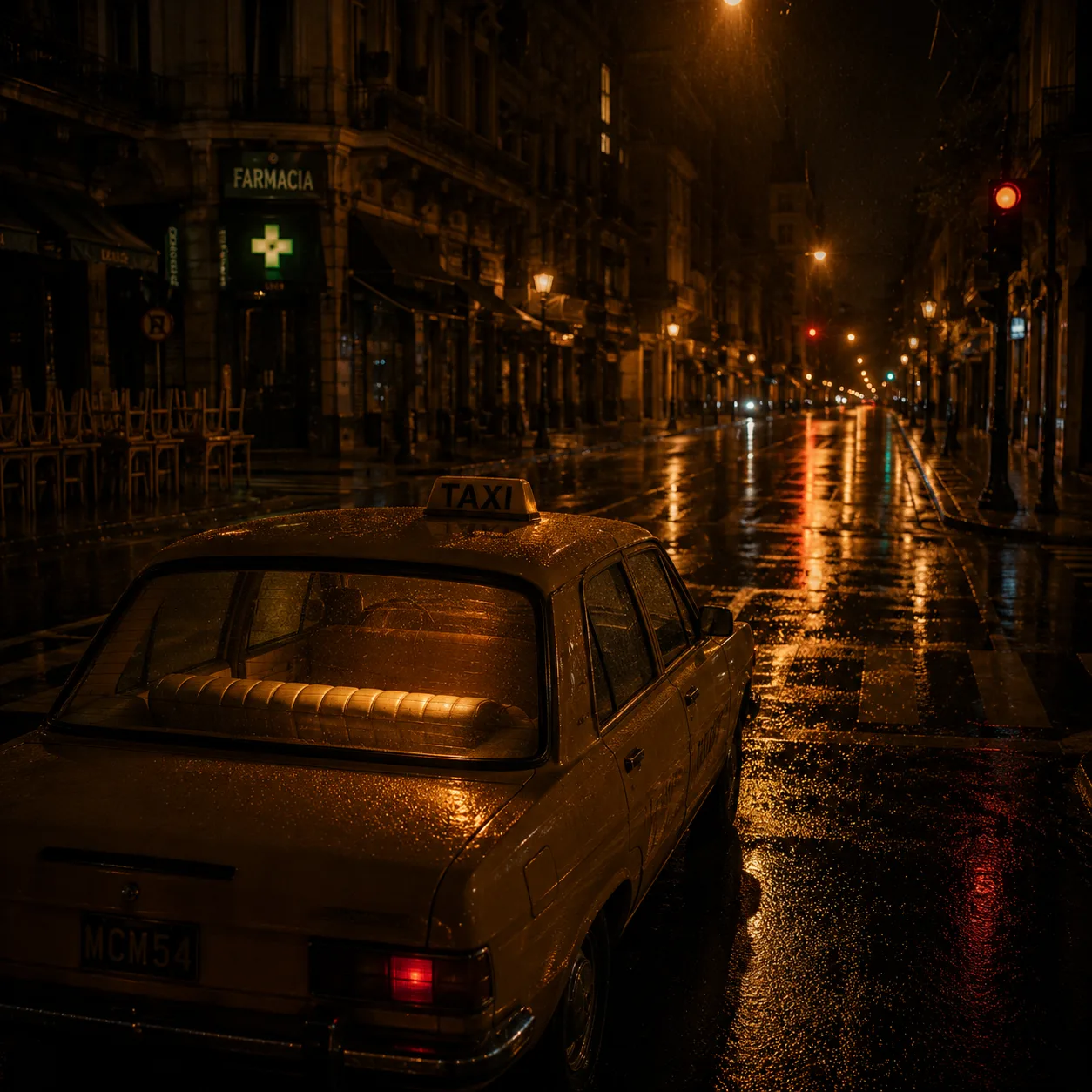
The Last Taxi Home
Music for remembering someone after the city has gone quiet
The moment
Riding alone through a nearly empty city after midnight while a name quietly returns and refuses to disappear.
Narrative function: Scores a transit or reflection beat that keeps moving forward without arriving or resolving.
Emotional subtext: Late-night longing without drama; remembering someone while still in motion.
Scene fit:
- night city B-roll and transit
- character alone in a vehicle at night
- first-person narration about someone left behind
- podcast transition between interview and narration
- urban memorial or tribute segment
What this music should do
Pick for night-transit reflection and memory scenes that must keep moving without resolving; choose over other Latin-flavored beds when the piece should imply forward motion (bass, faint brushes) rather than sit completely still.
What it must not do:
- romantic longing
- dramatic grief
- resolution or closure
- excitement or energetic city life
Creator fit
Use for:
- documentary night-city, transit and reflection B-roll
- podcast transition between interview and narration
- film scene of a character alone in a vehicle at night
- voiceover bed for first-person narration about someone left behind
- essay-style YouTube about memory or loss
- urban memorial or tribute segment
Avoid for:
- upbeat or celebratory
- motivational or inspirational
- trailer climax
- action
- scenes needing resolution
Preview & download
Behind the track
Scene ideas, musical character and editing guidance from the original MCM54 track documents.
In the edit
- Notes for editor
Works best under slow urban visuals — street reflections, empty intersections, rain on glass. Keep below voice. The motion of the track (slow pulse) pairs with the motion of a vehicle.
- Best for
late-night documentary scene
urban narrative film
podcast episode about loss or memory
reflection segment between interviews
social media short — city at night
- Works after
a farewell scene
a conversation that has just ended
a title card with a name
- Works before
a narrator returning to the story
a home arrival scene
a time-cut to the next morning
- Loop friendly
Yes
- Intro friendly
No
- Ending friendly
Yes
- Voiceover friendly 1 5
4
- Dialogue friendly 1 5
4
Musical character
- Genre
Urban Cinematic
- Subgenre
Late-Night Atmospheric
- Main instruments
muted acoustic guitar (fingerstyle, sparse)
sparse piano notes (single events, long decay)
subtle string pad (low, barely present)
distant city texture (sub-textural ambience)
- Texture
Urban and still. Like looking at a city through rain-covered glass. Motion implied but not driven.
- Mix character
Slightly dark mid-range. Gentle high-end gloss. Distant reverb. Wide stereo for the city field, more centered for the intimate guitar.
- Time signature
4/4
Emotional arc
- Primary emotion
Late-night longing
- Secondary emotion
Quiet carrying
- Story position
After departure — mid-journey home
- Emotional arc
Begins in motion. The city passes in fragments outside the window. A name returns without urgency. The piece does not arrive anywhere — it simply continues moving, as late-night memory does.
Original arrangement brief
Original creative intent. Timings, tonal targets and mix instructions describe the written brief; individual audio takes may differ.
- Emotional gravity
- Core
The city at midnight becomes the interior of someone who cannot stop carrying a name.
- Register
Quiet and moving — not static. Memory travels beside the listener, not behind them.
- Temperature
Cool urban night with warmth held inside the vehicle.
- Narrative function
- Type
Continuance
- Description
Music for a scene still in motion. Not an ending, not a beginning — a route.
- Best narrative position
Mid-journey. After something has happened, before the person has arrived anywhere.
- Editorial instruction
Place at the moment a name or face returns uninvited. Do not use for the parting scene itself.
- Arrangement stages
- Stage
1
- Name
Departure
- Timecode
0:00–0:45
- Description
Felted piano alone with distant ambient city. Silence is active. The atmosphere settles like a taxi pulling from a curb.
- Density
near-zero
- Stage
2
- Name
Route
- Timecode
0:45–1:50
- Description
Nylon guitar enters quietly. Upright bass appears almost unnoticed. No defined melody. The city continues moving.
- Density
sparse
- Stage
3
- Name
Memory Surface
- Timecode
1:50–3:00
- Description
Bass slightly more present. Piano and guitar exchange small fragments. Ambient textures widen. Dynamics remain restrained.
- Density
moderate-sparse
- Stage
4
- Name
Recognition
- Timecode
3:00–3:45
- Description
A simple melodic phrase emerges quietly — a forgotten memory briefly visible before dissolving. No climax. No emotional release.
- Density
sparse
- Stage
5
- Name
Continuation
- Timecode
3:45–4:20
- Description
Brush percussion disappears first. Bass fades. Guitar leaves the conversation to the piano. Ends on unresolved harmony — the taxi continues beyond the listener.
- Density
near-zero
- Instrument roles
- Felted piano
- Emotional role
The person. Sparse, reflective, unhurried. Speaks without trying to explain.
- Entry
0:00 — opens alone
- Constraint
Long pauses between ideas. Never melodically complete.
- Nylon guitar
- Emotional role
The city. Accompanies without leading. Its natural imperfections are the street passing.
- Entry
0:45 — enters quietly after the taxi has pulled away
- Constraint
Answers the piano. Never initiates a phrase.
- Upright bass
- Emotional role
Forward motion. The taxi continues. Never stops, never rushes.
- Entry
0:45 — appears almost unnoticed under the guitar
- Constraint
Soft sustained notes and occasional gentle pizzicato. Must not become rhythmic.
- Brush percussion
- Emotional role
Time. The rhythm of streetlamps passing. Felt as passage, not as groove.
- Entry
1:50 — very late, subliminal
- Constraint
Disappears in the outro before any other instrument. Must never establish a groove.
- Ambient city texture
- Emotional role
The external world. Continuous and indifferent. The emotional container.
- Entry
0:00 — always present beneath everything
- Constraint
Warm traffic wash, soft room reverb. Must be audible as a character, not decoration.
- Harmonic philosophy
- Key center
D minor
- Character
Minor key with warm coloring. The sadness of familiarity, not the drama of loss.
- Chord movement
Slow harmonic rhythm. No strong cadences. Chords drift rather than progress.
- Resolution policy
Never resolve. The piece ends as the taxi continues — no arrival.
- Forbidden intervals
Major third above root (too bright, too resolved)
Perfect authentic cadence V-I (too final)
Any harmonic gesture that produces a sense of landing
- Preferred character
Ambiguous minor chords with added ninths and sevenths. Warmth without arrival.
- Mix philosophy
- Stereo field
Wide ambient field for city texture. Instruments centered or near-center — personal, not spatial.
- Reverb character
Warm analog room reverb. Medium decay. City space — not a concert hall.
- Frequency balance
Warm low-mids from piano and bass. Nylon guitar in the mid-range. No harsh or digital-bright highs.
- Dynamic range
Wide. Analog warmth. No heavy limiting. Target: -16 LUFS integrated.
- Analog character
Tape warmth on the master. Subtle saturation on piano and bass. Nothing clinical.
- Dynamic philosophy
- Overall level
Restrained throughout. No moment should demand the listener's attention.
- Movement type
Slow continuous forward motion — a vehicle in the night, not a river.
- Peak policy
No emotional peak. No dynamic climax. Any rise exists only briefly before receding.
- Silence policy
Pauses between piano phrases are active — the city keeps moving while the person does not speak.
- Headroom for narration
Voiceover-first production. 6 dB dynamic space above the main body at all times.
- Listener outcome
- Intended feeling
That some goodbyes keep traveling with us.
- Not intended
Romantic longing
Dramatic grief
Resolution or closure
Nostalgia as comfort
Any identifiable emotion with a name
- Best descriptor
Moving forward while carrying something that has not yet let go.
License
Use any track in your videos, podcasts, films and narrated projects — including monetized ones. Credit MCM54 where your platform allows: video description, show notes, end credits or project credits. Do not resell, re-upload, or register the tracks with Content ID. Downloads you have already made keep their license even if these terms later change.
Credit line: Music: MCM54 — mcm54.com