Before the Door Opens
Music for the moment before a decision becomes action
The moment
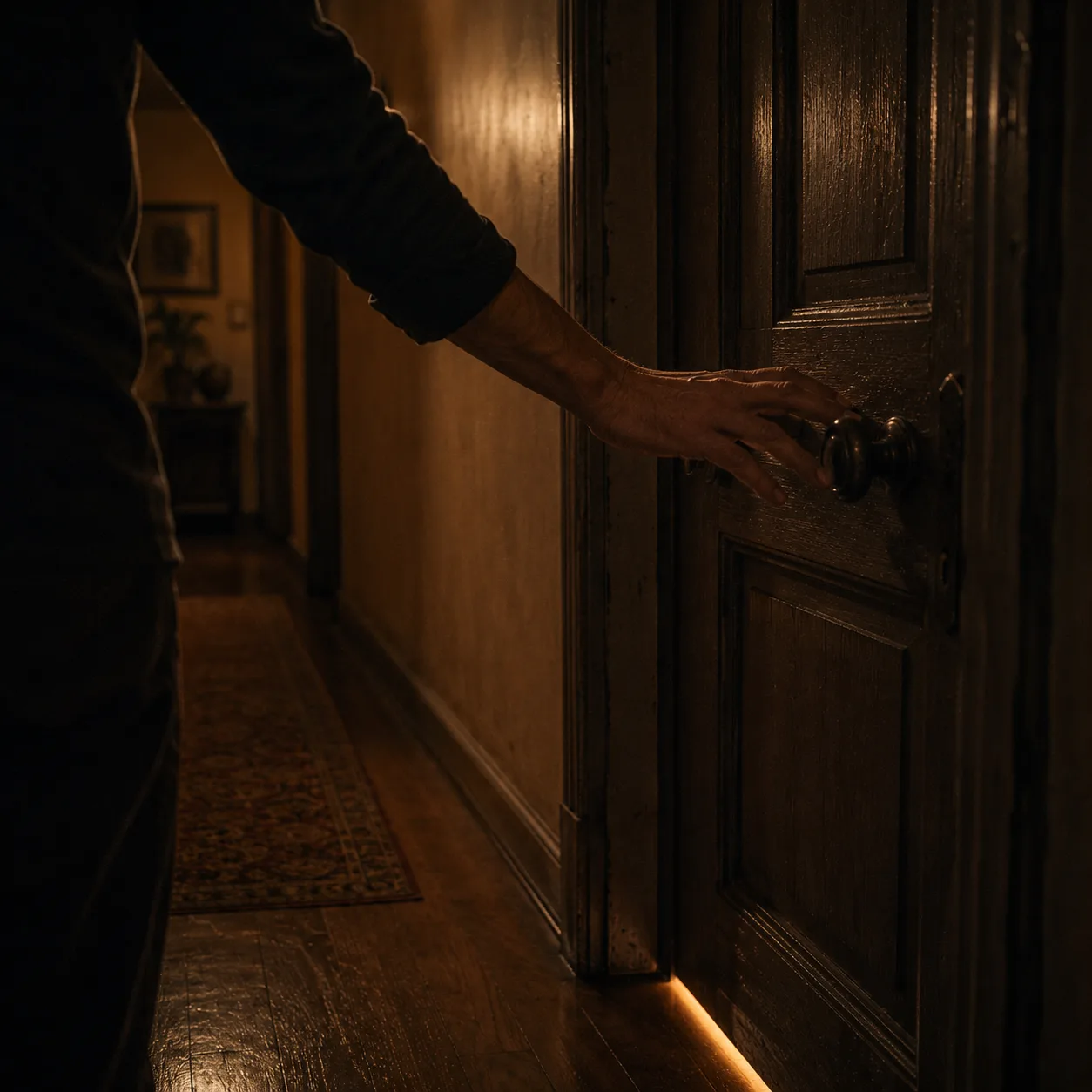
Standing still at a threshold with the decision already made internally but the body not yet moving, holding a held breath outside a closed door.
Narrative function: Scores the stillness right before a character acts on a decision already made, the held breath and not the exhale.
Emotional subtext: Suspended turning committed; internal, weighted, inevitable, never fearful or heroic.
Scene fit:
- the moment before a difficult interview begins
- character at a threshold before a confrontation, confession or departure
- narrator preparing the listener for something significant
- quiet scene of deliberation
- narration about a decision point in a life story
What this music should do
Pick for internal, pre-action stillness that must feel weighted but never thriller or horror; choose over any suspense cue when the tension is a personal decision rather than external danger, and cut to silence when the action begins.
What it must not do:
- fear or thriller-style suspense
- heroism or triumph
- external danger, threat or chase
- drama, relief or resolution
Creator fit
Use for:
- documentary moment before a difficult interview
- film character at a threshold before confrontation, confession or departure
- podcast narrator preparing a significant moment
- theater underlay for a character in deliberation
- voiceover bed about a decision point in a life story
- mindfulness content about the weight of choice
Avoid for:
- external action, conflict or movement
- thriller, horror or genre suspense
- energetic or forward-momentum content
- heroic or triumphant decisions
- scenes needing resolution or release
Preview & download
Behind the track
Scene ideas, musical character and editing guidance from the original MCM54 track documents.
In the edit
- Notes for editor
Use to extend the moment before a decision — not after. The track should make the waiting feel inevitable. Never use this for action sequences or reveals. Cut to silence, not music, when the door opens.
- Best for
film scene — character at a threshold moment
documentary — before a difficult revelation
podcast — before a major interview question
theater or performance atmosphere
narrative content with internal conflict
- Works after
a period of quiet or reflection
a narrator describing what is at stake
a close-up of a door, a hand, a face
- Works before
a door opening
a decision being spoken aloud
a scene cut to the aftermath
- Loop friendly
Yes
- Intro friendly
No
- Ending friendly
No
- Voiceover friendly 1 5
4
- Dialogue friendly 1 5
3
Musical character
- Genre
Psychological Cinematic
- Subgenre
Threshold Atmospheric
- Main instruments
sustained string chord (very soft — barely a sound, barely a decision)
sparse piano (single notes — long silence between each)
low bass pedal tone (subliminal, felt not heard)
breath-like synthesizer pad (slow swell, no attack, no release)
- Texture
Completely still but not empty. Tension without movement. Like a room that is holding its breath.
- Mix character
Narrow stereo at the core (the internal world), slight wideness on the sustained strings. Very little reverb — claustrophobic. Dark frequency profile. Sub-bass present.
- Time signature
free
Emotional arc
- Primary emotion
Suspended decision
- Secondary emotion
Internal threshold
- Story position
Threshold — between knowing and acting
- Emotional arc
Begins in complete suspension. Neither grows nor retreats. The tension is architectural, not dramatic — like a held breath, not a rising pulse. Does not resolve. The ending is not the door opening — it is still the moment before.
Original arrangement brief
Original creative intent. Timings, tonal targets and mix instructions describe the written brief; individual audio takes may differ.
- Emotional gravity
- Core
The body has not moved. The decision has already been made. The music lives in the distance between those two facts.
- Register
Internal and suspended. Not fearful, not heroic — the specific gravity of irreversibility before it is visible.
- Temperature
Late evening hallway. The light steady after one flicker. Still and inevitable.
- Narrative function
- Type
Threshold
- Description
Music for the moment before action — not the action itself. The silence between deciding and moving.
- Best narrative position
Immediately before a character acts on a decision already made internally. A confession, a departure, a truth that can no longer be postponed.
- Editorial instruction
Place the music when the scene is static but the internal state is irrevocable. Cut to silence — not music — when the door opens or the action begins. The music is the held breath, not the exhale.
- Arrangement stages
- Stage
1
- Name
The Deliberation
- Timecode
0:00–0:40
- Description
Piano alone. Single notes and open intervals from silence. Each pause is as long as a held thought. The decision is already made — this is only the body learning it.
- Density
near-zero
- Stage
2
- Name
The Weight Enters
- Timecode
0:40–1:35
- Description
Strings quietly enter beneath the piano — widening the emotional space without changing the tempo or increasing intensity. Harmony remains suspended. The room feels slightly heavier.
- Density
sparse
- Stage
3
- Name
The Deepening
- Timecode
1:35–2:45
- Description
Emotional weight deepens through subtle harmonic evolution. No melody develops. Low harmonic textures appear beneath the strings. Silence continues shaping the structure as much as the instruments.
- Density
moderate-sparse
- Stage
4
- Name
The Inevitability
- Timecode
2:45–3:25
- Description
A fragile melodic fragment briefly appears in the piano — almost immediately dissolving back into suspended harmony. The decision feels inevitable, yet still unspoken. The hand is still on the door handle.
- Density
sparse
- Stage
5
- Name
The Hand
- Timecode
3:25–4:00
- Description
Strings slowly disappear into silence. Piano remains alone, ending on an unresolved open harmony. The silence after the final note should feel like the hand finally reaching toward the door.
- Density
near-zero
- Instrument roles
- Felted piano
- Emotional role
The mind. Isolated, unhurried, not seeking resolution. Each note a thought that arrives without completing itself.
- Entry
0:00 — alone from the first sound, as though the deliberation has already been long
- Constraint
Single notes and open intervals only. Generous silence between phrases. Must never become melodic or emotionally directive — it is not expressing feeling, it is holding it.
- Small string ensemble
- Emotional role
The weight. What the decision costs. Enters almost imperceptibly and deepens the air without changing the tempo.
- Entry
0:40 — beneath the piano, barely distinguishable from silence at first
- Constraint
Extremely slow sustained textures only. Must create emotional gravity, not movement. If the strings are audible as an arrival, they are too present too soon.
- Ambient room texture
- Emotional role
The hallway itself. The specific quality of a space that is holding something in.
- Entry
0:00 — always present, nearly inaudible
- Constraint
Subtle room resonance, distant air movement, soft analog tape warmth. Must feel like the acoustic character of the space, not a sound design element.
- Low harmonic textures
- Emotional role
The irreversibility. A sub-perceptual presence that makes the moment feel heavier without making it louder.
- Entry
1:35 — as harmonic weight deepens in Section 2
- Constraint
Occasional deep sustained tones only. Must increase emotional weight without suggesting danger, action, or external threat. Not a bass line — a gravity.
- Percussion
- Emotional role
Completely absent. Rhythm exists only in breathing spaces and harmonic pacing.
- Entry
Never
- Constraint
No percussion of any kind. Any rhythmic element destroys the suspension. The absence of rhythm IS the music's emotional architecture.
- Harmonic philosophy
- Key center
E minor
- Character
Minor key without drama. The darkness of inevitability, not of danger. E minor here is a hallway, not a threat.
- Chord movement
Minimal and suspended. Chords are held rather than moved through. Harmonic change is geological — slow enough to feel like weight, not progression.
- Resolution policy
Never resolves. The final chord is open — offering nothing. The piece ends as the hand reaches the handle, not as the door opens.
- Forbidden intervals
Diminished seventh chord (thriller cliché)
Tritone leap (too overtly sinister)
Perfect authentic cadence of any kind (the decision cannot land)
Any interval associated with danger or horror
- Preferred character
Open fifth intervals, minor seconds held in sustain, E minor with major seventh — ambiguous, weighted, suspended. Harmony that does not declare its intention.
- Mix philosophy
- Stereo field
Intimate and narrow at the core — the inside of a mind. Strings and room texture widen slightly, but the space never becomes vast. This is a hallway, not a landscape.
- Reverb character
Short room reverb — the acoustic of an interior space at night. No large hall. The sound bounces off nearby walls and comes back quickly.
- Frequency balance
Dark. Low-mid emphasis. Restrained high end. No brightness — this is the absence of light, not the presence of darkness. Sub-bass present but not aggressive.
- Dynamic range
Maximum range. No limiting or loudness processing. Genuine silence between notes. Target: -20 LUFS integrated — quieter than the collection standard. This piece functions at low volume.
- Analog character
Warm analog tape character on the master — softens the high-end transients of the piano. Nothing digital-clinical.
- Dynamic philosophy
- Overall level
Extremely quiet and controlled throughout. The loudest moment should feel like a breath taken in a still room.
- Movement type
None. This piece does not move — it holds. Any sense of forward momentum is wrong.
- Peak policy
No peak. The Section 3 harmonic deepening is a change in weight, not volume. It should be felt, not heard as louder.
- Silence policy
Silence is the primary instrument. Gaps between piano notes are not rests — they are the held breath. They must be allowed to exist at full length without being filled.
- Headroom for narration
Maximum headroom. Designed to exist entirely beneath narration, confession, or spoken decision. 8 dB dynamic space above the body of the track.
- Listener outcome
- Intended feeling
The weight of a choice before it is spoken.
- Not intended
Fear
Heroism
Suspense in the thriller sense
Drama
Relief or resolution
- Best descriptor
The specific gravity of a moment when the internal has already moved but the external has not yet followed.
License
Use any track in your videos, podcasts, films and narrated projects — including monetized ones. Credit MCM54 where your platform allows: video description, show notes, end credits or project credits. Do not resell, re-upload, or register the tracks with Content ID. Downloads you have already made keep their license even if these terms later change.
Credit line: Music: MCM54 — mcm54.com