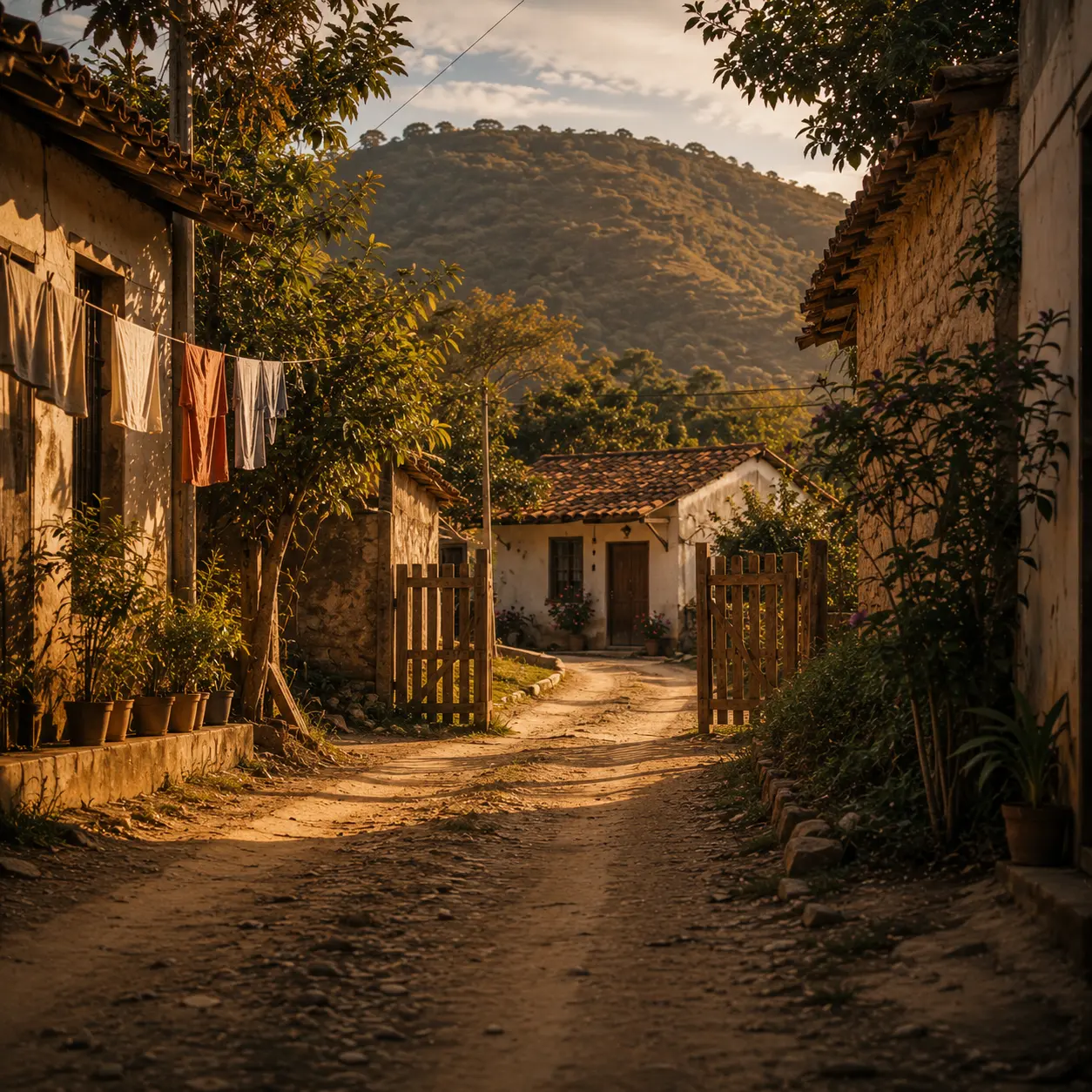
The Road Back to the Village
Music for returning to where you came from
The moment
Walking an old road back to an origin and discovering the place is smaller than memory made it, yet more precious for it.
Narrative function: Scores the return journey itself, the approach and re-seeing of a familiar place with present eyes, without collapsing into nostalgia or triumph.
Emotional subtext: Returning turning to belonging differently; tenderness and quiet grief held together.
Scene fit:
- return-to-origin or immigration narrative
- character returning to a childhood home or village
- identity, belonging and roots reflection
- first-person narration about where life began
- emotional travel documentary that is not tourism
What this music should do
Pick for complicated homecoming and origin stories that need earthy folk instrumentation without folklore or tourism gloss; choose when the cue must hold tenderness and disappointment together rather than simple warmth.
What it must not do:
- pure nostalgia or celebration of origin
- triumph of return
- simple warmth or sweetness
- tourist-friendly folk culture
Creator fit
Use for:
- documentary return-to-origin or immigration narrative
- podcast episode about identity, belonging and roots
- film scene of returning to a childhood home or village
- voiceover bed about where life began
- Latin American cultural origin storytelling
- emotionally deep travel documentary
Avoid for:
- celebratory or triumphant return
- tourist-friendly folk portrayal
- simple warmth or pure nostalgia
- energetic or forward-momentum content
- stories that resolve without complexity
Preview & download
Behind the track
Scene ideas, musical character and editing guidance from the original MCM54 track documents.
In the edit
- Notes for editor
Pair with slow or static shots of rural landscape. The complexity of the track — not purely happy or sad — mirrors the genuine experience of return. Do not use for celebrations or arrivals that should feel triumphant.
- Best for
documentary — return to origin story
film scene — homecoming after years away
podcast — episode about identity and roots
travel content with emotional depth
Latin American cultural storytelling
- Works after
an establishing shot of a village or rural landscape
a narrator describing their origin
a time-cut — years later
- Works before
a reunion with family
a narrator reflecting on what has changed
a close-up of a familiar object from childhood
- Loop friendly
Yes
- Intro friendly
Yes
- Ending friendly
Yes
- Voiceover friendly 1 5
5
- Dialogue friendly 1 5
4
Musical character
- Genre
Folk Cinematic
- Subgenre
Rural Atmospheric
- Main instruments
nylon string guitar (gentle fingerpicking — unhurried, familiar)
charango (background harmonic texture — subtle Latin rootedness)
sparse piano (enters mid-piece, warm voicing)
very soft string wash (distant, like memory)
ambient rural texture (sub-textural — wind, distant sounds)
- Texture
Warm and earthen. Like unpaved roads and old stone walls. Folk-influenced without being folkloric. The complexity of return is in the harmony, not the melody.
- Mix character
Warm low-mids. Natural high end — no sheen. Room reverb with medium decay. Charango sits in the mid-background, never foreground. Feels like the countryside.
- Time signature
4/4
Emotional arc
- Primary emotion
Complex homecoming
- Secondary emotion
Tender disappointment
- Story position
Return — threshold between past and present
- Emotional arc
Opens with the pace of approach — slow, familiar, smaller than expected. Deepens into the layered emotion of belonging differently: tenderness, loss, gratitude, and the discovery that roots survived the journey even if the place did not wait unchanged.
Original arrangement brief
Original creative intent. Timings, tonal targets and mix instructions describe the written brief; individual audio takes may differ.
- Emotional gravity
- Core
Tenderness in disappointment. The place is smaller than memory made it — and more precious because of that.
- Register
Complex and layered. Love, loss, gratitude, and the quiet discovery that roots survived the journey even when the place did not wait unchanged.
- Temperature
Late afternoon, rural. Warm but fading. The light that makes everything familiar and slightly sad at the same time.
- Narrative function
- Type
Recognition
- Description
Music for the walk itself — the approach, the noticing, the adjustment between memory and what remains. Not the arrival, not the reunion — the road between them.
- Best narrative position
The return journey. Arriving at a place from the past and seeing it with present eyes. Works best when the narrator or character is still moving — walking, driving, approaching.
- Editorial instruction
Place at the moment the familiar begins to reveal itself as smaller, older, different — but still there. Do not use for joyful reunions or celebrations of return. This is for the complicated truth of homecoming.
- Arrangement stages
- Stage
1
- Name
The Road
- Timecode
0:00–0:45
- Description
Nylon guitar alone with spacious phrases. Countryside ambience slowly appears. The journey is already long. Silence between notes is the distance being covered.
- Density
near-zero
- Stage
2
- Name
Recognition
- Timecode
0:45–1:50
- Description
Piano joins quietly as specific memories return — a door, a wall, a name. Upright bass enters beneath them, grounding the harmony like the earth underfoot. Small things are recognized.
- Density
sparse
- Stage
3
- Name
The Village
- Timecode
1:50–3:00
- Description
Accordion breathes slowly into the arrangement — the village itself, its walls and wind. Emotional landscape widens while remaining intimate. The harmony deepens: tenderness and loss in the same chord.
- Density
moderate-sparse
- Stage
4
- Name
What Remained
- Timecode
3:00–3:45
- Description
A simple phrase passes between guitar and piano — recognition, not nostalgia. The arrangement stays restrained. Every instrument breathes. Nothing is celebrated. The roots are simply there.
- Density
sparse
- Stage
5
- Name
At the Entrance
- Timecode
3:45–4:20
- Description
Accordion fades first. Bass slowly disappears. Piano offers one last quiet response. Guitar closes alone on an open unresolved harmony — standing once more at the entrance to the village, belonging differently.
- Density
near-zero
- Instrument roles
- Nylon guitar
- Emotional role
The person walking. Natural, unhurried, carrying the weight of years traveled. Its imperfections are the dust of the road.
- Entry
0:00 — alone from the first note, as if the journey has already been long
- Constraint
Warm fingerstyle with gentle pulse — suggesting footsteps, not a groove. Natural imperfections are essential. Must never sound virtuosic or performed.
- Felted piano
- Emotional role
Memory. Enters quietly as specific images return — a door, a name, a smell. Responds to the guitar rather than leading it.
- Entry
0:45 — joins gently, as memories do: without announcement
- Constraint
Simple open voicings. Spacious phrasing. Soft dynamics. Must feel like recollection, not commentary.
- Accordion
- Emotional role
The village itself. Its breath is the place — walls, wind, old wood, the sound of something that has stayed. Present but not dominant.
- Entry
1:50 — breathes slowly into the arrangement, widens the landscape
- Constraint
Long sustained tones and occasional melodic responses only. Must never become folkloric, festive, or the focus of the arrangement. The accordion is the place, not a performance of the place.
- Upright bass
- Emotional role
The ground. Roots. What endured. Calm, steady, unhurried — like the earth under a familiar road.
- Entry
0:45 — nearly unnoticed, beneath the piano
- Constraint
Soft sustained notes with occasional gentle pizzicato. Must suggest steady presence, not forward momentum. The ground does not move to greet you.
- Ambient countryside
- Emotional role
The world that stayed. Indifferent to the years that passed. Wind, birds, the sounds of a place that continued without the person in it.
- Entry
0:00 — present from the opening, barely perceptible
- Constraint
Subtle countryside ambience — warm breeze, distant birdsong, natural room resonance. Must feel like something discovered, not produced.
- Percussion
- Emotional role
Absent, or present only as the pulse of footsteps — too subtle to identify as rhythm.
- Entry
Only if unavoidable — never before section 2
- Constraint
Barely audible hand percussion or soft brushed pulse only. No defined groove. No identifiable rhythmic pattern.
- Harmonic philosophy
- Key center
C major
- Character
Major key used with full knowledge of what it costs — open and grounded, not bright. The warmth of something that endured, not something that triumphed.
- Chord movement
Unhurried and organic. Chords shift as the landscape shifts — slowly, without drama. The harmony of a place, not a progression.
- Resolution policy
Unresolved at the end. The piece closes on an open harmony — the listener stands at the entrance, not inside. Belonging differently means not quite arriving.
- Forbidden intervals
Perfect authentic cadence V-I with strong dominant energy (too final — the return is not a completion)
Any bright major chord voicing without added complexity (too naive for this emotional terrain)
Rising sixth leap (too declarative, too celebratory)
- Preferred character
Open C major chords with added ninths and suspended fourths. Warmth without sweetness. The chord of a place that is familiar but no longer entirely yours.
- Mix philosophy
- Stereo field
Wide but grounded. Countryside ambience fills the edges. Instruments sit in the center-to-slightly-wide range — present, never vast. The road is not infinite.
- Reverb character
Natural outdoor reverb — open air, not a hall. Medium-short decay with gentle early reflections. The acoustic of a village road at sunset.
- Frequency balance
Earthy low-mids from guitar and bass. Accordion adds warmth above. Piano brings clarity without brightness. No harsh high end — this is afternoon light, not morning.
- Dynamic range
Wide and honest. No limiting. No loudness compression. Target: -16 LUFS integrated. Let the quiet moments be genuinely quiet — the empty fields between sounds.
- Analog character
Warm tape character. Subtle second-harmonic saturation on guitar and bass. The sound of something recorded in a real room with real air.
- Dynamic philosophy
- Overall level
Intimate and earthen throughout. The loudest moment should sound like a conversation carried on a dirt road, not a stage.
- Movement type
A slow walk. No urgency. No arrival. The pace of someone who knows where they are going but is not rushing to get there.
- Peak policy
No peak. The accordion entry in Section 3 widens the landscape — it is not a climax. The emotional complexity should deepen without getting louder.
- Silence policy
Silence between guitar phrases is the distance. The road between what was and what is. Do not fill these gaps — they are part of the journey.
- Headroom for narration
Voiceover-first. 6 dB dynamic headroom at all times. Designed to carry personal narration about origin, identity, and return.
- Listener outcome
- Intended feeling
That coming back is also a way of saying goodbye.
- Not intended
Pure nostalgia
Celebration of origin
Simple warmth or sweetness
Triumph of return
Sadness without tenderness
- Best descriptor
The strange discovery that memory enlarges places in order to protect them — and that the roots are deeper than the place ever was.
License
Use any track in your videos, podcasts, films and narrated projects — including monetized ones. Credit MCM54 where your platform allows: video description, show notes, end credits or project credits. Do not resell, re-upload, or register the tracks with Content ID. Downloads you have already made keep their license even if these terms later change.
Credit line: Music: MCM54 — mcm54.com