The Visit That Changed Both of Us
Music for the hour that rewrote everything that came before it.
The moment
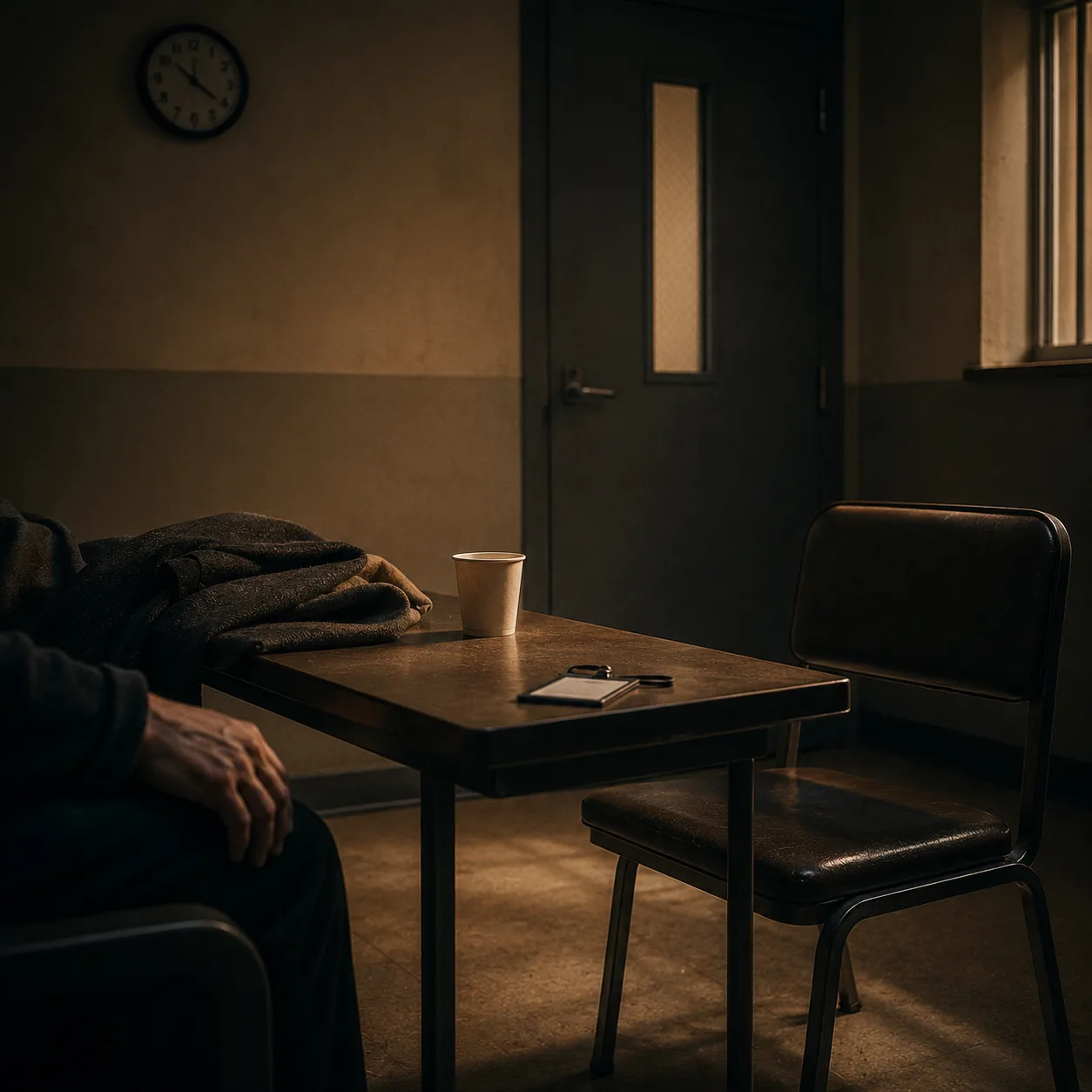
A small room with two chairs, a paper cup, a badge face down, a clock nobody looks at. The door has just closed and the hour has begun; during it both people change, but nothing resolves.
Narrative function: Underscore for a bounded visit between two presences who alter each other across one hour and then separate, with the relationship left unresolved.
Emotional subtext: Contained, present, slightly charged; both changed, neither healed or forgiven
Scene fit:
- documentary visit (hospital, prison, care home)
- estranged-family or reconciliation-adjacent scene
- justice documentary or personal essay about a bounded encounter
What this music should do
Pick for a bounded visit that changes two people without resolving them; two-voice relational chamber (upright piano visitor + solo cello resident) with an asymmetric ending (cello stops first, piano continues alone, altered). Not healing, reunion, hospital sadness or clean resolution.
What it must not do:
- healing montage or recovery
- sentimental reunion or forgiveness climax
- hospital sadness or prison regret cliche
- romantic scoring
- a clean resolution of the relationship
Creator fit
Use for:
- documentary visit scenes (hospital, prison, care home)
- estranged-family and reconciliation-adjacent stories
- justice documentaries and personal essays about a bounded encounter
Avoid for:
- healing / recovery montage
- reunion / forgiveness climax
- true-crime / confrontation
- therapy / inspirational
- trailer climax
- motivational / corporate
Preview & download
Behind the track
Scene ideas, musical character and editing guidance from the original MCM54 track documents.
In the edit
- Notes for editor
This track scores the visit as a transformation, not a healing. Keep it under a bounded encounter in one room — arrival, shared hour, departure — not a tearful breakthrough. It can underlay narration or play under a held two-shot. The ending is asymmetric and works as a closing cue (ending_friendly): the cello stops, the piano continues alone, changed. Do not crossfade the final piano phrase into resolution. Correct level under narration: -24 to -28 LUFS.
- Best for
a hospital visit
a prison or detention visiting room
a care-home visit
an estranged family meeting
a parent and child meeting after distance
a documentary subject returning to someone from their past
a conversation after years of avoidance
a meeting that changes both people without resolving the relationship
- Works after
an establishing shot of a small room with two chairs and a table
a door closing, a visitor badge, a paper cup
narration introducing a visit and why it finally happened
a held two-shot before either person speaks
- Works before
the visitor leaving
a cut to after the visit, both people changed
a chapter about an encounter that rewrote a relationship
the first reflection on what the hour did to both people
- Loop friendly
No
- Intro friendly
Yes
- Ending friendly
Yes
- Voiceover friendly 1 5
5
- Dialogue friendly 1 5
5
Musical character
- Genre
Relational Chamber Minimalism
- Subgenre
Two-Voice Documentary Score — the bounded visit
- Main instruments
vibraphone (opens — one isolated note, the visit beginning / door closing)
double bass (rare sustained low tone — the floor of the room)
upright piano (warm, close-miked, forward-moving — the visitor)
solo cello (settled, restrained, difficult to move — the person already in the room)
nylon-string guitar (brief, second half — shared memory surfacing)
close room tone (small contained room, two chairs, warm analog air)
- Texture
A contained room. Two voices that begin separate and gradually alter each other — the piano losing prepared shape, the cello borrowing a fragment of the piano. Wide silences remain active. The tempo (68) carries slightly more forward motion than INST-021 and INST-022, reflecting the visitor who arrived with a purpose.
- Mix character
Warm analog realism, close contained-room presence. Natural stereo distance between piano and cello, as if on different sides of a small table. Soft transients, minimal compression, restrained low end, transparent midrange for narration. Intimate and human, never glossy, never theatrical, never institutional.
- Time signature
free / rubato — conversational, non-metronomic
Emotional arc
- Primary emotion
Mutual alteration
- Secondary emotion
Contained encounter — two people changed without being healed or resolved
- Story position
The visit itself — a bounded hour in one room where neither person can keep the old story intact
- Emotional arc
Prepared distance → Altered understanding. The piece does not resolve. The visitor (piano) loses some prepared shape; the resident (cello) takes a small fragment from the piano; they almost share one motif and separate; the cello stops first and the piano continues alone, now carrying a contour learned from the cello.
Original arrangement brief
Original creative intent. Timings, tonal targets and mix instructions describe the written brief; individual audio takes may differ.
- Emotional profile
- Primary
Mutual alteration
- Secondary
Contained encounter — both people changed, neither healed or resolved
- Arc type
Two-voice relational arc inside a bounded hour. The visit opens officially (vibraphone, bass), the visitor enters prepared (piano), the resident answers settled (cello), the two alter each other across the middle, almost share one motif and separate, then the cello stops first and the piano continues alone carrying a contour learned from the cello.
- Listener journey
Prepared distance → Altered understanding
- Emotional temperature
Contained and human. The temperature of a small room with two chairs after the door has closed — neither warm comfort nor cold institution. Present, restrained, slightly charged by a purpose that the hour will quietly rewrite.
- Arrangement stages
- Stage
1
- Name
The Door Closes
- Duration approx
0:00–0:30
- Description
One isolated vibraphone note, then silence — the visit beginning, the door closing. The double bass enters with one low sustained tone, the floor of the room, and the space becomes official. No piano and no cello yet.
- Instrumentation active
vibraphone (one note)
double bass (one sustained tone)
- Density
near-zero
- Stage
2
- Name
The Visitor Enters
- Duration approx
0:30–1:15
- Description
Upright piano enters as the visitor — careful and organized, trying to keep the purpose of the visit clear. Short phrases, close room sound, restrained motion with slightly more forward intent than INST-021/022. The visitor arrived with a plan.
- Instrumentation active
vibraphone (sparse)
double bass (sustained)
upright piano
- Density
sparse
- Stage
3
- Name
The Person Already in the Room
- Duration approx
1:15–2:05
- Description
Solo cello enters late as the person already in the room — settled, restrained, difficult to move. It does not comfort or resist openly. It answers with weight, restraint and human presence, from a position that was here before the visitor arrived.
- Instrumentation active
upright piano
solo cello
double bass (occasional)
- Density
sparse
- Stage
4
- Name
They Begin to Change Each Other
- Duration approx
2:05–3:00
- Description
Piano and cello begin to change each other. The piano loses some of its prepared shape — phrases become less organized, more uncertain. The cello takes a small fragment from the piano and holds it. Neither dominates. Silence remains the third presence.
- Instrumentation active
upright piano
solo cello
- Density
moderate-sparse
- Stage
5
- Name
Almost One Motif, Then Apart
- Duration approx
3:00–3:45
- Description
Nylon guitar appears briefly as shared memory surfacing. Piano and cello almost meet around one small motif, then separate again. This is not a duet, not reconciliation, not a climax — a brief mutual recognition that does not become resolution.
- Instrumentation active
upright piano
solo cello
nylon-string guitar (brief)
- Density
moderate-sparse
- Stage
6
- Name
The Door Closes After
- Duration approx
3:45–4:20
- Description
Cello stops first, as if the person in the room has said all they can. Upright piano continues alone for a few final notes — now carrying a contour learned from the cello. The visitor leaves with something that did not belong to them when they arrived. End unresolved, like the door closing after the visit.
- Instrumentation active
upright piano (continues alone, altered)
- Density
near-zero to silence
- Instrumentation roles
- Threshold
- Instrument
Vibraphone
- Role
The visit beginning — the door closing. A single isolated note that marks the threshold of the bounded hour.
- Priority
opens the piece — one note, then sparse if at all
- Melodic content
One isolated note at the open; at most one more later. No pattern.
- Forbidden
Magical nostalgia, dreamy shimmer, repeated patterns, jazz lounge, sentimental sparkle, melodic role
- Floor
- Instrument
Double bass
- Role
The floor of the room — the space becoming official once the door has closed.
- Priority
enters stage 1, occasional sustained presence
- Melodic content
Rare sustained low tones. No movement.
- Forbidden
Groove, pulse, walking bass, forward rhythmic movement, tension build, dramatic low-end
- Visitor
- Instrument
Upright piano
- Role
The visitor — prepared, careful, forward-moving, who arrived with a purpose and gradually loses some prepared shape. Ends alone, carrying a contour learned from the cello.
- Priority
enters stage 2, remains to the end
- Melodic content
Organized careful phrases at first, loosening across the middle, finally shaped by a fragment of the cello's contour.
- Forbidden
Sentimental piano formula, healing-scene warmth, polished concert sound, muffled felted tone (reads as Series B), moral superiority in tone
- Resident
- Instrument
Solo cello
- Role
The person already in the room — settled, restrained, difficult to move. The central second voice that answers with weight and borrows a fragment of the piano.
- Priority
enters stage 3, stops first in stage 6
- Melodic content
Grounded, weighted responses entering late. Takes and keeps a fragment of the piano's material. Stops before the piano finishes.
- Forbidden
Crying cello, tragic cello, romantic cello, swelling cinematic cello, background support, being scored as a 'lesson' or a victim
- Memory
- Instrument
Nylon-string guitar
- Role
Shared memory surfacing during the second half — what the two people already carry between them.
- Priority
brief, stage 5 only — never opens
- Melodic content
A short memory gesture, sparse, long decay. Not continuous.
- Forbidden
Opening the track, continuous accompaniment, romantic fingerstyle, Latin cliché, sentimental melody
- Room
- Instrument
Close room tone — warm analog air
- Role
A small contained room with two chairs and one table. The listener is inside the hour with the two people.
- Priority
constant and very subtle
- Melodic content
n/a
- Forbidden
Archival haze, institutional/hospital fog, distant room tone, cinematic atmosphere, reverb that makes the room feel large or theatrical
- Harmonic philosophy
- Key center
A minor
- Modal inflections
Suspended minor colors, open intervals and restrained modal harmony. The harmony allows both people to change without suggesting forgiveness, repair, tragedy or clear hope. Neither consonant-comforting nor dramatically dissonant.
- Arc
The vibraphone note and bass imply A minor without committing. The piano states organized suspended voicings; the cello answers from a grounded, slightly different harmonic vantage. Across the middle their harmonic positions exchange material. The almost-shared motif circles a suspended voicing and releases it unresolved; the final piano phrase keeps a fragment of the cello's harmonic shape.
- Chord movement
Slow with quiet forward motion. Am(add9), Am sus2, open fifths A–E, F/A and Dm as passing colors. No functional cadence drive. The ending leaves an unresolved Am suspension in the altered piano alone.
- Resolution policy
Never resolve. No perfect authentic cadence. The visit is not concluded harmonically — the final piano phrase is left open and audibly changed.
- Forbidden intervals
Major third C-to-C# brightening (would imply healing or hope)
Perfect authentic cadence E–Am with full resolution (too final — the visit changed the people, it did not resolve the relationship)
Sentimental suspended-to-resolved movement (implies forgiveness or reunion)
Tragic minor cadence clichés (implies hospital sadness or regret)
Any swelling dominant build toward a breakthrough
- Preferred intervals
Open fifth A–E (two presences sharing a room without merging)
Suspended second Am sus2 (the unresolved encounter)
Added ninth Am add9 (alteration without resolution)
Gentle minor sevenths as restrained, non-tragic weight
F major as a passing warmth, never a destination
- Key production note
A minor here must read as mutual alteration, not sadness or healing. A sad A minor makes it hospital/prison sorrow; a warm resolving A minor makes it reconciliation; a hopeful A minor makes it recovery. The correct A minor says: two people shared one hour, and both leave carrying something of the other, with nothing resolved.
- Mix philosophy
- Stereo field
Intimate and contained, with natural distance between the two main voices — upright piano and solo cello on different sides of a small table. Vibraphone close and central at the threshold; bass centered and low; guitar brief and close.
- Reverb character
Short and natural — 0.6 to 1.2 seconds — the acoustic of a small contained room with two chairs. No archival or institutional/hospital space, nothing cinematic.
- Frequency balance
Warm low-mids for the human body of piano and cello. Transparent midrange reserved for narration. Gentle high rolloff — intimate, never bright. Restrained low end so the double bass grounds without dominating.
- Dynamic range
Wide and restrained, with quiet forward motion. Loudness target: -18 LUFS integrated. Under narration: -24 to -28 LUFS. The silences between phrases — and the final silence after the door closes — must remain genuinely quiet.
- Headroom for narration
Maximum. This track underlays narration and reflective voiceover about a visit and its aftermath — voice must always lead. The music holds the hour; it never competes with speech.
- Dynamics philosophy
- Overall level
Quiet and contained throughout, with slightly more forward motion than INST-021/022 (the visitor arrived with a purpose). Never loud.
- Movement type
Directional and conversational — call, answer, then gradual exchange of material. Never a continuous build toward breakthrough.
- Peak policy
No peaks. The almost-shared motif in stage 5 is the fullest texture and must remain restrained. If strings or piano swell into a forgiveness/breakthrough climax, the truth of the visit is broken — reject.
- Silence policy
Silence is the third presence. The space after the vibraphone note, the gap before the cello answers, and the final silence after the door closes are all active material. In the ending, the silence where the cello has stopped lets the altered piano be heard alone.
- Compression policy
Minimal. No limiting. Preserve the natural dynamics of vibraphone, upright piano and cello and the breath between phrases. No artificial loudness evening.
- Listener outcome
- Intended feeling
That a visit does not have to resolve the past to change the people inside it — one hour ended, the door closed, and both people now carry something they did not carry before.
- Not intended
Healing, forgiveness or reconciliation declared
Hospital sadness, prison regret or institutional sorrow
The visitor sounding morally superior or the resident reduced to a lesson
A clean resolution of the relationship
Any feeling produced by the music that was not already created by the encounter
- Best descriptor
Two chairs, a paper cup, a badge face down, a clock nobody looks at. The door closed. Both people leave the hour changed and nothing is resolved.
License
Use any track in your videos, podcasts, films and narrated projects — including monetized ones. Credit MCM54 where your platform allows: video description, show notes, end credits or project credits. Do not resell, re-upload, or register the tracks with Content ID. Downloads you have already made keep their license even if these terms later change.
Credit line: Music: MCM54 — mcm54.com