I Recognized You From the Story
Music for the moment when a stranger becomes someone you already knew.
The moment
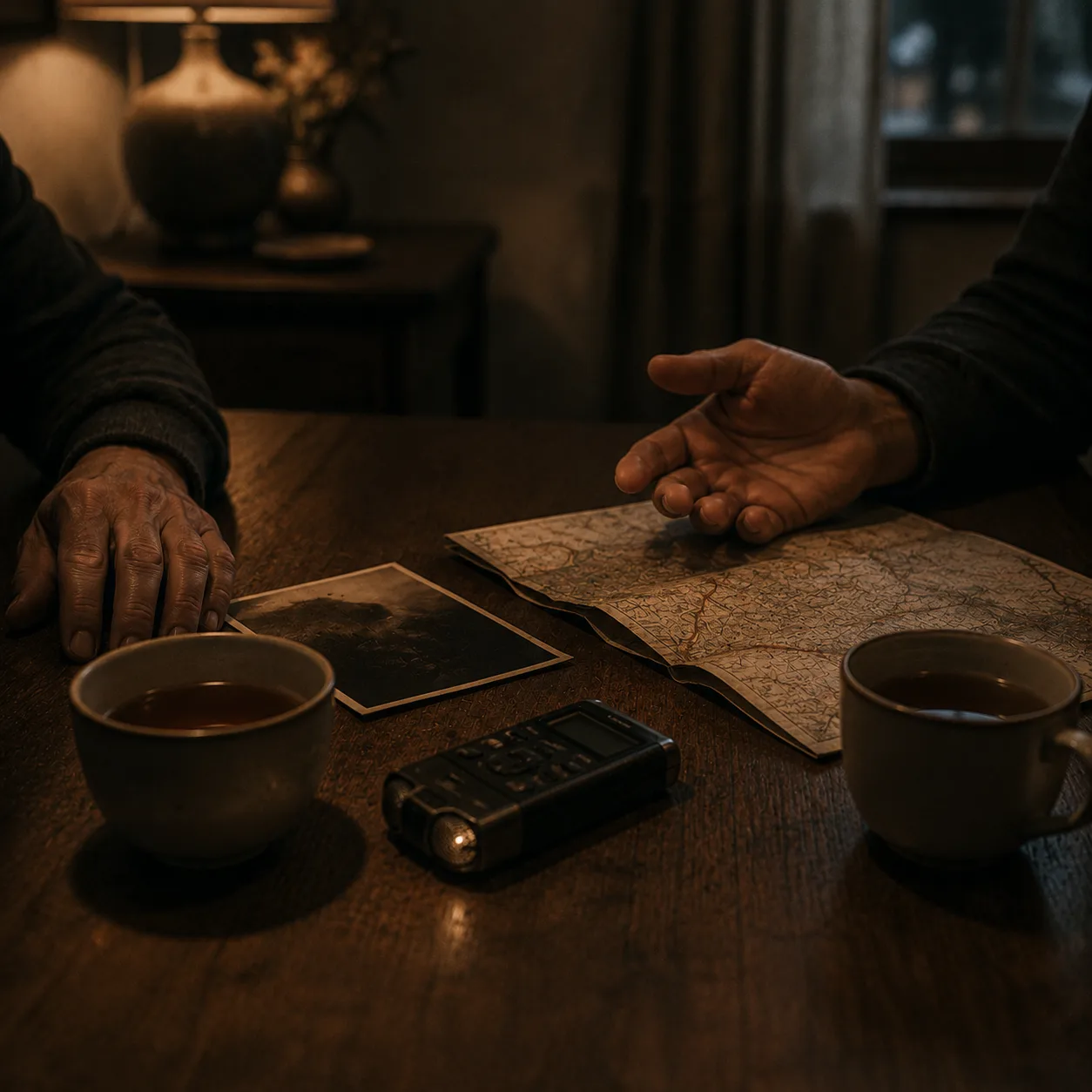
Two people after a long conversation: an old photograph, a folded map, two cups of tea, a recorder already off. Someone has told a story, and the listener recognizes the person across the table through a name, place, habit or detail, not through the face.
Narrative function: Underscore for recognition arriving through narrative rather than proof, making a stranger quietly familiar without resolving who they are.
Emotional subtext: Quietly connected but uncertain; a stranger become known without proof
Scene fit:
- roots / ancestry documentary
- refugee, migration or oral-history interview
- family-history or identity essay where a story makes a stranger familiar
What this music should do
Pick for recognition that arrives through a story rather than proof; two-voice relational chamber (upright piano listener + solo cello stranger) over an opening double-bass root and a nylon-guitar story, with a four-stage asymmetric fade. Not reunion, sentimental ancestry, ethnic cliche or magical discovery.
What it must not do:
- reunion or sentimental ancestry
- ethnic cliche or folkloric color
- magical discovery or dramatic reveal
- nostalgic roots music
- recognition that solves belonging
Creator fit
Use for:
- roots and ancestry documentaries
- refugee, migration and oral-history interviews
- family-history and identity essays where a story makes a stranger familiar
Avoid for:
- reunion / sentimental ancestry
- ethnic cliche / folkloric
- magical discovery / dramatic reveal
- therapy / healing
- trailer climax
- motivational / corporate
Preview & download
Behind the track
Scene ideas, musical character and editing guidance from the original MCM54 track documents.
In the edit
- Notes for editor
This track scores recognition through story, not facial recognition or reunion. Keep it under a quiet table after a long conversation — a detail, a name, a place — not a dramatic reveal. The guitar carries the story between the listener (piano) and the stranger (cello); the recognition is partial and unresolved. The ending is a four-stage fade (bass, guitar, piano, then cello remains) and works as a closing cue. Do not crossfade the final cello breath into reunion. Correct level under narration: -24 to -28 LUFS.
- Best for
a roots documentary where a person recognizes someone through a family story
a refugee interview where two lives connect through a remembered place
a person discovering that a stranger knew their parent or grandparent
a family-history sequence where a name or phrase creates recognition
a documentary subject meeting someone connected to a lost community
an oral-history project where identity arrives through narrative
an identity essay about belonging through story
a migration-story scene of quiet, partial recognition
- Works after
an establishing shot of two people at a table — photograph, map, tea, a recorder turned off
a story just told — a village name, a road, a phrase
narration introducing recognition through a detail rather than a face
an archival photo or map being set on the table
- Works before
the listener looking at the stranger differently
a reflection on identity travelling through language
a chapter about ancestry, migration or a lost community
the realization that a story arrived before proof did
- Loop friendly
No
- Intro friendly
Yes
- Ending friendly
Yes
- Voiceover friendly 1 5
5
- Dialogue friendly 1 5
5
Musical character
- Genre
Relational Chamber Minimalism
- Subgenre
Two-Voice Documentary Score — narrative recognition
- Main instruments
double bass (opens alone — one sustained warm low tone, an old root beneath the floor)
nylon-string guitar (the story being told — sparse imperfect fragments, oral memory in pieces)
upright piano (the listener — careful, curious, hesitant phrases connecting details)
solo cello (the stranger — a contour that begins to resemble what the story already carried)
vibraphone (optional, one isolated note — a detail suddenly becoming recognizable)
close room tone (quiet table presence, warm analog air)
- Texture
Four presences in a fixed human order: a root (bass), a story (guitar), a listener (piano), a stranger (cello). The story moves between listener and stranger until the cello's contour echoes what the guitar already carried. Wide silences are active. Recognition is partial — the shared phrase always keeps a missing note or a slight delay.
- Mix character
Warm analog realism, close room presence. Natural stereo distance between piano and cello, with the guitar as the story moving between them and the bass as the root beneath. Soft transients, minimal compression, restrained low end, transparent midrange for narration. Intimate and human, never glossy, never folkloric, never cinematic-reunion.
- Time signature
free / rubato — oral, fragmentary phrasing
Emotional arc
- Primary emotion
Narrative recognition
- Secondary emotion
Connected uncertainty — a stranger become quietly familiar without proof
- Story position
The moment a story makes a stranger recognizable — identity arriving through narrative before it arrives through proof
- Emotional arc
Distance → Connected uncertainty. The piece does not resolve into reunion. A root (bass) holds beneath a story (guitar); a listener (piano) tries to connect details; a stranger (cello) enters whose contour begins to resemble what the story already carried; they almost recognize the same phrase but with a missing note or slight delay, and end without proof.
Original arrangement brief
Original creative intent. Timings, tonal targets and mix instructions describe the written brief; individual audio takes may differ.
- Emotional profile
- Primary
Narrative recognition
- Secondary
Connected uncertainty — a stranger become familiar through story, not proof
- Arc type
Four-presence relational arc in a fixed human order: a root (bass), a story (guitar), a listener (piano), a stranger (cello). The story moves between listener and stranger until the cello's contour echoes what the guitar already carried; they almost recognize the same phrase but keep a missing note or slight delay; the ending fades in order (bass, guitar, piano) and the cello carries the final unresolved breath.
- Listener journey
Distance → Connected uncertainty
- Emotional temperature
Warm, low and still at first, opening into quiet human closeness. The temperature of a table after a long conversation — tea gone lukewarm, a recorder already off. Not cold, not sentimental; present, partial, and quietly changed.
- Arrangement stages
- Stage
1
- Name
The Root Beneath the Floor
- Duration approx
0:00–0:35
- Description
Double bass alone. One sustained low tone, warm and still, like a root older than the conversation. No pulse, no suspense, no darkness.
- Instrumentation active
double bass
- Density
near-zero
- Stage
2
- Name
The Story in Pieces
- Duration approx
0:35–1:20
- Description
Nylon guitar enters with sparse broken fragments, like a story arriving in pieces — oral memory. Silence is left around each phrase.
- Instrumentation active
double bass
nylon-string guitar
- Density
sparse
- Stage
3
- Name
The Listener
- Duration approx
1:20–2:10
- Description
Upright piano enters as the listener, gently arranging details — careful, hesitant phrases, as if something is becoming familiar before it is understood.
- Instrumentation active
double bass
nylon-string guitar
upright piano
- Density
sparse
- Stage
4
- Name
The Stranger Across the Table
- Duration approx
2:10–3:05
- Description
Solo cello enters as the stranger. It answers with a related shape, making the listener feel that the person and the story share a hidden contour.
- Instrumentation active
double bass
nylon-string guitar
upright piano
solo cello
- Density
moderate-sparse
- Stage
5
- Name
Almost the Same Phrase — Without Proof
- Duration approx
3:05–3:45
- Description
Guitar introduces a small fragment. Piano repeats part of it with uncertainty. Cello responds almost at the same time, but with a missing note or slight delay. Recognition without proof.
- Instrumentation active
nylon-string guitar
upright piano
solo cello
vibraphone (optional, one note)
- Density
moderate-sparse
- Stage
6
- Name
Recognition Without Proof
- Duration approx
3:45–4:20
- Description
The double bass root disappears first. The guitar story fragment fades next. Piano and cello remain briefly, but the piano stops before the cello. The cello carries the final unresolved breath. No reunion, no proof, no full resolution.
- Instrumentation active
upright piano (stops first of the pair)
solo cello (remains, unresolved)
- Density
near-zero to silence
- Instrumentation roles
- The root
- Instrument
Double bass
- Role
An old root beneath the floor — ancestral ground older than the conversation. Opens the piece; disappears first at the end.
- Priority
opens the piece, fades first in stage 6
- Melodic content
One sustained warm low tone, occasionally renewed. No movement, no rhythm.
- Forbidden
Groove, pulse, walking bass, ominous/suspense low-end, darkness, dramatic tension
- The story
- Instrument
Nylon-string guitar
- Role
The story being told — oral memory arriving in fragments. Carries the contour the stranger will later resemble. Fades second at the end.
- Priority
enters stage 2, fades second in stage 6
- Melodic content
Sparse, imperfect, fragmentary gestures with silence around each; a distinct contour that can be recognized later.
- Forbidden
Continuous accompaniment, romantic fingerstyle, Latin/folkloric cliché, sentimental melody, leading the arrangement
- The listener
- Instrument
Upright piano
- Role
The listener — curious, careful, trying to connect the story's details into meaning. Stops before the cello at the end.
- Priority
enters stage 3, stops third in stage 6
- Melodic content
Hesitant, careful phrases that reach toward an unnamed recognition; repeats part of the story's fragment with uncertainty.
- Forbidden
Felted/distant tone (reads as Series B), sentimental piano formula, sad-piano cliché, romantic warmth, being proven 'right'
- The stranger
- Instrument
Solo cello
- Role
The stranger across the table — a human presence whose contour begins to resemble what the story already carried. Remains alone at the end with one unresolved breath.
- Priority
enters stage 4, is the final voice in stage 6
- Melodic content
A related shape that echoes the story without copying it; in the almost-recognition keeps a missing note or slight delay; ends on one final unresolved tone.
- Forbidden
Crying cello, tragic cello, romantic cello, swelling cinematic cello, background support, becoming family too quickly, proving the recognition
- The detail
- Instrument
Vibraphone (optional)
- Role
A detail suddenly becoming recognizable — a single isolated note near the almost-recognition.
- Priority
optional — one isolated note in stage 5
- Melodic content
One isolated note, no pattern.
- Forbidden
Shimmer, repeated patterns, nostalgia, dreamy fantasy, magical-discovery sparkle
- Room
- Instrument
Close room tone — warm analog air
- Role
A quiet table after a long conversation — tea, a map, a photograph, a recorder turned off. The listener is at the table with the two people.
- Priority
constant and very subtle
- Melodic content
n/a
- Forbidden
Archival haze, ethnic/folkloric ambience, institutional fog, reverb that makes the space feel large or theatrical
- Harmonic philosophy
- Key center
B minor
- Modal inflections
Suspended minor colors, open intervals and restrained modal harmony. Small echoes between guitar, piano and cello, as if the same story is moving through different people. Gentle unresolved warmth; avoid both sentimental ancestry sweetness and dramatic-reveal tension.
- Arc
The bass roots the piece on B without committing the mode. The guitar states a fragmentary contour; the piano reaches toward it; the cello answers with a shape that resembles the guitar's contour. In the almost-recognition the three circle the same phrase while the cello keeps one different note. The ending leaves the cello on a single unresolved tone after the others have gone.
- Chord movement
Slow and non-functional. Bm(add9), Bm sus2, open fifths B–F#, D/B and Em as passing colors, with the cello echoing the guitar's contour over them. No cadence drive. The ending does not resolve.
- Resolution policy
Never resolve, and never turn recognition into proof. No perfect authentic cadence. The almost-recognition keeps its missing note; the final cello tone is left open.
- Forbidden intervals
Clean unison/full agreement at the moment of recognition (would make it proof or reunion)
Perfect authentic cadence F#–Bm with full resolution (implies belonging solved)
Sentimental major-key 'found you' turn (turns it into reunion/ancestry sweetness)
Ethnic or folkloric modal cliché used as color
Dramatic-reveal dissonance or any swelling toward a discovery climax
- Preferred intervals
Open fifth B–F# (two people connected without merging)
Added ninth Bm add9 (presence and recognition without resolution)
Suspended second Bm sus2 (a recognition held, not settled)
Echoed contours between guitar and cello with one note different (recognition without proof)
D major as a passing warmth, never a destination
- Key production note
B minor here must read as connected uncertainty, not reunion or ancestry sentiment. A sentimental B minor makes it found-family ancestry; a dramatic B minor makes it a reveal; a resolving B minor solves belonging. The correct B minor says: a story made a stranger familiar, and nothing has been proven.
- Mix philosophy
- Stereo field
Intimate, with natural distance between piano (listener) and cello (stranger), the guitar (story) moving between them, and the bass (root) centered and low. Two people at a table, the story travelling across it.
- Reverb character
Short and natural — 0.6 to 1.2 seconds — the acoustic of a quiet room with a table. No archival, folkloric or institutional space, nothing cinematic.
- Frequency balance
Warm low-mids for the body of bass, piano and cello and the wood of the guitar. Transparent midrange reserved for narration. Gentle high rolloff — intimate, never bright. Low end warm but restrained so the bass roots without dominating.
- Dynamic range
Wide and restrained. Quiet throughout, with the fragmentary rise and fall of a story being heard. Loudness target: -18 LUFS integrated. Under narration: -24 to -28 LUFS. The silences around each story fragment and the final unresolved cello breath must remain genuinely quiet.
- Headroom for narration
Maximum. This track underlays narration and interview audio about roots, migration and recognition — voice must always lead. The music carries the story between two people; it never competes with speech.
- Dynamics philosophy
- Overall level
Quiet and restrained throughout. Never loud, never building toward a discovery climax. The dynamics trace a story moving between a listener and a stranger.
- Movement type
Fragmentary and additive — a root, then a story in pieces, then a listener, then a stranger. Recognition emerges through resemblance, not through a build.
- Peak policy
No peaks. The almost-recognition in stage 5 is the fullest texture and must remain restrained — the missing note carries the moment, not volume. If the voices swell into a reveal or resolve into reunion, the premise is broken — reject.
- Silence policy
Silence holds the recognition that has no proof. The space around each guitar fragment, the gap before the cello resembles the story, and the final silence after the others have gone are active material. The cello's final breath sits in that silence, unresolved.
- Compression policy
Minimal. No limiting. Preserve the natural dynamics of bass, guitar, piano and cello and the silence around the story's fragments. No artificial loudness evening.
- Listener outcome
- Intended feeling
That stories can make strangers familiar before life is ready to explain why — recognition without proof, belonging without closure.
- Not intended
A reunion or found-family resolution
Sentimental ancestry, ethnic nostalgia or magical discovery
The sense that recognition has solved belonging
Certainty — the recognition stays partial and unfinished
Any feeling produced by the music that was not already created by the story between the two people
- Best descriptor
A table after a long conversation; a photograph, a map, two cups of tea, a recorder turned off; a story that made a stranger known before anyone could prove why.
Creator note
# Creator Note — INST-026
# I Recognized You From the Story
Some people you meet feel like home before you know why.
That's what this track does.
Something real, something primary — it opens the heart
without overwhelming it.
And the cello? It's there because it has a role.
It enters exactly where it needs to, so the harmony holds.
— Oshi, MCM54
License
Use any track in your videos, podcasts, films and narrated projects — including monetized ones. Credit MCM54 where your platform allows: video description, show notes, end credits or project credits. Do not resell, re-upload, or register the tracks with Content ID. Downloads you have already made keep their license even if these terms later change.
Credit line: Music: MCM54 — mcm54.com