What I Learned From Watching You
Music for the lessons no one taught with words.
The moment
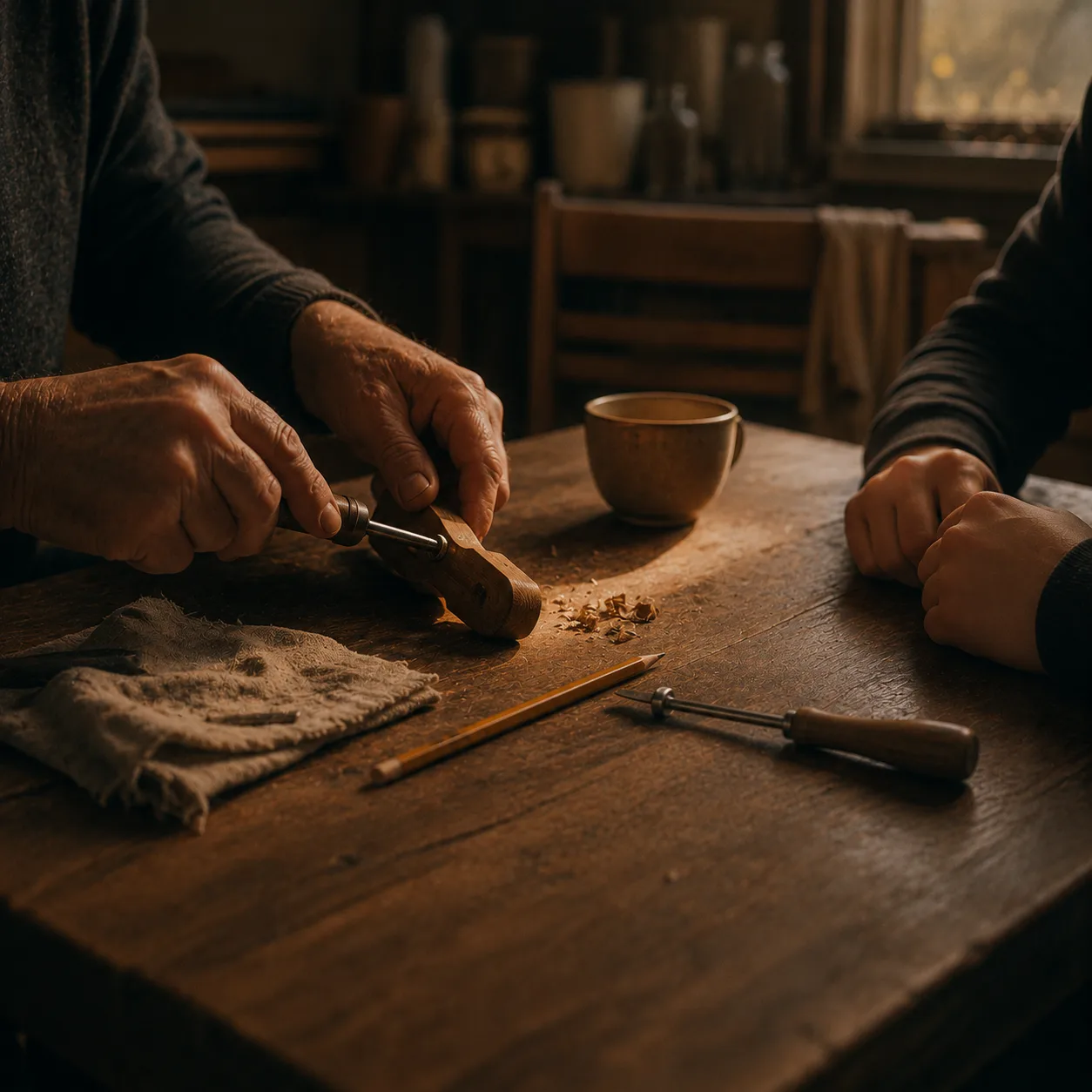
Someone older does an ordinary task with their hands while someone younger quietly watches. No lesson is announced; years later the watcher realizes they learned from the way that person moved through the world.
Narrative function: Underscore for a wordless transfer across time between two presences separated by years, one doing and one becoming, with the inherited pattern kept complex rather than clean.
Emotional subtext: Warm but complex; silent absorption, not admiration or simple gratitude
Scene fit:
- biography or mentor / formative-influence story
- family-history or parent-and-child documentary
- legacy podcast or memoir voiceover about inheritance and influence
What this music should do
Pick for wordless learning absorbed across time; two-voice relational chamber (upright piano the watched + nylon guitar the watcher) in a rare warm major key, with an asymmetric ending (piano gone first, guitar remains imperfect). Not inspirational biography, parent-child sentiment or warm nostalgia.
What it must not do:
- inspirational biography uplift
- sentimental parent-child sweetness or nostalgia
- the older person scored as a saint
- a clean, resolved lesson
- romantic or therapy scoring
Creator fit
Use for:
- biography and mentor / formative-influence films
- family-history and parent-and-child documentaries
- memoir and legacy voiceover about inheritance and influence
Avoid for:
- inspirational biography uplift
- sentimental parent-child / nostalgia
- therapy / healing
- trailer climax
- motivational / corporate
- romantic scoring
Preview & download
Behind the track
Scene ideas, musical character and editing guidance from the original MCM54 track documents.
In the edit
- Notes for editor
This track scores silent absorption, not admiration. Keep it under ordinary work and quiet watching — hands, tools, routine — not a tearful tribute. The warmth comes from repetition and closeness, so it can underlay reflective narration about influence. The ending is asymmetric (the watched disappears first; the watcher remains, imperfect) and works as a closing cue. Do not crossfade the final guitar gesture into clean resolution. Correct level under narration: -24 to -28 LUFS.
- Best for
a child watching a parent work
a student remembering a teacher's silence
a person describing what they learned from someone's habits
a biography sequence about formative influence
a family archive scene built around hands, tools, routines or repeated gestures
a voiceover about inherited behavior
a documentary subject realizing they became like someone they once watched
a mentor-story or legacy sequence
- Works after
an establishing shot of hands doing an ordinary task — fixing, folding, making coffee
a child watching nearby, saying nothing
narration introducing a formative figure
an archival photo or home-movie of someone at work
- Works before
a present-day shot of the watcher repeating the same gesture
a reflection on what was inherited without being taught
a chapter about influence, lineage or formation
the realization that the subject became like the person they watched
- Loop friendly
No
- Intro friendly
Yes
- Ending friendly
Yes
- Voiceover friendly 1 5
5
- Dialogue friendly 1 5
5
Musical character
- Genre
Relational Chamber Minimalism
- Subgenre
Two-Voice Documentary Score — relationship across time
- Main instruments
upright piano (warm, close-miked, practical — the person doing the ordinary task)
nylon-string guitar (sparse, delayed, imperfect echo — the watcher learning)
solo cello (later — adult recognition, the watcher's grown self understanding)
double bass (rare sustained low tones — inherited weight)
vibraphone (avoid unless needed; if used, one isolated note near the final third — recognition arriving years later)
close room tone (warm domestic/workshop presence, human imperfection)
- Texture
Warm and human, built from repetition rather than harmony. The piano repeats a small practical phrase; the guitar echoes a fragment imperfectly; the cello arrives later as recognition above the repeated pattern. Warmth comes from closeness and repetition, never from sentimental voicing. The first major-key track of Series C — major used for warmth, not optimism.
- Mix character
Warm analog realism, close room presence. Natural stereo space between piano and guitar, as if one person is doing and another is watching nearby. Soft transients, minimal compression, restrained low end, transparent midrange for narration. Intimate and human, never glossy, never motivational.
- Time signature
free / rubato — the gentle repetition of a practical task
Emotional arc
- Primary emotion
Wordless learning
- Secondary emotion
Warm complexity — silent absorption, not admiration
- Story position
The moment of learning by watching — an ordinary gesture becoming a lifelong pattern, recognized only years later
- Emotional arc
Observation → Recognition. The piece does not resolve into gratitude. The piano repeats a practical task, the guitar (the watcher) echoes it imperfectly, the cello arrives as adult recognition, and the piano disappears first while the guitar remains carrying an imperfect version of what it learned.
Original arrangement brief
Original creative intent. Timings, tonal targets and mix instructions describe the written brief; individual audio takes may differ.
- Emotional profile
- Primary
Wordless learning
- Secondary
Warm complexity — silent absorption, not admiration or gratitude
- Arc type
Two-voice relational arc across time. The piano repeats an ordinary practical task; the guitar (the watcher) echoes a fragment imperfectly; the cello arrives later as adult recognition above the repeated pattern; the piano disappears first and the guitar remains carrying an imperfect version of what it learned. No inspirational lift, no clean lesson, no resolution.
- Listener journey
Observation → Recognition
- Emotional temperature
Warm and human, but complex. The temperature of a kitchen or workshop where someone works with their hands and someone younger watches. Tender without being sentimental, warm without being nostalgic. The first warmth in Series C — earned through repetition, not harmony.
- Arrangement stages
- Stage
1
- Name
Hands at an Ordinary Task
- Duration approx
0:00–0:40
- Description
Upright piano alone. A small repeated practical phrase — like someone fixing, folding, writing, or making coffee. Ordinary, warm, unannounced. The gesture of hands repeating a task, not a melody being performed. This must NOT sound like Series B felted piano.
- Instrumentation active
upright piano
- Density
sparse
- Stage
2
- Name
The Watcher Begins to Echo
- Duration approx
0:40–1:30
- Description
Nylon guitar enters quietly, slightly delayed, echoing part of the piano phrase but not copying it perfectly. The watcher is learning without knowing they are learning — imitation before understanding.
- Instrumentation active
upright piano
nylon-string guitar
- Density
sparse
- Stage
3
- Name
The Pattern Becomes Familiar
- Duration approx
1:30–2:25
- Description
Piano and guitar overlap gently. The pattern becomes familiar but still imperfect. Warmth enters — but through repetition and closeness, not through sentimental harmony.
- Instrumentation active
upright piano
nylon-string guitar
- Density
moderate-sparse
- Stage
4
- Name
Recognition Arrives Later
- Duration approx
2:25–3:20
- Description
Solo cello enters as later recognition — the watcher's adult self understanding what was absorbed — holding a longer breath above the repeated human pattern. Double bass may appear once as inherited weight. No swell, no inspirational lift.
- Instrumentation active
upright piano
nylon-string guitar
solo cello
double bass (once)
- Density
moderate
- Stage
5
- Name
Almost the Same Phrase
- Duration approx
3:20–3:50
- Description
Piano, guitar and cello almost understand the same phrase. The guitar carries the learned fragment; the cello gives it gravity. This is not a climax, not a lesson — just recognition. An optional single vibraphone note may mark recognition arriving years later.
- Instrumentation active
upright piano
nylon-string guitar
solo cello
vibraphone (optional, one note)
- Density
moderate
- Stage
6
- Name
The Final Gesture Belongs to the Watcher
- Duration approx
3:50–4:20
- Description
The original piano pattern disappears first — the person being watched is gone from the sound. Nylon guitar remains with an imperfect version of what it learned. Cello may hold one unresolved breath. The final gesture belongs to the watcher.
- Instrumentation active
nylon-string guitar (remains, imperfect)
solo cello (one unresolved breath, optional)
- Density
near-zero to silence
- Instrumentation roles
- The watched
- Instrument
Upright piano
- Role
The person doing the ordinary task — hands repeating a small practical gesture. Warm, close-miked, practical, slightly imperfect. Disappears first, as the watched person eventually leaves the watcher's life.
- Priority
opens the piece, departs first in stage 6
- Melodic content
A small repeated practical phrase, humble and human, with slight unevenness. Not a theme; a task being done again. No development toward resolution.
- Forbidden
Felted/distant tone (reads as Series B), emotional piano formula, sentimental warmth, polished concert sound, symbolic phrasing, sad-piano cliché
- The watcher
- Instrument
Nylon-string guitar
- Role
The watcher learning without knowing it — imitation before understanding. Echoes a fragment of the piano imperfectly; remains at the end carrying what it learned.
- Priority
enters stage 2, is the final voice in stage 6
- Melodic content
An imperfect echo of a fragment of the piano's gesture — wrong timing, a missing note, a slightly altered shape. Never a clean copy. Ends alone, still imperfect.
- Forbidden
Romantic fingerstyle, continuous accompaniment, Latin cliché, clean/perfect imitation, sentimental melody, leading the arrangement
- Later recognition
- Instrument
Solo cello
- Role
Adult recognition — the watcher's later self understanding what was absorbed. A presence across time, not a second person in the room.
- Priority
enters stage 4, may hold one final breath in stage 6
- Melodic content
Longer restrained breaths above the repeated human pattern. Lends gravity to the learned fragment without correcting it.
- Forbidden
Crying cello, wisdom-cliché cello, romantic cello, swelling cinematic cello, background support, inspirational lift
- Inherited weight
- Instrument
Double bass
- Role
Inherited weight beneath the room — what is carried along with the lesson, including what is heavy in it.
- Priority
rare — once in stage 4
- Melodic content
One rare sustained low tone. No movement.
- Forbidden
Groove, pulse, walking bass, forward rhythmic movement, dramatic low-end tension
- Recognition note
- Instrument
Vibraphone (optional)
- Role
Recognition arriving years later — a single isolated note near the final third.
- Priority
optional — one isolated note in stage 5
- Melodic content
One isolated note, no pattern.
- Forbidden
Shimmer, repeated patterns, nostalgia, dreamy fantasy, sentimental sparkle
- Room
- Instrument
Close room tone — warm analog air
- Role
A warm domestic or workshop space — a kitchen, a yard, a workbench. Human imperfection and closeness. The listener is near the hands.
- Priority
constant and very subtle
- Melodic content
n/a
- Forbidden
Archival haze, institutional ambience, distant room tone, cinematic atmosphere, reverb that makes the space feel large or theatrical
- Harmonic philosophy
- Key center
D major
- Modal inflections
Warm open intervals, restrained major colors, suspended harmony and gentle unresolved movement. The first major-key track of Series C: major is used for human warmth, not optimism or uplift. Allow warmth without nostalgia and recognition without inspirational lift.
- Arc
The piano states a humble D major practical phrase using open voicings (no sweet full triads as destinations). The guitar echoes a fragment imperfectly, slightly off the piano's harmony. The cello adds a longer suspended line that lends gravity. The almost-shared phrase circles an open suspended D voicing and does not resolve; the final guitar gesture keeps an unresolved, imperfect shape.
- Chord movement
Slow and gentle. Dadd9, Dsus2, open fifths D–A, G/D and Bm as passing colors, occasional Asus4. No functional cadence drive, no sweet IV–I or V–I resolution. The ending leaves an open D suspension in the guitar alone.
- Resolution policy
Never fully resolve. No perfect authentic cadence, no sentimental major resolution. The lesson is not made clean — the final guitar phrase stays open and imperfect.
- Forbidden intervals
Sweet full D major triad used as a sentimental destination (turns it into parent-child sweetness)
Perfect authentic cadence A–D with full resolution (implies a clean, completed lesson)
Bright IV–I plagal 'amen' warmth (inspirational/biographical cliché)
Major-key suspended-to-resolved lift (implies uplift and gratitude)
Any swelling progression toward an inspirational climax
- Preferred intervals
Open fifth D–A (warmth without sweetness)
Added ninth Dadd9 (humble, open, unresolved warmth)
Suspended second Dsus2 (gesture held, not resolved)
Gentle major sevenths used sparingly as warmth, not as romance
Bm as a passing shadow so the major never becomes purely sweet
- Key production note
D major here must read as warm human complexity, not optimism. A sweet D major makes it sentimental parent-child music; a bright, lifting D major makes it inspirational biography. The correct D major says: the warmth is real, but so is everything complicated inside the lesson — including what may later need to be unlearned.
- Mix philosophy
- Stereo field
Intimate and close, with natural space between piano and guitar — one person doing, another watching nearby from a few feet away. Cello placed slightly wider as the later, outer perspective; bass centered and low.
- Reverb character
Short and natural — 0.6 to 1.2 seconds — a warm domestic or workshop room. No archival or institutional space, nothing cinematic.
- Frequency balance
Warm low-mids for the body of upright piano and the wood of the guitar. Transparent midrange reserved for narration. Gentle high rolloff — intimate and warm, never bright or glossy. Restrained low end so the double bass grounds without dominating.
- Dynamic range
Wide and gentle. Quiet throughout, with the soft rise and fall of a repeated task. Loudness target: -18 LUFS integrated. Under narration: -24 to -28 LUFS. The silences and the final solo-guitar gesture must remain genuinely quiet.
- Headroom for narration
Maximum. This track underlays reflective voiceover about influence, inheritance and formation — voice must always lead. The music holds the wordless transfer; it never competes with narration.
- Dynamics philosophy
- Overall level
Quiet and warm throughout. Slightly more forward and lively than INST-021/022/023 (70 BPM, the gentle motion of a task being done), but never loud and never building toward uplift.
- Movement type
Repetitive and human — a task done again, an echo, a longer breath of recognition. Never a continuous build toward a climax.
- Peak policy
No peaks. The almost-shared phrase in stage 5 is the fullest texture and must stay restrained. If the cello or harmony swells into an inspirational lift, the truth of silent absorption is broken — reject.
- Silence policy
Silence carries what was never explained. The space around the repeated piano gesture, the delay before the guitar echoes, and the final silence after the piano has gone are active material. In the ending, the silence where the piano stopped lets the watcher's imperfect learned fragment be heard alone.
- Compression policy
Minimal. No limiting. Preserve the natural dynamics of upright piano, nylon guitar and cello and the human unevenness of repetition. No artificial loudness evening.
- Listener outcome
- Intended feeling
That some of the deepest lessons in life are absorbed silently, long before we know we are learning them — and that the watcher's hands may still remember something the other person never explained.
- Not intended
Simple gratitude or admiration
Inspirational biography uplift
Sentimental parent-child sweetness or nostalgia
The sense that the older person was a saint or every lesson was good
A clean, resolved lesson
Any feeling produced by the music that was not already present in the silent transfer between the two lives
- Best descriptor
Hands repeating an ordinary task; a younger person watching, saying nothing; years later, the same gesture surfacing imperfectly in the watcher's own hands.
License
Use any track in your videos, podcasts, films and narrated projects — including monetized ones. Credit MCM54 where your platform allows: video description, show notes, end credits or project credits. Do not resell, re-upload, or register the tracks with Content ID. Downloads you have already made keep their license even if these terms later change.
Credit line: Music: MCM54 — mcm54.com