Two Chairs and One Story
Music for the interview — the space between a question and an honest answer.
The moment
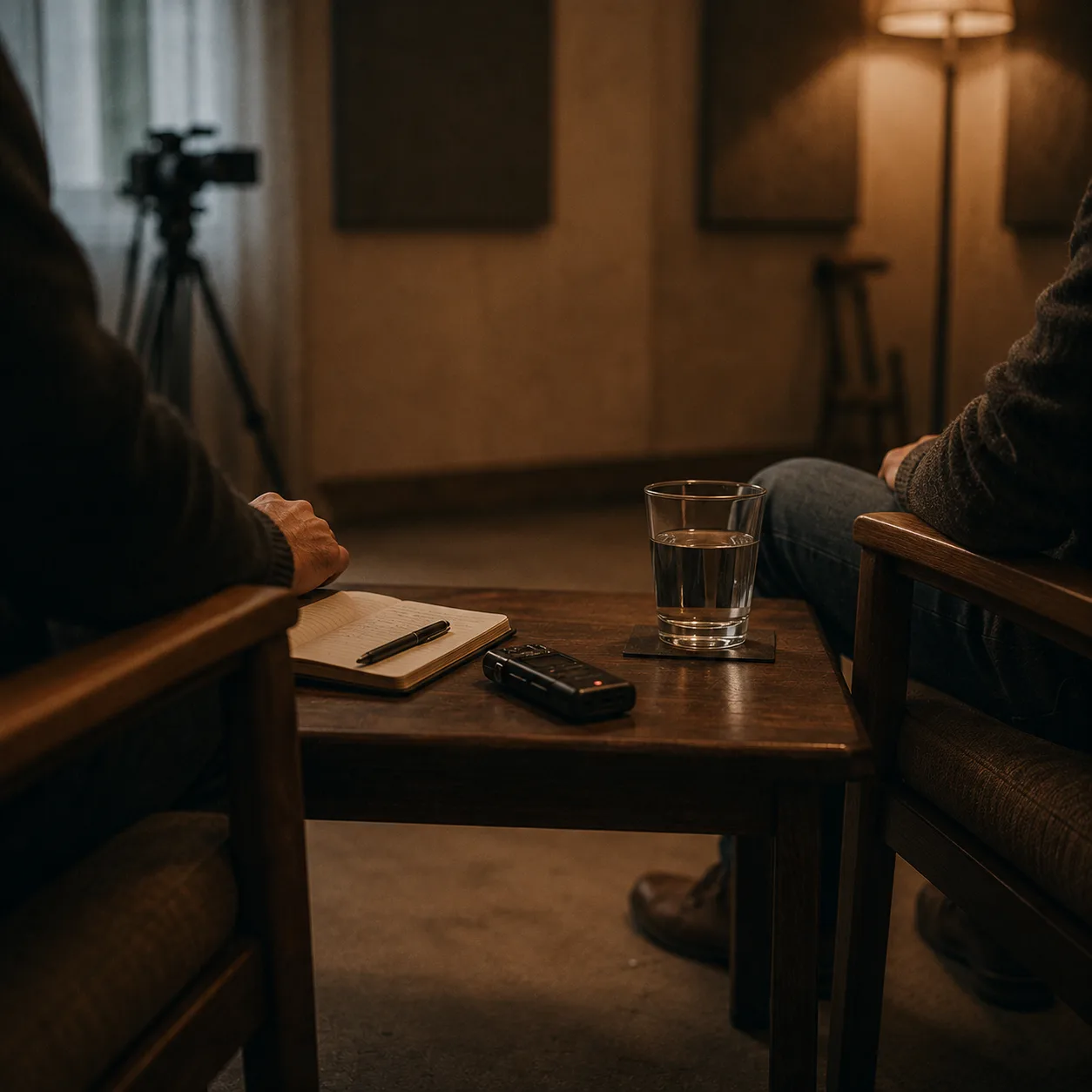
Two chairs in a quiet interview room, a recorder running, a notebook on the table, one question just asked, and the other person looking down before answering. The question changes the person asked; the answer changes the one who asked.
Narrative function: Underscore for the charged space between a question and an honest answer, scoring the interviewer as a real present voice rather than an invisible neutral.
Emotional subtext: Charged, attentive, serious; both interviewer and subject at risk of being changed
Scene fit:
- documentary interview or podcast
- oral history, biography profile or investigative journalism
- family-history recording where a question changes the room
What this music should do
Pick for a documentary interview where the interviewer is a real presence; a no-cello two-presence chamber (bass clarinet interviewer + upright piano subject) with an asymmetric ending (clarinet withdraws, piano changed, guitar's unresolved fragment). Not interrogation, testimony, true-crime or therapy.
What it must not do:
- interrogation or confession drama
- true-crime tension or detective color
- testimony music or sentimental testimony
- therapy-room or suspense scoring
- making the interviewer predatory or the subject guilty
Creator fit
Use for:
- documentary interviews and podcasts
- oral history, biography profiles and investigative journalism
- family-history recordings where a question changes the room
Avoid for:
- interrogation / confession drama
- true-crime / detective
- testimony / suspense beds
- therapy room
- trailer climax
- motivational / corporate
Preview & download
Behind the track
Scene ideas, musical character and editing guidance from the original MCM54 track documents.
In the edit
- Notes for editor
This track scores the relationship inside an interview — the interviewer is a present voice (bass clarinet), not an invisible neutral. There is NO cello. Keep it under the space before an honest answer, not the answer itself, and not an interrogation or testimony. The bass clarinet must never become noir/jazz/detective. The ending is asymmetric (clarinet withdraws, piano changed, guitar leaves an unresolved fragment) and works as a closing cue. Do not crossfade the final fragment into resolution. Correct level under narration/dialogue: -24 to -28 LUFS.
- Best for
a documentary interview before an honest answer
a journalist asking a careful question
a podcast guest pausing before telling the real version
an oral-history interview where memory becomes fragile
a subject correcting their prepared story
a biographical interview where the room changes after one question
a family-history conversation on record
a long-form profile interview
- Works after
an establishing shot of two chairs, a table, a glass of water, a recorder running
a question just asked, the subject looking down
narration introducing an interview about to go deeper
a held two-shot of interviewer and subject before the answer
- Works before
the honest answer itself (the music holds the space before it)
a cut to the subject correcting their prepared story
a reflection on what the question did to both people
the recorder still running after the room goes quiet
- Loop friendly
No
- Intro friendly
Yes
- Ending friendly
Yes
- Voiceover friendly 1 5
5
- Dialogue friendly 1 5
5
Musical character
- Genre
Relational Chamber Minimalism
- Subgenre
Two-Voice Documentary Score — the interview
- Main instruments
bass clarinet (the interviewer — close, breathy, restrained; a question that may change the room)
upright piano (the person being asked — hesitant, guarded, short incomplete phrases, gradually less prepared)
nylon-string guitar (the recorded story itself — sparse fragments, said and reconsidered)
double bass (rare sustained low tones — the floor beneath the interview)
vibraphone (optional, one isolated note — the weight of a question landing)
close room tone (quiet interview room, two chairs, one table, warm analog air)
- Texture
Two presences facing each other: a breathy bass clarinet (the interviewer) and a guarded upright piano (the subject), with a nylon guitar carrying pieces of the story between them. Wide charged silences are active material. The interviewer keeps the question present without interrupting; the subject answers in fragments and small corrections. The charge grows but never becomes suspense.
- Mix character
Warm analog realism, close interview-room presence. Bass clarinet and piano placed like two chairs facing each other, with the guitar as the story moving between them; bass centered and low. Soft transients, minimal compression, restrained low end, transparent midrange for narration and dialogue. Intimate and serious, never glossy, never theatrical, never crime-room.
- Time signature
free / rubato — question-and-answer phrasing with charged pauses
Emotional arc
- Primary emotion
Charged attention
- Secondary emotion
Relational risk — the alive space between a question and an honest answer
- Story position
The interview — the charged space after a question lands and before the answer decides how honest it can be
- Emotional arc
Observation → Charged attention. The piece does not resolve the question. The interviewer (bass clarinet) asks; the subject (piano) answers in guarded fragments and small corrections; the story on record (guitar) surfaces; question and answer briefly occupy the same truth; the interviewer withdraws first and the subject's final notes are no longer the prepared answer.
Original arrangement brief
Original creative intent. Timings, tonal targets and mix instructions describe the written brief; individual audio takes may differ.
- Emotional profile
- Primary
Charged attention
- Secondary
Relational risk — the alive space between a question and an honest answer
- Arc type
Two-voice relational arc of an interview. The interviewer (bass clarinet) asks; the subject (piano) answers in guarded fragments and small corrections; the recorded story (guitar) surfaces; question and answer briefly occupy the same truth without agreeing; the interviewer withdraws first and the subject's final notes are changed from the prepared answer. No resolution of the question.
- Listener journey
Observation → Charged attention
- Emotional temperature
Serious, close and charged, but never cold or threatening. The temperature of a quiet interview room with a recorder running — two chairs not quite aligned, a question still in the air. Alive with risk and care, never the chill of an interrogation.
- Arrangement stages
- Stage
1
- Name
The Question Enters the Room
- Duration approx
0:00–0:35
- Description
Bass clarinet alone. One short low breath-like phrase, then silence. The question enters the room before the answer.
- Instrumentation active
bass clarinet
- Density
near-zero
- Stage
2
- Name
The Person Being Asked
- Duration approx
0:35–1:20
- Description
Upright piano enters cautiously as the person being asked. Short incomplete phrases, prepared but uncertain. Space is left for voiceover.
- Instrumentation active
bass clarinet (receding)
upright piano
- Density
sparse
- Stage
3
- Name
The Question Stays Present
- Duration approx
1:20–2:10
- Description
Bass clarinet returns gently, not interrupting but keeping the question present. Piano answers in fragments, with pauses and small corrections.
- Instrumentation active
bass clarinet
upright piano
- Density
sparse
- Stage
4
- Name
The Story on Record
- Duration approx
2:10–3:00
- Description
Nylon guitar enters as pieces of the story on record — sparse fragments, memory details, things said and reconsidered. Double bass may appear once as grounding. The charged space grows, but never becomes suspense.
- Instrumentation active
bass clarinet
upright piano
nylon-string guitar
double bass (once)
- Density
moderate-sparse
- Stage
5
- Name
The Same Truth, Briefly
- Duration approx
3:00–3:45
- Description
Bass clarinet and piano almost share a phrase. Not agreement, not resolution — the question and answer briefly occupy the same truth.
- Instrumentation active
bass clarinet
upright piano
vibraphone (optional, one note)
- Density
moderate-sparse
- Stage
6
- Name
The Recorder Still Running
- Duration approx
3:45–4:20
- Description
Bass clarinet withdraws first; the interviewer stops asking. Piano remains for a few changed notes, no longer the prepared answer from the beginning. Nylon guitar leaves one unresolved fragment, like the tape still running after the room goes quiet.
- Instrumentation active
upright piano (changed notes)
nylon-string guitar (one unresolved fragment)
- Density
near-zero to silence
- Instrumentation roles
- The interviewer
- Instrument
Bass clarinet
- Role
The interviewer — a real, present voice carrying curiosity, care, pressure and responsibility. Asks the question that may change the room; keeps it present without interrupting; withdraws first at the end.
- Priority
opens the piece, returns in stage 3 and 5, withdraws first in stage 6
- Melodic content
Short, breathy, restrained low phrases — a question, then its quiet persistence. Almost shares a phrase with the piano in stage 5 without agreeing.
- Forbidden
Noir, jazz or detective phrasing, predatory pressure, interrogation tension, suspense, continuous lead, becoming a mood instead of a person
- The subject
- Instrument
Upright piano
- Role
The person being asked — guarded at first with a prepared version, gradually less prepared, changed by the question. Remains at the end on changed notes.
- Priority
enters stage 2, is the final melodic voice (with guitar) in stage 6
- Melodic content
Short incomplete phrases with pauses and small corrections; by the end, notes that are no longer the prepared answer.
- Forbidden
Felted/distant tone (reads as Series B), emotional piano formula, confident resolved answers, sad-piano cliché, sounding guilty
- The story on record
- Instrument
Nylon-string guitar
- Role
The recorded story itself — pieces of memory said and reconsidered. Leaves one unresolved fragment at the end, like the tape still running.
- Priority
enters stage 4, leaves an unresolved fragment in stage 6
- Melodic content
Sparse fragments of memory detail; one final unresolved fragment.
- Forbidden
Continuous accompaniment, romantic fingerstyle, Latin cliché, completing the story, leading the arrangement
- The floor
- Instrument
Double bass
- Role
The floor beneath the interview — the quiet ground under two present people.
- Priority
rare — once in stage 4
- Melodic content
One rare sustained low tone. No movement.
- Forbidden
Groove, pulse, walking bass, suspense low-end, ominous drone, forward rhythmic movement
- Question landing
- Instrument
Vibraphone (optional)
- Role
The weight of a question landing — a single isolated note after a pause.
- Priority
optional — one isolated note in stage 5
- Melodic content
One isolated note, no pattern.
- Forbidden
Shimmer, repeated patterns, suspense punctuation, mystery sparkle, magical color
- Room
- Instrument
Close room tone — warm analog air
- Role
A quiet interview room — two chairs, a table, a glass of water, a recorder running. Close, intimate, serious.
- Priority
constant and very subtle
- Melodic content
n/a
- Forbidden
Crime-room or police-room ambience, courtroom reverb, archival haze, institutional fog, reverb that makes the space feel large or theatrical
- Cello
- Instrument
NONE — cello is deliberately absent
- Role
There is no cello in this track. Its absence is a defining production rule. The second human presence is the bass clarinet (the interviewer), not a cello.
- Priority
absent
- Melodic content
n/a
- Forbidden
Any cello, any sustained bowed string, any string pad standing in for cello
- Harmonic philosophy
- Key center
D minor
- Modal inflections
Suspended minor colors, open intervals, restrained modal harmony and unresolved tension. The harmony should feel like a responsible question waiting for an honest answer — charged but not threatening. Neither consonant-comforting nor dark-suspenseful.
- Arc
The bass clarinet states an open, breathy D minor question without committing. The piano answers in related but guarded fragments, re-voicing as it corrects itself. The clarinet's returns keep an unresolved suspension alive. The almost-shared phrase in stage 5 circles one voicing from two sides without resolving. The ending leaves the piano on changed, open notes over the guitar's unresolved fragment.
- Chord movement
Slow and non-functional. Dm, Dm(add9), Dm sus2, open fifths D–A, Gm and Bb as restrained passing colors. No cadence drive, no resolution of the question's harmonic tension. The ending does not resolve.
- Resolution policy
Never resolve the question, and never let the two voices fully agree. No perfect authentic cadence. The almost-shared phrase stays unresolved; the final notes are open and changed.
- Forbidden intervals
Interrogation minor-second/tritone tension build (turns the question into pressure)
Perfect authentic cadence A–Dm with full resolution (implies the question answered/closed)
True-crime dark drone or suspense cluster (turns charge into danger)
Therapeutic major-key warmth (turns the room into therapy)
Any swelling progression toward a confession climax
- Preferred intervals
Open fifth D–A (two present people, a question held open)
Added ninth Dm add9 (charged attention without resolution)
Suspended second Dm sus2 (a question waiting for an honest answer)
Re-voiced repeats with one changed note (the subject correcting the prepared answer)
Bb major as a passing warmth, never a destination
- Key production note
D minor here must read as charged attention, not danger. A tense D minor makes it interrogation; a dark D minor makes it true crime; a warm resolving D minor makes it therapy or confession. The correct D minor says: a responsible question is in the air, and an honest answer is deciding whether it can appear.
- Mix philosophy
- Stereo field
Intimate and close, with bass clarinet and piano placed like two chairs facing each other (not quite aligned), the guitar as the story moving between them, and the bass centered and low. The listener is in the room with both presences.
- Reverb character
Short and natural — 0.5 to 1.0 seconds — a quiet, dry interview room, not a courtroom, police room or cavernous space. Nothing theatrical.
- Frequency balance
Warm low-mids for the breath of the bass clarinet and the body of the piano; the wood of the guitar; restrained low end for the bass. Transparent midrange reserved for narration and dialogue. Gentle high control so the clarinet stays breathy and human, never shrill.
- Dynamic range
Wide and restrained, charged but never building to suspense. Loudness target: -18 LUFS integrated. Under narration/dialogue: -24 to -28 LUFS. The charged silences after the question and the final beat (the recorder still running) must remain genuinely quiet.
- Headroom for narration
Maximum. This track sits under interview dialogue and reflective narration — voice must always lead. The music holds the space between question and answer; it never competes with the words on record.
- Dynamics philosophy
- Overall level
Quiet and restrained throughout, charged but never loud and never building toward suspense or a confession peak. The dynamics trace a question held present and an answer deciding how honest to be.
- Movement type
Question-and-answer with charged pauses — the clarinet asks and persists, the piano answers in fragments and corrections. The only convergence is the brief almost-shared phrase in stage 5.
- Peak policy
No peaks, and especially no suspense build. Stage 4 (the story on record) and stage 5 (the same truth, briefly) are the fullest textures and must stay restrained. If the music builds tension, pulses or drones, the charge becomes danger — reject.
- Silence policy
Silence holds the space before honesty appears. The pause after the opening question, the gaps in the subject's fragmented answer, and the final beat after the room goes quiet are active material. The recorder runs one second longer than expected.
- Compression policy
Minimal. No limiting. Preserve the breath of the bass clarinet, the natural dynamics of the piano, and the charged silences. No artificial loudness evening.
- Listener outcome
- Intended feeling
That an interview is not just a question and an answer, but a charged human space where both people risk being changed by what is said — with the recorder running one second longer than expected.
- Not intended
Interrogation, true-crime tension or suspense
Testimony around one protected speaker (the interviewer is present)
The interviewer as predatory or the subject as guilty
Therapy, confession or sentimental testimony
The question resolved or the answer pushed
Any feeling produced by the music that was not already in the charged space between the two people
- Best descriptor
Two chairs not quite aligned, a recorder running, a question still in the air, a subject looking down before deciding how honest the answer can be.
Creator note
# Creator Note — INST-029
# Two Chairs and One Story
This one is very useful, but it's not background
interview music.
I wanted it to hold the space where a question
changes the room before the answer even arrives.
The interviewer is present here too — not as a judge,
but as someone who may also leave changed
by what they asked.
— Oshi, MCM54
License
Use any track in your videos, podcasts, films and narrated projects — including monetized ones. Credit MCM54 where your platform allows: video description, show notes, end credits or project credits. Do not resell, re-upload, or register the tracks with Content ID. Downloads you have already made keep their license even if these terms later change.
Credit line: Music: MCM54 — mcm54.com