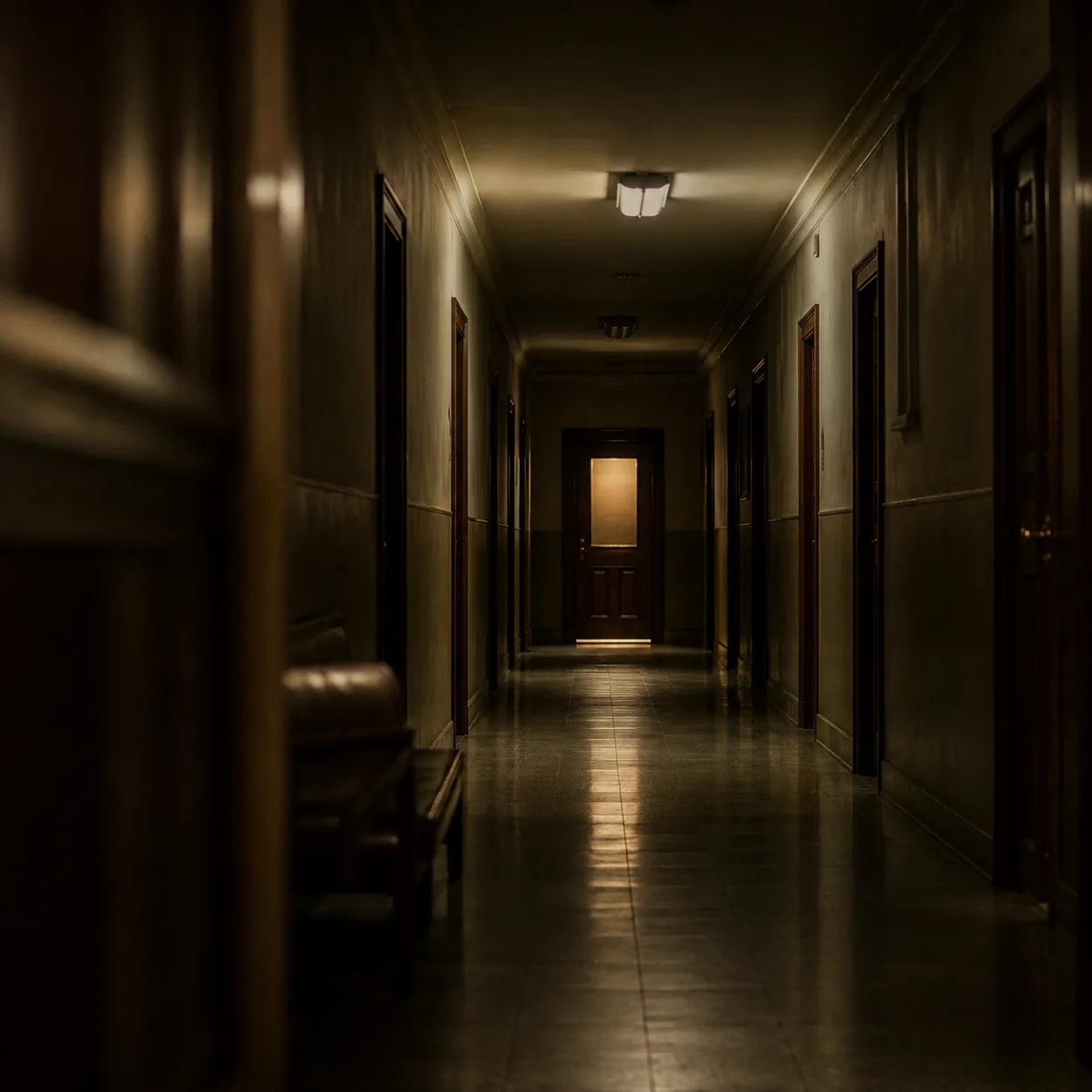
The Last Office Still Lit
Music for the decisions nobody sees being made
The moment
The space immediately before an invisible decision is made behind a single closed office door, late at night in an almost-empty institutional building.
Narrative function: Establishes institutional tone and psychological weight under b-roll or before narration begins, signalling that what follows is important rather than dangerous.
Emotional subtext: Quiet institutional gravity — the weight of an unseen consequence that has not yet been spoken.
Scene fit:
- Moment before an important signature in documentary film
- Institutional decision-making scenes without visible action
- Ethical dilemma sequences with no dialogue
- Government investigation or archival b-roll underlay
- Historical turning-point sequences where nothing appears to happen
- Investigative video essay establishing institutional tone
- Serious podcast or documentary opening before the first word
What this music should do
Recommend for documentary, investigative and institutional voiceover where weight is needed without tension; keep at -25 to -28 LUFS under narration and fade slowly. Steer away from thriller, trailer, action and motivational uses.
What it must not do:
- Thriller, espionage or danger
- Moral judgment on whether the decision is right or wrong
- Suspense, urgency or excitement
- Sadness or grief
- Resolution or closure
Creator fit
Use for:
- Moment before an important signature in documentary film
- Institutional decision-making scenes without visible action
- Ethical dilemma sequences with internal conflict and no dialogue
- Government investigation b-roll or archival footage underlay
- Historical turning-point sequences
- Investigative journalism video essay establishing tone
- Serious political or institutional podcast opening
- Corporate or legal documentary board-meeting aftermath
Avoid for:
- trailer climax
- action or chase
- motivational or corporate
- celebratory content
- news or fast-paced segments
- social short-form
Preview & download
Behind the track
Scene ideas, musical character and editing guidance from the original MCM54 track documents.
In the edit
- Notes for editor
This track functions as a sustained emotional atmosphere, not underscore. Play it under b-roll or wide establishing shots before the narrator speaks. Never duck aggressively under voice — the track is built with inherent voiceover headroom (-18 LUFS target). If used under narration, keep track at -25 to -28 LUFS session level. The psychological tension is carried by stillness, not dynamics — abrupt cuts will destroy the effect. Always fade out over minimum 8 seconds.
- Best for
moment before an important signature in documentary film
institutional decision-making scenes without visible action
ethical dilemma sequences — internal conflict, no dialogue
government investigation b-roll or archival footage underlay
historical turning-point sequences where nothing appears to happen
investigative journalism video essay — establishing institutional tone
podcast episode opening — before first word on serious topics
corporate or legal documentary — board meeting aftermath scenes
- Works after
an establishing shot of a government building at night
a title card naming a specific date or institution
aerial b-roll of an empty city at late hours
a written statement appearing on screen
- Works before
the narrator's first word identifying a decision or its consequences
a slow-motion document or signature close-up
an interview beginning with a witness or official
a chapter title card naming a specific event
- Loop friendly
Yes
- Intro friendly
Yes
- Ending friendly
No
- Voiceover friendly 1 5
5
- Dialogue friendly 1 5
4
Musical character
- Genre
Psychological Cinematic Documentary
- Subgenre
Institutional Minimalism
- Main instruments
felted piano — isolated low-register chords, sparse voicings, generous silence between phrases
small chamber strings — muted violas and cellos, sustained textures, very slow evolution
processed electric guitar harmonics — distant, near-inaudible, adding subtle unease
warm analog air — faint electrical resonance, restrained room ambience of empty institutional building
- Texture
Confined and still. The spatial quality of a government corridor after hours — acoustic dampening, fluorescent hum, the kind of quiet that is not peaceful but purposeful. Sound events are sparse and deliberate. Silence between phrases is arranged.
- Mix character
Intimate mid-width — not vast like a desert, but contained like a corridor. Analog warmth. Minimal high-frequency shimmer. No boomy low-end — the bass is controlled, like a building foundation rather than a landscape. Voiceover headroom built in at -18 LUFS. Natural room depth without excessive reverb.
- Time signature
4/4 implied — pulse almost imperceptible, rhythm never established
Emotional arc
- Primary emotion
Quiet institutional gravity
- Secondary emotion
The weight of unseen consequence
- Story position
The space immediately before an invisible decision is made
- Emotional arc
No arc. The piece exists inside a single prolonged pre-decision moment. It does not build toward the decision. It does not describe its aftermath. It inhabits the room where the decision already exists but has not yet been spoken. The ending is not a resolution — it is the moment the music stops being a witness.
Original arrangement brief
Original creative intent. Timings, tonal targets and mix instructions describe the written brief; individual audio takes may differ.
- Emotional profile
- Primary
Quiet institutional gravity
- Secondary
The weight of unseen consequence
- Arc type
No arc — sustained pre-decision atmosphere throughout
- Listener journey
Watching → Understanding
- Emotional temperature
Cool and still. The temperature of a government corridor at 11pm — neither threatening nor welcoming. Purposefully neutral.
- Arrangement stages
- Stage
1
- Name
The Corridor
- Time range
0:00–0:45
- Description
Single felted piano notes emerge from silence. Long pauses between each note — the room feels larger than the music. No harmonic context yet. Harmonic ambiguity. The listener does not yet know what kind of space they have entered.
- Instrumentation active
felted piano — isolated single notes, low register
- Density
near-zero
- Dynamic level
ppp
- Production notes
The silence between notes is part of the composition. Do not compress or fill the gaps. If the AI generates a note every 2 seconds, reject that take — gaps should reach 4–6 seconds minimum.
- Stage
2
- Name
The Presence
- Time range
0:45–1:45
- Description
Low chamber strings quietly appear beneath the piano. No melody yet. Only slowly shifting harmony and controlled emotional pressure. The listener now senses that the space is not empty — something is present behind the door.
- Instrumentation active
felted piano — sparse chord voicings
muted violas — sustained low texture
- Density
sparse
- Dynamic level
pp
- Production notes
Strings should not announce themselves. They should feel as though they were always there and are only now becoming audible. If the string entry feels like a 'moment', it is too loud.
- Stage
3
- Name
The Document
- Time range
1:45–2:50
- Description
Subtle harmonic movement begins. A restrained motif quietly develops between piano and strings. Distant guitar harmonics become barely perceptible — not as melody but as unease. Dynamics increase only slightly. The listener senses importance without knowing why.
- Instrumentation active
felted piano — slow harmonic movement
muted violas and cellos
processed guitar harmonics — barely audible
- Density
moderate-sparse
- Dynamic level
p to mp
- Production notes
The guitar harmonics should sit at the edge of audibility — present enough to register subconsciously, absent enough that a first-time listener might not consciously identify them. If they are identifiable as guitar, they are too loud.
- Stage
4
- Name
The Weight
- Time range
2:50–3:35
- Description
The central motif becomes momentarily clear between piano and strings, then immediately retreats. Nothing resolves. The music has arrived at its emotional center without declaring it. Every instrument leaves space for narration. The unresolved suspension hangs.
- Instrumentation active
felted piano — motif briefly clarified
muted cellos — low sustained tones
- Density
sparse
- Dynamic level
p
- Production notes
The motif should appear only once and feel accidental rather than composed. The moment the listener recognizes it as a theme, it should already be retreating. Never repeat the motif identically.
- Stage
5
- Name
The Corridor Again
- Time range
3:35–4:10
- Description
Strings disappear first — no dramatic exit, simply no longer present. Piano remains alone. Final unresolved suspended harmony. The piece fades naturally into silence without conclusion. The decision has not been made — or perhaps it has already been made and nothing yet shows it.
- Instrumentation active
felted piano — alone, final suspended chord
- Density
near-zero
- Dynamic level
ppp to silence
- Production notes
Fade must be natural and slow — minimum 12 seconds. Never a hard cut. The reverb tail of the final chord should outlast the note itself. End on an unresolved suspension: B minor sus2 or similar open voicing with no third.
- Instrumentation roles
- Foundation
- Instrument
Felted piano
- Role
The mind behind the door. Isolated, deliberate, unperforming. Low-register chords with sparse voicings. The piano is not playing — it is thinking.
- Priority
always-on
- Melodic content
sparse single notes opening → slow chord voicings developing → brief motif in stage 4 → single suspended final chord
- Texture
- Instrument
Muted violas and cellos (small chamber strings)
- Role
The institutional space itself — the walls, the air, the weight of the building. Sustained textures that slowly evolve. Never melodic. No vibrato.
- Priority
stages 2–4, absent in stage 5
- Melodic content
none — sustained harmonic texture only
- Unease
- Instrument
Processed electric guitar harmonics
- Role
The electrical hum of aging fluorescent lights. Almost inaudible. Not music — subliminal texture. Creates slight unease without ever announcing itself as a sound source.
- Priority
stage 3 only — barely perceptible
- Melodic content
none — pure harmonic texture at edge of audibility
- Space
- Instrument
Warm analog air and room ambience
- Role
The institutional building itself after hours. Acoustic dampening, faint ventilation movement, the kind of silence that has substance. Not reverb as effect — the spatial identity of the track.
- Priority
constant throughout
- Melodic content
n/a
- Harmonic philosophy
- Key center
B minor
- Modal inflections
Aeolian primarily. Occasional Phrygian coloring (flat second — C natural over B root) for moments of maximum psychological weight without thriller energy.
- Chord movement
Very slow. Long pedal tones in the bass. Harmonic drift rather than progression. The listener should not be able to identify where chord changes occur.
- Resolution policy
Never resolve. End on suspended harmony. The piece does not conclude — it simply stops, as if the music chose to leave the room before the decision was made.
- Forbidden intervals
major third above root (too bright, signals conclusion)
perfect authentic cadence F#–B (V–I, too final)
rising major sixth (D# over F# — too hopeful, too declarative)
any interval that implies the music knows how the decision ends
- Preferred intervals
minor second (B to C — creates institutional gravity without thriller drama)
perfect fourth and fifth (open, unresolved, patient)
minor seventh (A over B root — ambiguity without despair)
- Mix philosophy
- Stereo field
Mid-width — not as vast as a desert, but wider than a single room. The sound of a long corridor. Piano centered. Strings slightly wide. Guitar harmonics far left and right at very low level.
- Reverb character
Moderate institutional reverb — 2 to 4 seconds decay. Pre-delay 20–40ms. The room sounds real, not cinematic. Like a government corridor with acoustic tiles and linoleum floors. Not a concert hall.
- Frequency balance
Controlled low-mids — the piano warmth should not bloom. Slightly scooped mids (300–800Hz) — the institutional quality. Restrained highs — no shimmer, no sparkle. This is fluorescent light, not sunlight.
- Dynamic range
Wide. Quiet moments must be genuinely quiet. Loudness target: -18 LUFS integrated for library delivery. Session level for narration underlay: -25 to -28 LUFS.
- Headroom for narration
Built in by design. The arrangement leaves transparent midrange at all times. No frequency masking of the voice range (200Hz–3kHz).
- Dynamics philosophy
- Overall level
Very quiet throughout. This music occupies a room — it does not fill it.
- Movement type
Imperceptible swell across minutes. The only dynamic event is the clarification and retreat of the motif in stage 4 — and even that should be barely noticeable.
- Peak policy
No sudden peaks. Any increase in level happens across a minimum of 20 bars. The moment a dynamic change is audible as a change — it is too fast.
- Silence policy
Silence between piano events in stages 1 and 5 is compositional. 4–6 second gaps minimum. Do not mistake silence for failure.
- Compression policy
No limiting. Light transparent compression if needed for delivery formats only. Dynamic range must be preserved — it is the primary emotional carrier.
- Listener outcome
- Intended feeling
That the quietest rooms carry the greatest weight
- Not intended
Suspense or fear
Political alignment or judgment
Excitement or anticipation
Sadness or grief
Resolution or closure
- Best descriptor
Quietly understanding that this is where history actually begins
License
Use any track in your videos, podcasts, films and narrated projects — including monetized ones. Credit MCM54 where your platform allows: video description, show notes, end credits or project credits. Do not resell, re-upload, or register the tracks with Content ID. Downloads you have already made keep their license even if these terms later change.
Credit line: Music: MCM54 — mcm54.com