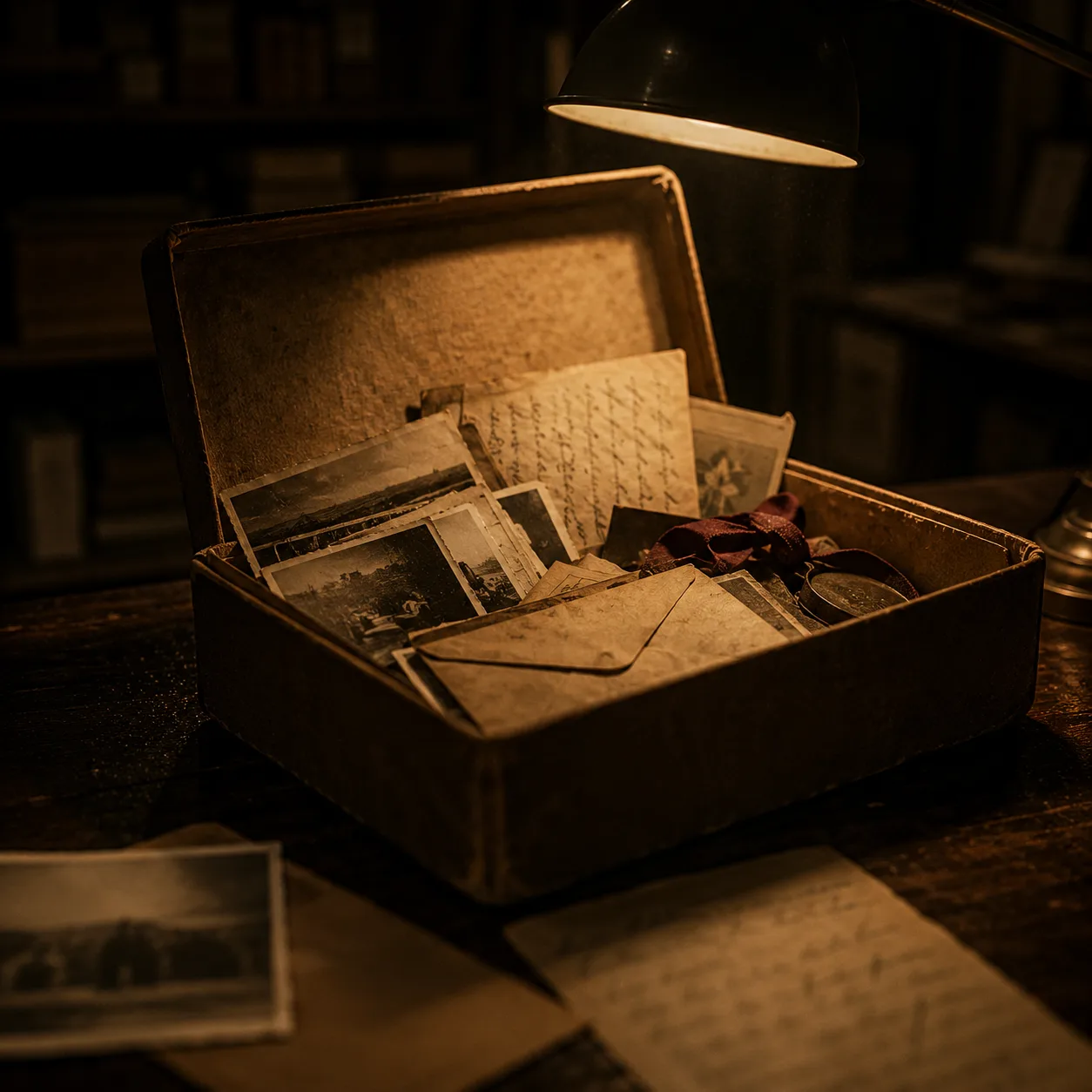
The Box That Waited
Music for the moment forgotten lives return to the light
The moment
The transitional moment when an archive box is opened and its objects stop being records and become people — a life returning quietly to the light.
Narrative function: Scores the archive-to-person transition, giving forgotten lives emotional permission to become present again under narration or archival footage.
Emotional subtext: Quiet discovery — warm recognition of forgotten lives, without nostalgia or grief.
Scene fit:
- Opening an archive box in documentary film
- First family photograph appearing on screen
- Reading handwritten letters in close-up archival footage
- Introducing a historical figure through personal artifacts
- Museum exhibit walk-through or artifact reveal
- Genealogy and family-history discovery moment
- Biography channel personal-archive sequence
What this music should do
Recommend for documentary, historical, genealogy and biography voiceover on the archive-to-person transition; let the piano opening breathe before narration and keep at -26 to -28 LUFS under voice. Steer away from triumphant, urgent, nostalgic period-drama or fast-paced uses.
What it must not do:
- Nostalgia or longing for a specific past
- Sadness or grief
- Joy, triumph or celebration
- The sense that the past is over
- Sentimental climax or emotional manipulation
Creator fit
Use for:
- Opening an archive box in documentary film
- First family photograph appearing on screen
- Reading handwritten letters in close-up archival footage
- Introducing a historical figure through personal artifacts
- Museum exhibit walk-through or artifact reveal
- Genealogy and family-history documentary discovery moment
- Biography channel personal-archive sequence
- Investigative video essay transitioning from fact to person
- Podcast opening using archival audio material
Avoid for:
- trailer climax
- action or fast historical sequence
- celebratory or triumphant content
- news or current affairs
- nostalgic period drama
- social short-form
Preview & download
Behind the track
Scene ideas, musical character and editing guidance from the original MCM54 track documents.
In the edit
- Notes for editor
This track is designed for transition — the emotional bridge between archival document and human being. Play it during the visual movement from archive material to a face, name or personal object. Do not begin narration until Section 1 (0:45) at the earliest — allow the piano's patient opening to create the emotional space. When used under active narration, set session level to -26 to -28 LUFS to preserve the track's warm midrange without masking the voice. Always fade out over a minimum of 10 seconds — an abrupt cut removes the quiet invitation the track has constructed.
- Best for
opening an archive box in documentary film
first family photograph appearing on screen
reading handwritten letters — close-up archival footage
introducing a historical figure through personal artifacts
museum exhibit walk-through or artifact reveal
genealogy and family history documentary — discovery moment
biography channel — subject's personal archive sequence
investigative YouTube essay — transition from fact to person
- Works after
a title card establishing place and time
an aerial shot of a city or landscape dissolving to archive footage
a narrator establishing the subject without yet revealing the human dimension
black screen or slow fade-in from black
- Works before
the narrator's first words naming a specific person
a close-up of a handwritten signature or a face in a photograph
an interview with a family member beginning
a chapter title revealing whose story this is
- Loop friendly
Yes
- Intro friendly
Yes
- Ending friendly
No
- Voiceover friendly 1 5
5
- Dialogue friendly 1 5
4
Musical character
- Genre
Cinematic Documentary Chamber
- Subgenre
Archival Minimalism
- Main instruments
felted piano — soft mid-register voicings, sparse phrases, generous silence between notes
small chamber strings — muted violas and cellos, slowly evolving sustained harmonies
nylon-string guitar — delicate fingerstyle, subtle harmonics, warm natural imperfections
soft upright bass — extremely restrained long notes, grounding without rhythmic emphasis
warm analog air — subtle room ambience, faint natural resonance of archival quiet space
- Texture
Warm and intimate. The texture of filtered light through a single reading lamp falling on old paper. No harshness. No bright edges. Everything is slightly soft at the edges — like a photograph that has been handled many times. Sound events are spaced like someone working slowly through something that deserves patience.
- Mix character
Warm analog realism. Wide stereo image without artificial width. Natural room depth — the acoustic quality of a small study or archive room, not a concert hall or studio. Exceptionally clean midrange for narration. Soft transients throughout. No compression artifacts. Organic acoustic presence. -18 LUFS integrated for library delivery.
- Time signature
3/4 implied or free — pulse almost never felt, phrases breathe independently
Emotional arc
- Primary emotion
Quiet discovery
- Secondary emotion
The recognition of forgotten lives
- Story position
The transitional moment when an archive becomes memory — when objects become people
- Emotional arc
No traditional arc. The piece moves with the patience of someone turning fragile pages. It begins in careful stillness, gradually reveals more texture as more of the archive is uncovered, reaches a single brief moment of human recognition in the motif, then retreats — returning the room to its quiet invitation. Discovery, not revelation. Recognition, not catharsis.
Original arrangement brief
Original creative intent. Timings, tonal targets and mix instructions describe the written brief; individual audio takes may differ.
- Emotional profile
- Primary
Quiet discovery
- Secondary
The recognition of forgotten lives
- Arc type
Gradual revelation — patient stillness opening slowly, brief moment of human recognition, returning to quiet invitation
- Listener journey
Observing → Remembering
- Emotional temperature
Warm and still. The temperature of a room where old things have been kept safely — not cold archive storage, but a personal space where objects have been treated with care.
- Arrangement stages
- Stage
1
- Name
The Lid Lifts
- Time range
0:00–0:45
- Description
Felted piano alone. Isolated notes separated by generous silence. Harmony open and unresolved. No melodic intention yet — only the patient invitation to enter. The listener does not yet know whose story this is.
- Instrumentation active
felted piano — isolated mid-register notes, long silences between
- Density
near-zero
- Dynamic level
ppp
- Production notes
Silence between piano notes must be 4–6 seconds minimum in this section. If the AI generates a flowing piano line, reject that take — this is not piano music yet. It is the sound of a box being opened carefully, one moment at a time.
- Stage
2
- Name
The First Object
- Time range
0:45–1:45
- Description
Nylon-string guitar quietly joins the piano. Simple musical dialogue — a phrase from one answered gently by the other. No obvious melody. Every phrase feels like another object carefully removed from the box. The room is warmer now. Someone is beginning to look.
- Instrumentation active
felted piano — sparse chord voicings
nylon guitar — delicate fingerstyle, entering naturally not dramatically
- Density
sparse
- Dynamic level
pp
- Production notes
The guitar entry must feel like a natural continuation of the piano's thought, not a new voice arriving. If the listener notices the guitar entering, it entered too loudly. The guitar should feel as though it was always in the room.
- Stage
3
- Name
The Photographs
- Time range
1:45–2:50
- Description
Chamber strings slowly emerge beneath the acoustic instruments. Soft upright bass grounds the harmony without establishing rhythm. The texture grows warmer and slightly richer — more photographs have been lifted, more lives becoming visible. Emotional warmth increases without drawing attention to itself.
- Instrumentation active
felted piano
nylon guitar
muted violas and cellos — sustained harmonics entering gradually
upright bass — long restrained tones, almost subliminal
- Density
moderate-sparse
- Dynamic level
p to mp
- Production notes
The strings must not feel like an orchestral arrival — they should feel like the emotional weight of the photographs accumulating. The upright bass should be felt more than heard. If the bass creates any sense of rhythmic pulse, it is too prominent. Each additional instrument represents another life in the box becoming visible.
- Stage
4
- Name
The Name on the Back
- Time range
2:50–3:40
- Description
A quiet melodic motif finally appears between piano and strings — understated, memorable and deeply human. This is the moment the archive becomes a person. The instruments respond to one another rather than performing independently. Dynamics remain restrained throughout — importance is carried by the motif's presence, not its volume.
- Instrumentation active
felted piano — motif appears, simple and human
muted violas — response to piano
nylon guitar — quiet harmonic presence
upright bass — continued grounding
- Density
moderate
- Dynamic level
mp
- Production notes
The motif must be simple enough to feel like something that has always existed — not composed but remembered. Three to five notes maximum. If the listener feels it as a composed theme rather than a discovered one, it is too elaborate. This is the emotional peak of the piece and must not feel like a peak — only a quiet clarification.
- Stage
5
- Name
Returning the Photographs
- Time range
3:40–4:15
- Description
Strings gradually disappear. Guitar gently fades. Piano remains alone as in the opening — but the silence it inhabits now carries everything that has been found. Final unresolved suspended harmony. The box is not closed. The invitation remains open.
- Instrumentation active
felted piano — alone again, final suspended chord
- Density
near-zero
- Dynamic level
ppp to silence
- Production notes
The outro must mirror the intro in texture and dynamic level, but the emotional meaning has changed entirely. The same patient piano that opened an empty box now closes a box full of lives. Fade naturally over minimum 10 seconds. End on G minor sus2 or similar open voicing — no resolution, only continuation.
- Instrumentation roles
- Foundation
- Instrument
Felted piano
- Role
The archivist's hands. Patient, careful, deliberate. Moves with the pace of someone who understands that what they are handling cannot be recovered if damaged. Not sentimental — simply respectful.
- Priority
always-on — opens and closes the piece alone
- Melodic content
isolated single notes opening → sparse chord voicings developing → hosts the melodic motif in stage 4 → single suspended final chord
- Humanity
- Instrument
Nylon-string guitar
- Role
The human presence in the archive — warm, slightly imperfect, never leading. Suggests that what is in the box once belonged to a living person rather than a historical category. The guitar's natural overtones carry the warmth of wood, string and fingerprint that a photograph cannot.
- Priority
stages 2–5, absent in stage 1
- Melodic content
fingerstyle dialogue with piano — no independent melody, only response and presence
- Depth
- Instrument
Muted violas and cellos (chamber strings)
- Role
The accumulating weight of discovered lives. Each string entry represents another photograph lifted, another name encountered. Never dramatic — only patient and warm.
- Priority
stages 3–4, recedes in stage 5
- Melodic content
sustained harmonics and slow-moving textural lines — the motif response in stage 4 only
- Grounding
- Instrument
Soft upright bass
- Role
The wooden table beneath the archive box. Constant and quiet. Prevents the arrangement from floating into abstraction. Felt more than heard.
- Priority
stages 3–4 only — subliminal presence
- Melodic content
single sustained root tones — no melodic content
- Space
- Instrument
Warm analog air and room ambience
- Role
The archive room itself. The acoustic quality of old paper, filtered lamplight, and careful attention. Not a reverb effect — the spatial identity of the track.
- Priority
constant throughout
- Melodic content
n/a
- Harmonic philosophy
- Key center
G minor
- Modal inflections
Aeolian primarily. Dorian coloring in stages 3–4 (raised sixth — E natural over G root) for moments of warm recognition without brightness or resolution.
- Chord movement
Very slow. Long sustained harmonies. The listener should feel harmonic movement only as a gradual change in emotional temperature — never as a chord progression with identifiable steps.
- Resolution policy
Never resolve completely. The suspended final chord (G minor sus2 or open fifth) must leave the story open — these lives have not concluded, they have simply become visible again.
- Forbidden intervals
bright major third above root (Bb major third — too resolved, too uplifting)
perfect authentic cadence D–G (V–I — too final, closes what must remain open)
rising major sixth leap (too hopeful, too declarative — belongs to a different musical world)
any gesture that implies the memories have been safely resolved or concluded
- Preferred intervals
minor third G–Bb (warm without brightness)
perfect fifth G–D (open, unresolved, patient)
minor seventh F over G (gentle ambiguity — the past that cannot quite be named)
major second A over G (quiet tension that asks rather than declares)
- Mix philosophy
- Stereo field
Wide and warm — not artificially widened but naturally open, like a room with high ceilings and wooden floors. Piano centered. Guitar slightly right of center. Strings wide. Bass centered and low. Analog air fills the full stereo field.
- Reverb character
Short to medium — 1.5 to 3 seconds decay, simulating a small study or reading room with natural acoustic warmth. Pre-delay 15–30ms. Not a concert hall or studio — the intimacy of a personal space.
- Frequency balance
Warm low-mids present and natural. Clean upper midrange for narration transparency. Soft high frequencies — no shimmer, no sparkle. The warmth of old paper and filtered lamp-light, not sunlight.
- Dynamic range
Wide. The quietest moments must be genuinely quiet. Loudness target: -18 LUFS integrated for library delivery. Session level under narration: -26 to -28 LUFS.
- Headroom for narration
Exceptional clarity at all times in the voice range (200Hz–3kHz). The arrangement was designed around narration, not adapted for it — no frequency masking is present in any stage.
- Dynamics philosophy
- Overall level
Quiet to moderately quiet. The dynamic range of someone turning pages in a silent room — never silent, never loud.
- Movement type
Gradual accumulation of warmth, not volume. The single dynamic event is the motif arrival in stage 4, which should feel like recognition rather than climax.
- Peak policy
No sudden peaks. Any increase in emotional weight comes from the addition of instruments and harmonic depth, not from volume increase. The motif (stage 4) should arrive at the same dynamic level as the strings — only its melodic clarity distinguishes it.
- Silence policy
Silence is an equal compositional partner to every instrument. Stages 1 and 5 depend entirely on the quality of silence between notes. If a take fills the silences, reject it.
- Compression policy
No limiting. Minimal transparent compression for delivery only. The piece's emotional movement is carried by dynamic variation — compression removes its ability to feel like a living room.
- Listener outcome
- Intended feeling
That every forgotten life still deserves to be remembered
- Not intended
Sadness or grief
Nostalgia — longing for a specific past
Joy or celebration
Emotional resolution or closure
The sense that the past is over
- Best descriptor
Quiet recognition — the feeling that the people in the photographs are still somehow present
License
Use any track in your videos, podcasts, films and narrated projects — including monetized ones. Credit MCM54 where your platform allows: video description, show notes, end credits or project credits. Do not resell, re-upload, or register the tracks with Content ID. Downloads you have already made keep their license even if these terms later change.
Credit line: Music: MCM54 — mcm54.com