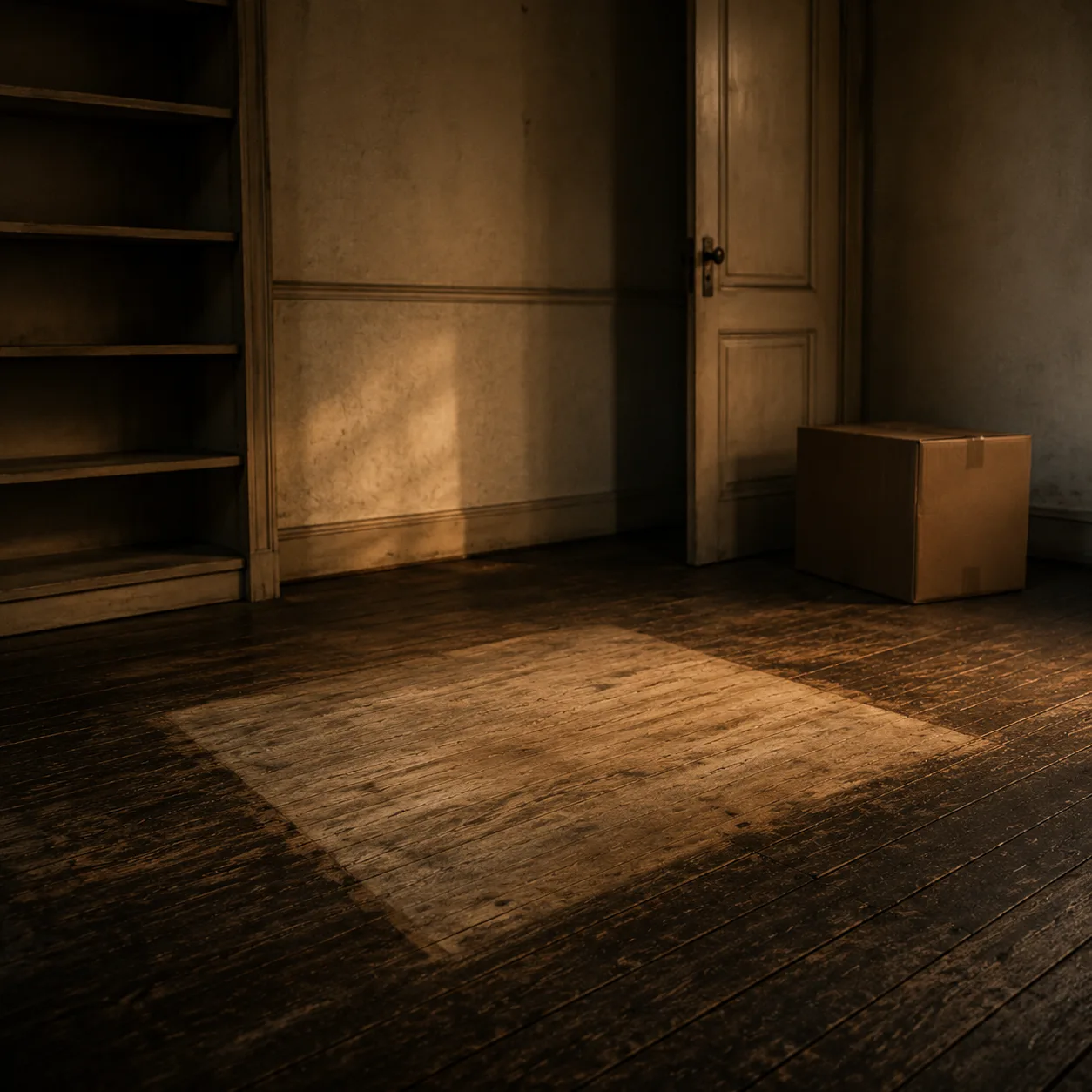
The Room After Everything Was Packed
Music for the last quiet moment before a place becomes a memory
The moment
The aftermath of goodbye — standing in an almost-empty room after everything has been packed, when the room already echoes differently.
Narrative function: Inhabits what departure leaves behind rather than narrating the leaving; opens the emotional space for reflection under narration or a wide empty-room shot.
Emotional subtext: Quiet departure — gratitude rather than grief, the invisible imprint of ordinary living.
Scene fit:
- Final sequence before departure — moving out, selling a family home, closing an office
- Empty room wide shot after furniture is removed
- Childhood bedroom first or final visit in a biography
- Returning keys or a final walkthrough
- Personal-narrative video essay opening or chapter break
- Memoir or family-story podcast chapter
- Character standing in the doorway of a room being left behind
What this music should do
Recommend for reflective documentary, memoir and personal-essay voiceover on departure and place; enter on stillness not on packing action, keep at -26 to -28 LUFS under voice, fade slowly. Steer away from performed-sadness farewell cues, trailer climax and upbeat or fast content.
What it must not do:
- Performed sadness or grief
- Regret or the sense that leaving was a mistake
- Nostalgia or longing for a specific past
- Farewell or goodbye announced by the music
- Resolution or the sense that the story is over
Creator fit
Use for:
- Final sequence before departure — moving out, selling the family home, closing an office
- Empty room scene wide shot after furniture is removed
- Childhood bedroom sequence in a biography
- Returning keys or completing a final walkthrough
- Personal-narrative video essay opening or chapter break
- Memoir or personal-essay podcast chapter
- Independent film doorway moment
- Memorial or legacy documentary on a building's final day
Avoid for:
- trailer climax
- action or fast-paced sequence
- celebratory content
- packing montage or active movement
- overt farewell or sad-piano cue
- social short-form
Preview & download
Behind the track
Scene ideas, musical character and editing guidance from the original MCM54 track documents.
In the edit
- Notes for editor
This track is designed for the moment after departure, not the moment of departure. Do not place it under packing montage or active movement — it belongs to stillness. Begin the track during a wide shot of an empty room, or on a cut to a person standing quietly in a doorway. The room echoing differently is the emotional entry point. Under narration, set session level to -26 to -28 LUFS. The track's increasing spaciousness mirrors the room becoming acoustically larger — allow that parallel to function visually and sonically. Minimum 10-second fade at the end.
- Best for
packing the final box in a documentary or personal film
returning an apartment or house key — the last moment before departure
empty childhood bedroom scene in a biography or family documentary
closing an office forever — institutional or personal farewell
selling the family home — final walkthrough sequence
YouTube essay on identity and the places that shaped us
podcast chapter opening — personal narrative about leaving and carrying
independent film — character standing in doorway of a room being left behind
- Works after
a wide shot of a room being emptied
time-lapse or montage of packing
a title card naming a place and dates
a narrator establishing the history of a location without yet addressing departure
- Works before
the narrator's first words about what this place meant
a close-up of a door closing or a key being placed on a counter
an interview with someone describing the moment of leaving
an exterior shot as a car pulls away
- Loop friendly
Yes
- Intro friendly
No
- Ending friendly
Yes
- Voiceover friendly 1 5
5
- Dialogue friendly 1 5
4
Musical character
- Genre
Cinematic Documentary Minimalism
- Subgenre
Spatial Minimalism
- Main instruments
felted piano — soft mid and low register voicings, widely spaced phrases, delicate touch
nylon-string guitar — intimate fingerstyle, warm human imperfections, responding rather than leading
small chamber strings — muted violas and cellos, slow sustained textures, quietly expanding space
soft upright bass — restrained sustained notes, warmth rather than rhythm, almost subliminal
warm natural room resonance — acoustic reflections of an empty room, analog air
- Texture
Increasingly spacious. The arrangement opens gradually, as though the room is growing larger with each passing phrase. The acoustic quality shifts from intimate to expansive — mirroring the experience of hearing a familiar room echo for the first time without furniture and life inside it. Every instrument occupies its own space and leaves room for the others and for silence.
- Mix character
Warm analog realism. Wide natural stereo field. Acoustic depth of a medium-sized empty room — more echo than INST-012, more natural reflections. Transparent mid-range for narration. Soft transients throughout. No compression artifacts. The sense that the room's acoustic signature is changing as the piece unfolds. -18 LUFS integrated for library delivery.
- Time signature
free — no pulse established, phrases breathe independently at their own pace
Emotional arc
- Primary emotion
Quiet departure
- Secondary emotion
The invisible imprint of ordinary living
- Story position
The aftermath of goodbye — the moment between having left a place and beginning to carry it
- Emotional arc
Not a journey toward departure — the departure is already complete. The piece begins inside the aftermath, where the room already echoes differently. It gradually reveals the emotional weight of what ordinary living leaves behind, reaches a single moment of quiet recognition in stage 4, then returns to patient stillness. The ending is not a farewell — it is the first note of memory.
Original arrangement brief
Original creative intent. Timings, tonal targets and mix instructions describe the written brief; individual audio takes may differ.
- Emotional profile
- Primary
Quiet departure
- Secondary
The invisible imprint of ordinary living
- Arc type
Spatial revelation — begins in intimate stillness, gradually expands like a room growing acoustically larger, reaches a single moment of quiet recognition, returns to patient spaciousness
- Listener journey
Leaving → Carrying
- Emotional temperature
Warm at the center, spacious at the edges. The temperature of a room at dusk where the afternoon light is still present but the warmth of life has already moved out.
- Arrangement stages
- Stage
1
- Name
The Room Echoes Differently
- Time range
0:00–0:50
- Description
Felted piano alone. Isolated chords separated by long silence. The silence is not empty — it carries the acoustic quality of a room that now echoes. The listener enters the aftermath: the goodbye has already happened. The music does not narrate departure; it inhabits what departure leaves behind.
- Instrumentation active
felted piano — isolated chords, low to mid register, widely spaced
- Density
near-zero
- Dynamic level
ppp
- Production notes
The piano chords in this stage must have natural decay that extends into the silence. The reverb tail is the room's echo — it should be 2–3 seconds, natural and unhurried. If the piano sounds intimate and close, add gentle room ambience. The listener should feel the room has become slightly larger since they entered. Minimum 5-second silences between chord events.
- Stage
2
- Name
Something Remains
- Time range
0:50–1:45
- Description
Nylon-string guitar quietly enters. Short musical phrases respond to the piano rather than accompany it — as though noticing what the piano has left in the room rather than joining it. Harmony remains simple and spacious. The room is warmer now. Something of the life that lived here is becoming briefly perceptible.
- Instrumentation active
felted piano — sparse continued voicings
nylon guitar — responsive fingerstyle, entering as discovery not arrival
- Density
sparse
- Dynamic level
pp
- Production notes
The guitar and piano must never play simultaneously without leave-taking — each phrase from one should complete before the other responds. The musical dialogue should feel like two people quietly noticing the same thing in different corners of a room, not like ensemble playing. If they sound like a duo performing, the take is too coordinated.
- Stage
3
- Name
The Lighter Rectangle
- Time range
1:45–2:55
- Description
Chamber strings slowly emerge. The upright bass grounds the harmony almost subliminally. The acoustic space expands — mirroring the floor's lighter rectangle where the bookshelf stood: the visible imprint of what is no longer there. Emotional warmth increases but never announces itself.
- Instrumentation active
felted piano
nylon guitar
muted violas and cellos — emerging gradually
upright bass — subliminal long tones
- Density
moderate-sparse
- Dynamic level
p to mp
- Production notes
The strings represent the visible imprint of invisible life — present precisely because something is absent. They must not feel like emotional reinforcement; they should feel like the room revealing what it held. The upright bass should be experienced as warmth rather than sound. If a listener can consciously identify the bass as a musical element, it is too prominent.
- Stage
4
- Name
The Chapter That Lived Here
- Time range
2:55–3:45
- Description
A quiet melodic idea appears naturally — as though discovered inside the empty space rather than composed. Simple, unhurried, deeply human. The instruments breathe together without competing. This is the emotional center of the piece: the quiet recognition that this ordinary room once held an entire chapter of life. It does not linger or repeat.
- Instrumentation active
felted piano — melodic idea, patient and simple
muted strings — gentle harmonic response
nylon guitar — quiet presence
upright bass — continued grounding
- Density
moderate
- Dynamic level
mp
- Production notes
The melodic idea must feel like something that was always in the room — waiting to be noticed rather than placed there. Four to six notes maximum, moving slowly. No rhythmic definition. If the listener perceives it as a 'theme' with intention, it is too composed. The test: does the melody feel like the room is humming quietly to itself? If yes — correct.
- Stage
5
- Name
The Keys Are Left on the Counter
- Time range
3:45–4:15
- Description
Strings disappear first — not dramatically, simply no longer present. Guitar slowly fades as if walking away. Piano remains alone, as at the beginning, but the room it now occupies carries everything that has been revealed. Final suspended unresolved harmony dissolves naturally into silence. Not an ending — the first note of memory.
- Instrumentation active
felted piano — alone, final suspended chord with natural decay
- Density
near-zero
- Dynamic level
ppp to silence
- Production notes
The outro must mirror the intro in texture but the emotional weight has shifted entirely. The same piano that began in an empty room now ends in a room full of invisible life. Final chord: E minor sus2, open fifth, or similar voicing with no third — unresolved but not unfinished. Natural fade minimum 12 seconds. The reverb tail should outlast the note itself, becoming the silence that follows.
- Instrumentation roles
- Foundation
- Instrument
Felted piano
- Role
The acoustic memory of the room itself. Patient and unhurried, it does not describe emotion — it creates the space in which recognition can form. Opens and closes the piece alone, carrying everything before and after the other instruments arrive.
- Priority
always-on — opens and closes alone
- Melodic content
isolated chord voicings throughout → slow harmonic movement → brief melodic idea in stage 4 → single suspended final chord
- Humanity
- Instrument
Nylon-string guitar
- Role
The warm human presence of whoever once lived here. Not sentimental — simply present. Its natural imperfections and overtones carry the warmth that photographs and objects cannot. Responds rather than leads.
- Priority
stages 2–4, recedes in stage 5
- Melodic content
responsive fingerstyle phrases — dialogue with piano, no independent melody
- Imprint
- Instrument
Muted violas and cellos (chamber strings)
- Role
The visible rectangle on the floor where the bookshelf stood. The acoustically larger space the empty room has become. Present precisely because something is absent. Never orchestral — only warmly spatial.
- Priority
stages 3–4 only
- Melodic content
sustained harmonic textures — gentle response to the melodic idea in stage 4
- Grounding
- Instrument
Soft upright bass
- Role
The wooden floor. The structural memory of the building itself. Felt rather than heard — preventing the arrangement from floating away from the physical reality of the space.
- Priority
stages 3–4 only — subliminal
- Melodic content
single root tones sustained — no melodic content
- Space
- Instrument
Warm natural room resonance
- Role
The empty room's own acoustic voice. As the piece progresses, the room should feel increasingly present as an instrument — its echo, its ambience, its particular quality of afternoon light and empty shelves.
- Priority
constant — and increasing as arrangement thins in stage 5
- Melodic content
n/a
- Harmonic philosophy
- Key center
E minor
- Modal inflections
Aeolian primarily. Brief Dorian coloring (raised sixth — C# over E) in stage 4 for the moment of recognition — warmth without brightness, familiarity without nostalgia.
- Chord movement
Very slow harmonic drift. The listener should feel harmonic movement only as a shift in emotional temperature — never as chord changes with identifiable steps. Harmony suggests continuity, not resolution.
- Resolution policy
Never resolve. The final suspended harmony (E minor sus2 or open fifth E–B) must leave the story not finished but continuing inward. These lives have not ended — they have become internal.
- Forbidden intervals
major third above root (G# over E — too bright, signals arrival rather than departure)
perfect authentic cadence B–E (V–I — too final, closes what must remain open)
rising sixth leap (too hopeful or declarative — wrong emotional register)
any harmonic gesture that implies emotional resolution or conclusion
- Preferred intervals
minor third E–G (warm without brightness, familiar without nostalgia)
perfect fifth E–B (open, unresolved, patient — the structural memory of the room)
minor seventh D over E (gentle ambiguity — the life that was here, imprecisely remembered)
suspended second E–F# (quiet expectation — something continues, somewhere)
- Mix philosophy
- Stereo field
Wide and gradually widening. The sense that the room is acoustically expanding as the arrangement unfolds. Piano slightly left of center — intimate but present. Guitar slightly right. Strings wide. Bass centered and deep. Room resonance fills the full stereo field with increasing prominence as instruments depart in the outro.
- Reverb character
Medium room — 2 to 4 seconds decay with slightly more echo than INST-012, reflecting a larger empty space. Pre-delay 20–40ms. The reverb should feel like the room itself, not like a recording effect. As the arrangement thins in stage 5, the room resonance should become slightly more audible — an acoustic revelation.
- Frequency balance
Warm low-mids present but never muddy. Transparent upper-mids for narration. Soft high frequencies — afternoon light quality, not clinical brightness. The sound of a room that has held warmth and is now holding its memory.
- Dynamic range
Wide. The widest of the library so far — the piece depends on the contrast between the intimate piano openings and the quietly full ensemble of stages 3–4. Loudness target: -18 LUFS integrated. Session level under narration: -26 to -28 LUFS.
- Headroom for narration
Transparent midrange at all stages. No frequency masking — the arrangement was built around narration space, not adapted for it. The most voiceover-transparent of the current library.
- Dynamics philosophy
- Overall level
Quiet to moderately quiet. The dynamic of a room at dusk — not silent, not loud, simply present. The single dynamic moment is the brief arrival of the melodic idea in stage 4, which should feel like recognition rather than climax.
- Movement type
Gradual spatial expansion — not volume increase but acoustic opening. The listener should feel the room becoming larger rather than the music becoming louder.
- Peak policy
No sudden peaks. The melodic idea in stage 4 arrives at the same dynamic level as the surrounding texture — distinguished by melodic clarity, not by volume. Any increase in emotional weight comes from harmonic warmth and spatial depth, never from amplitude.
- Silence policy
Silence is the primary compositional element. The room echoes differently — and that echo, and the silence around it, are as composed as every note. Stages 1 and 5 depend entirely on the quality of silence. If a take fills the silences, reject it without audition.
- Compression policy
No limiting. No aggressive compression. The spatial expansion and the quiet intimacy both depend on genuine dynamic range. Compression removes the piece's primary emotional carrier — the sense that the room is larger than the music.
- Listener outcome
- Intended feeling
That places remember us long after we leave them — and that we carry them quietly inside us
- Not intended
Sadness or grief
Regret or longing
Nostalgia — longing for a specific past
The sense that something has been lost
Emotional resolution or closure
- Best descriptor
Gratitude rather than grief — the quiet understanding that ordinary life leaves an invisible and permanent imprint
License
Use any track in your videos, podcasts, films and narrated projects — including monetized ones. Credit MCM54 where your platform allows: video description, show notes, end credits or project credits. Do not resell, re-upload, or register the tracks with Content ID. Downloads you have already made keep their license even if these terms later change.
Credit line: Music: MCM54 — mcm54.com