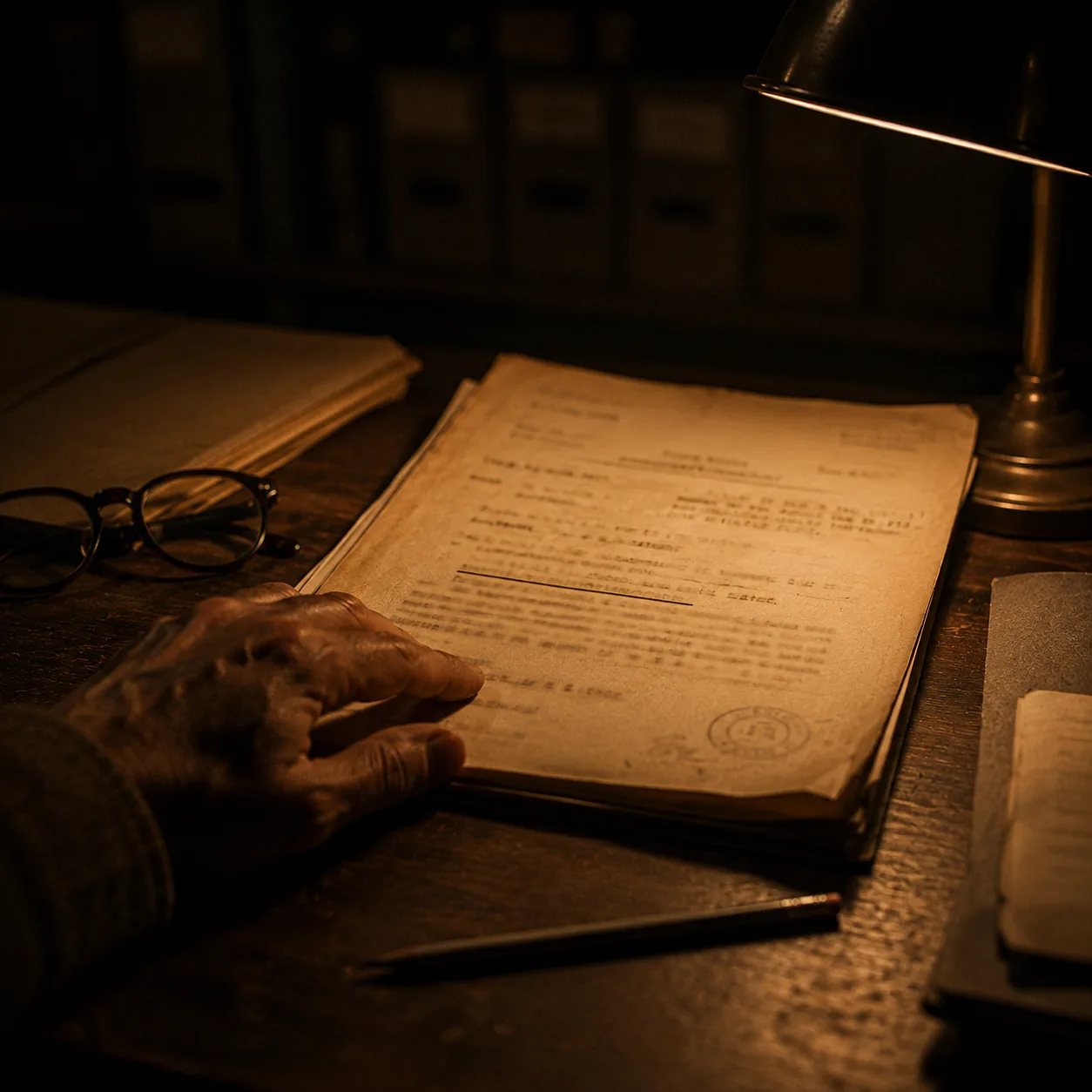
The Line That Changed the Story
Music for the moment a single discovered fact quietly rearranges everything that came before
The moment
The seconds after a single discovered fact is recognized but before it is explained — when the old version of a story quietly becomes impossible to hold.
Narrative function: The library's dedicated revelation beat: makes a discovered document, name or date land without announcing its importance, sitting after establishment and before interpretation.
Emotional subtext: Quiet destabilization — certainty becoming reconsideration, without drama, fear or thriller tension.
Scene fit:
- Documentary revelation sequence when a key document or fact contradicts the established story
- Investigative podcast beat when the journalist realizes the story is larger
- Video essay frame where a fact reframes what the audience understood
- Archive footage underlay when a name, date or signature doesn't fit the record
- Legal or biographical documentary when a record reveals a hidden connection
- Family archive when a letter or photograph changes what was believed
- Slow interview underlay when a subject names the fact that changed their understanding
What this music should do
Recommend for investigative, historical and biographical documentary and podcast on the discovery beat; place on the fact itself, not before (foreshadowing) or after (explanation), and do not duck during the reveal. Keep at -22 to -26 LUFS under narration. Steer away from thriller/true-crime suspense scoring, trailer climax and motivational uses.
What it must not do:
- Thriller, true-crime or suspense tension
- Mystery, conspiracy or approaching danger
- Dramatic orchestral announcement of importance
- Fear or shock
- Catharsis or resolution
Creator fit
Use for:
- Documentary revelation when a key document or fact contradicts the established story
- Investigative podcast realization beat
- Video essay moment where a historical or personal fact reframes everything before it
- Archive footage underlay when a name, date or image doesn't fit
- Legal or biographical documentary hidden-connection reveal
- Family archive storytelling when a document changes the story
- Slow interview underlay on the fact that changed a subject's understanding
- True-story narration between finding evidence and explaining it
Avoid for:
- trailer climax
- thriller or true-crime suspense scoring
- action or fast-paced sequence
- foreshadowing before the reveal
- motivational or corporate
- social short-form
Preview & download
Behind the track
Scene ideas, musical character and editing guidance from the original MCM54 track documents.
In the edit
- Notes for editor
This track lives in the seconds after recognition but before interpretation. Play it under the moment the fact appears — not before (where it would function as foreshadowing) and not after (where the story has already moved to explanation). The unresolved ending is intentional: allow the silence after the final suspended chord to remain before narration resumes. Never duck this track during the revelation itself — the music and the fact occupy the same emotional space. Use at -22 to -26 LUFS when narration is active; allow the full dynamic range during the 3-5 seconds of silence around the key document or image.
- Best for
documentary revelation sequence — a key document is found or a fact changes the timeline
investigative podcast moment when the journalist realizes the story is larger than expected
YouTube essay — the moment a historical or personal fact reframes everything before it
archive footage underlay — when a name, date or image contradicts the official story
legal or biographical documentary — a record reveals a hidden connection
family archive storytelling — a photograph or document changes what was believed
slow interview underlay — when the subject names the fact that changed their understanding
true-story narration — the beat between finding the evidence and explaining what it means
- Works after
establishing sequence of ordinary facts or background
narration setting up the story as it was understood before the discovery
interview subject describing events in a way that will soon be contradicted
archival footage of ordinary life before the revealed truth was known
- Works before
narrator explaining what the discovered fact means
interview subject reacting to the revelation
a second silence as the audience processes
a new chapter title card or date card
- Loop friendly
No
- Intro friendly
No
- Ending friendly
No
- Voiceover friendly 1 5
5
- Dialogue friendly 1 5
5
Musical character
- Genre
Cinematic Documentary
- Subgenre
Revelation Minimalism — Archival Documentary Score
- Main instruments
felted piano (primary — low and mid register, sparse)
nylon-string guitar (secondary — restrained fingerstyle responses)
muted chamber strings — violas and cellos (slow harmonic pressure)
soft upright bass (rare grounding tones only)
warm analog air and archival room tone (ambient texture)
- Texture
Sparse and weighted. Each phrase placed with deliberate intention. Long silences between instrumental statements. The room feels controlled and slightly airless — like a reading room, not a concert hall. Nothing fills space. Everything is placed.
- Mix character
Close and intimate. Warm analog realism with subtle tape grain. Natural stereo depth — not wide but present. Transparent midrange for narration. Restrained low end — the bass is weight, not pulse. No reverb excess — this is an indoor room, not a cathedral.
- Time signature
free / restrained rubato — no rhythmic pulse
Emotional arc
- Primary emotion
Quiet destabilization
- Secondary emotion
Archival gravity
- Story position
Revelation — the moment a single fact makes the old story impossible to hold
- Emotional arc
Apparent certainty dissolves into reconsideration. The arrangement opens in apparent stability, then small shifts enter almost imperceptibly until the floor has moved beneath the story. The piece does not resolve, because the revelation is not an ending. It is the moment the old version of events becomes insufficient.
Original arrangement brief
Original creative intent. Timings, tonal targets and mix instructions describe the written brief; individual audio takes may differ.
- Emotional profile
- Primary
Quiet destabilization
- Secondary
Archival gravity
- Arc type
Apparent stability dissolves into reconsideration — no resolution
- Listener journey
Certainty → Reconsideration
- Emotional temperature
Cool and controlled. The temperature of a reading room. Not cold — weighted.
- Arrangement stages
- Stage
1
- Name
The Document
- Duration approx
0:00–0:45
- Description
Felted piano alone. A simple restrained phrase appears with apparent stability — as though the story has always had a known shape. Long silences between phrases. The room feels official, quiet and controlled. Nothing announces what is about to change. The music accepts the old version of events.
- Instrumentation active
felted piano
- Density
near-zero
- Stage
2
- Name
Something Doesn't Fit
- Duration approx
0:45–1:40
- Description
Nylon guitar quietly enters with short sparse responses. The harmony begins to tilt almost imperceptibly — not toward suspense, but toward instability. Nothing announces the reveal. The music simply makes certainty feel slightly less solid. The guitar does not accompany the piano — it responds to it, cautiously.
- Instrumentation active
felted piano
nylon guitar
- Density
sparse
- Stage
3
- Name
The Floor Moves
- Duration approx
1:40–2:50
- Description
Muted chamber strings emerge beneath piano and guitar. Slow harmonic shifts create quiet destabilization. Dynamics rise only very slightly. The feeling should be that one fact has been placed on the table and everyone in the room understands — without speaking — that the story has changed. The strings create instability without threat.
- Instrumentation active
felted piano
nylon guitar
muted chamber strings
- Density
moderate-sparse
- Stage
4
- Name
Evidence on the Table
- Duration approx
2:50–3:45
- Description
A minimal melodic idea appears — fragmented and incomplete. Piano, guitar and strings do not resolve it. Each instrument contributes one careful piece of information. A soft upright bass note may appear once, grounding the room without rhythm. The arrangement should feel like evidence accumulating, each piece placed carefully, none of it explained.
- Instrumentation active
felted piano
nylon guitar
muted chamber strings
upright bass (rare)
- Density
moderate
- Stage
5
- Name
The Next Page
- Duration approx
3:45–4:15
- Description
Strings slowly thin out. Guitar disappears first. Piano remains with one final unresolved phrase, ending on a suspended minor harmony that does not answer the question it has raised. The silence after the final note should feel like the next page waiting to be turned — the story is not over. It has simply become something else.
- Instrumentation active
felted piano
muted chamber strings (fading)
warm analog air
- Density
near-zero
- Instrumentation roles
- Primary
- Instrument
Felted piano
- Role
The document being read. Each phrase is a sentence. Each silence is a pause before reading the next line. The piano does not interpret the document — it inhabits it.
- Priority
always-on
- Melodic content
Sparse measured phrases — low and mid register. No emotional arcs. No melodic runs. Phrases are placed, not performed.
- Forbidden
Emotional piano runs, ascending figures, sentimental voicings, bright upper-register passages, resolution cadences
- Secondary
- Instrument
Nylon-string guitar
- Role
The first sign that something doesn't fit. The guitar is the cautious reader who pauses, looks again, places a finger on the line that doesn't match. Short responses, never accompaniment.
- Priority
enters stage 2
- Melodic content
One or two restrained notes per response. No warmth. No melody. Subtle natural harmonics acceptable.
- Forbidden
Warm fingerpicking patterns, melodic focus, sentimental arpeggios, continuous accompaniment
- Harmonic pressure
- Instrument
Muted chamber strings — violas and cellos
- Role
The certainty quietly becoming unstable. The strings create harmonic pressure from below the acoustic instruments — they do not carry the melody, they shift the ground beneath it.
- Priority
enters stage 3
- Melodic content
Slow sustained harmonics — shifting between minor colors without resolution. No melodic lines.
- Forbidden
Lush string swells, orchestral drama, thriller-adjacent tension, bright violin passages, harmonic resolution
- Foundation
- Instrument
Soft upright bass
- Role
The weight of what the fact means. Appears once or twice in stage 4 — a low sustained note that grounds the room without creating rhythm or momentum.
- Priority
rare — maximum 1-2 appearances in stage 4
- Melodic content
Single sustained tones only — no movement, no pulse, no rhythm
- Forbidden
Rhythmic bass line, walking bass, pulse, momentum, anything that creates forward movement
- Space
- Instrument
Warm analog air and archival room tone
- Role
The room itself — a reading room, a file room, a quiet office where facts wait patiently. The ambient texture should feel like stillness around evidence, not atmosphere for atmosphere's sake.
- Priority
constant and subtle
- Melodic content
n/a
- Forbidden
Literal sound effects (ticking, paper sounds, ambient noise), theatrical atmosphere, too-present reverb
- Harmonic philosophy
- Key center
A minor
- Modal inflections
Aeolian primarily. Dorian (raised sixth — F# over A root) may appear briefly in stage 4 as the minimal melodic idea — suggesting a possibility that doesn't resolve.
- Chord movement
Very slow. Harmonic shifts happen over many bars. Preferred movement: Am — Am7 — Am add9 — Am sus2. No V-I cadences. No dominant resolution.
- Resolution policy
Never resolve. The piece ends on a suspended harmony. If a take produces a resolved ending — reject it.
- Forbidden intervals
perfect authentic cadence E–Am (too final, too traditional)
major third (too bright, too optimistic)
dominant seventh V chord used as harmonic tension (too theatrical)
- Preferred intervals
minor seventh — Am7, Am9 (ambiguity without drama)
open fifth — A–E (unresolved, spacious)
suspended second — Am sus2 (stable but unanswered)
minor second as gentle dissonance (instability without threat)
- Key production note
A minor must feel like reconsideration, not danger. If any harmonic choice sounds like a thriller or creates fear — it is wrong. The dissonances should feel like facts that don't align, not like threats approaching.
- Mix philosophy
- Stereo field
Moderate — natural indoor space. Not wide ambient. Not mono. The listener should feel present in a room, not surrounded by landscape.
- Reverb character
Short to medium — 1.5 to 2.5 seconds. Natural room decay. Pre-delay: 15–25ms. The reverb should feel like an interior space — not a cathedral, not a concert hall. A quiet office or reading room.
- Frequency balance
Restrained low end — present but not boomy. Transparent midrange (500Hz–3kHz clear for narration). Gentle upper presence (6–10kHz) — the analog warmth. No excessive sub-bass. No high-frequency harshness.
- Dynamic range
Moderate-wide. Quiet moments must be genuinely quiet. Loudness target: -18 LUFS integrated. Allow -22 to -26 LUFS when under active narration.
- Headroom for narration
Always. This is a voiceover-first track. Full dynamic headroom throughout. The music never competes — it coexists beneath narration at all times.
- Dynamics philosophy
- Overall level
Restrained throughout. The music does not fill space — it occupies it carefully.
- Movement type
Very slow gradual shifts. No sudden changes. No crescendos that announce themselves.
- Peak policy
No sudden peaks. Any increase in volume happens over a minimum of 20 seconds.
- Silence policy
Silence between phrases is composed, not accidental. Do not fill gaps. Gaps are where the fact lands.
- Compression policy
Minimal compression. No limiting. Preserve soft transients of felted piano. Organic acoustic dynamics throughout.
- Listener outcome
- Intended feeling
Reconsideration — awareness that a single quiet fact has changed the shape of the story
- Not intended
Suspense or fear
Thriller excitement
Dramatic emotional impact
Catharsis or resolution
The sense that something dangerous is approaching
- Best descriptor
The floor has moved slightly beneath the story — without anyone announcing it
License
Use any track in your videos, podcasts, films and narrated projects — including monetized ones. Credit MCM54 where your platform allows: video description, show notes, end credits or project credits. Do not resell, re-upload, or register the tracks with Content ID. Downloads you have already made keep their license even if these terms later change.
Credit line: Music: MCM54 — mcm54.com