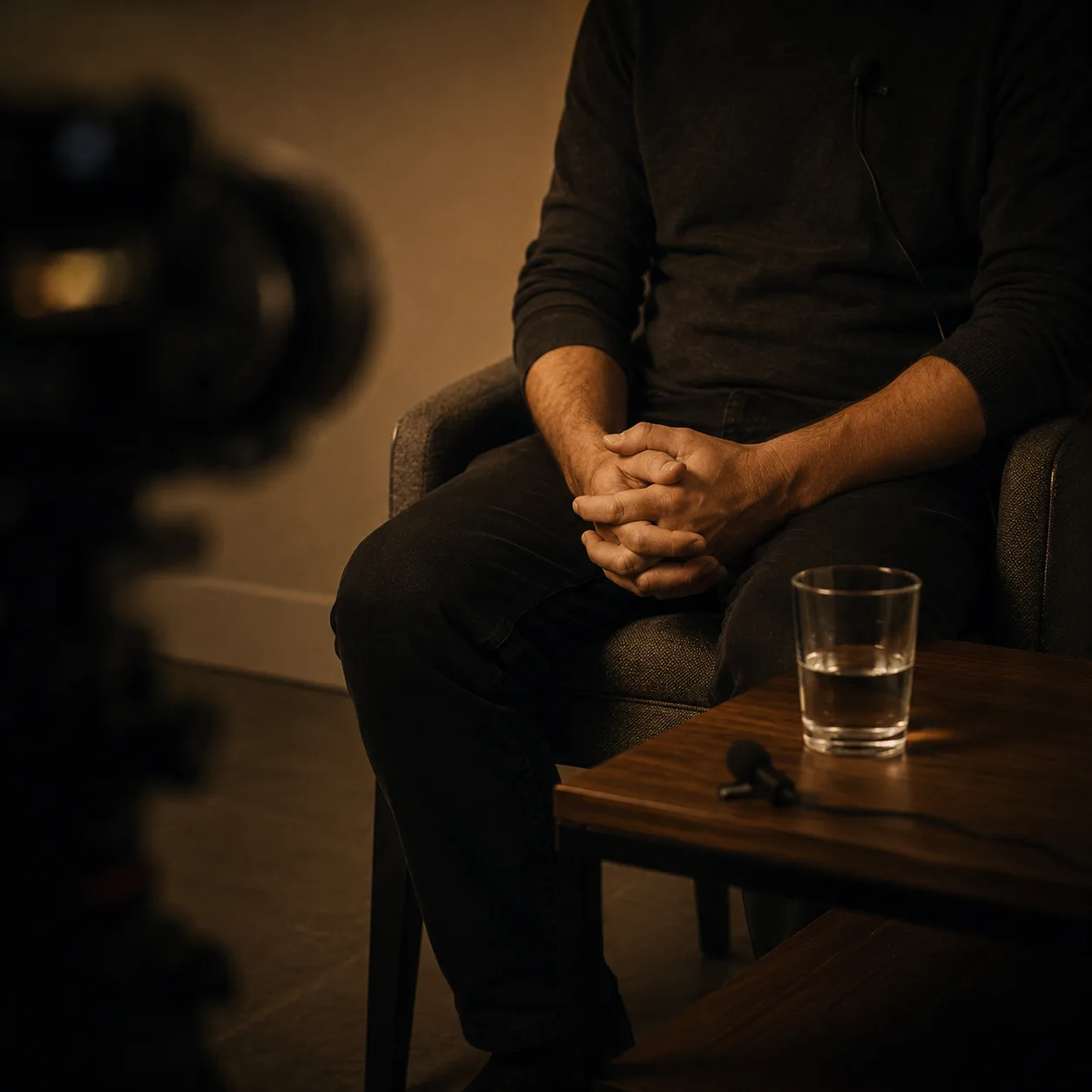
The Chair Across From the Camera
Music for the moment someone speaks about what they survived, and the room learns how to listen.
The moment
A person sits across from the camera, microphone on, choosing words carefully about something they survived, while the room learns how to listen.
Narrative function: Testimony support that protects the space around a voice; it stays quietest when the voice speaks most, never leading or intensifying the scene.
Emotional subtext: Ethical attention and reverence for the act of speaking — presence that holds a testimony without interpreting it.
Scene fit:
- Documentary interview about what a subject survived or experienced
- Oral history recorded for archive, family memory or institutional record
- Human rights film with a witness or survivor speaking
- Narrative podcast guest sharing a life-defining experience with pauses
- Personal essay documentary narrated from lived experience
- Family archive testimony never fully said before
- Educational documentary using testimony as primary source
What this music should do
Recommend for survivor testimony, oral history and interview-driven documentary and podcast where restraint is an ethical requirement; run under speech at -28 to -32 LUFS, never swell at emotional moments (reduce instead), and loop stages 2-4 for interviews of variable length. Steer away from sad-piano, trauma, inspirational, trailer and motivational uses.
What it must not do:
- Pity or the speaker as a victim
- Trauma dramatized or classified by the music
- Triumph, inspiration or survival-as-heroism
- Sadness produced for the audience
- Catharsis, resolution or emotional instruction
Creator fit
Use for:
- Documentary interview about what a subject survived
- Oral history recording for archive or family memory
- Human rights film witness or survivor testimony
- Narrative podcast guest sharing a life-defining experience
- Personal essay documentary narrated from lived experience
- Family archive storytelling of something never fully said
- Educational documentary using testimony as primary source
- Biographical interview describing who a subject was before change
Avoid for:
- trailer climax
- trauma or thriller dramatization
- inspirational or triumph payoff
- sad-piano interview cue
- action or fast-paced sequence
- motivational or corporate
- social short-form
Preview & download
Behind the track
Scene ideas, musical character and editing guidance from the original MCM54 track documents.
In the edit
- Notes for editor
This track is designed to underlie speaking — never to replace it or lead it. The correct level under active testimony is -28 to -32 LUFS, leaving the voice fully in front. The loop_friendly flag is true: the main body (stages 2–4) sustains naturally for interviews of variable length. Never swell the music at an emotional moment in the testimony — if anything, reduce the level slightly when the speaker reaches the most important words, allowing the voice to be fully unaccompanied at the most significant moment. The music earns its presence by staying quiet when the voice speaks most.
- Best for
documentary interview — a subject speaking on camera about what they survived or experienced
oral history — recorded testimony for archive, family memory or institutional record
human rights film — a witness or survivor speaking about events that shaped or ended lives
narrative podcast — a guest sharing a life-defining experience with care and pauses
personal essay documentary — a person narrating their own story from lived experience
family archive storytelling — a family member speaking about something that was never fully said before
educational documentary — testimony as primary source, voice as evidence
biographical film — a subject in interview describing who they were before something changed them
- Works after
contextual establishment of who the person is and what the documentary is about
archival photographs or footage of the person's life before testimony begins
a title card introducing the speaker
a moment of quiet before the first words are spoken
- Works before
return to archive material or contextual footage after testimony
narration that reflects on what the person said
a chapter transition after the testimony sequence ends
silence or a natural cut to another scene
- Loop friendly
Yes
- Intro friendly
No
- Ending friendly
No
- Voiceover friendly 1 5
5
- Dialogue friendly 1 5
5
Musical character
- Genre
Cinematic Documentary
- Subgenre
Testimony Minimalism — Ethical Interview Score
- Main instruments
felted piano (primary — sparse, careful, placing presence)
nylon-string guitar (secondary — short human responses, never leading)
muted chamber strings — violas and cellos (slow transparent warmth, widening gently)
soft upright bass (rare grounding tones only)
warm analog air and natural room resonance (intimate interview space)
- Texture
Sparse and deeply patient. The music occupies space the way a respectful listener occupies a room — present, quiet, making space for whoever is speaking. Long silences between phrases are essential, not accidental. The texture of deep attention.
- Mix character
Very close and intimate. The listener is in the room with the speaker. Warm analog realism with natural room resonance. Transparent midrange — this is the most voiceover-critical track in the library. Nothing in the frequency range of speech (200Hz–4kHz) may compete with the voice. Soft transients throughout.
- Time signature
free / very slow rubato — no rhythmic pulse, breathing tempo
Emotional arc
- Primary emotion
Ethical attention
- Secondary emotion
Reverence for the act of speaking
- Story position
Testimony — the act of putting words around something that shaped a life
- Emotional arc
The music does not arc. It deepens in presence without building toward catharsis or resolution. It begins as permission for silence and ends as honor for the voice that chose to remain. Nothing resolves because testimony does not resolve — it continues to be held.
Original arrangement brief
Original creative intent. Timings, tonal targets and mix instructions describe the written brief; individual audio takes may differ.
- Emotional profile
- Primary
Ethical attention
- Secondary
Reverence for the act of speaking
- Arc type
No arc — sustained presence that deepens without building. The room learns to listen; it does not conclude.
- Listener journey
Attention → Reverence
- Emotional temperature
Warm but not soft. The temperature of a room that holds something serious without flinching. Present, careful, still.
- Arrangement stages
- Stage
1
- Name
The Microphone Is On
- Duration approx
0:00–0:55
- Description
Felted piano alone. Very sparse notes surrounded by silence. The music enters almost as permission for the room to become quiet — as if acknowledging that something important is about to be said without announcing it. Nothing asks for attention. The piano places one or two careful tones and waits. This is the moment before the first word.
- Instrumentation active
felted piano
- Density
near-zero
- Stage
2
- Name
The Room Makes Space
- Duration approx
0:55–1:50
- Description
Nylon guitar enters with short incomplete responses. The piano and guitar leave large spaces between phrases — spaces large enough for a speaker who may pause before continuing, who may need a moment before the next sentence. Neither instrument leads. Neither instrument comments on the testimony. Together they simply hold the room open.
- Instrumentation active
felted piano
nylon guitar
- Density
sparse
- Stage
3
- Name
The Room Learns to Listen
- Duration approx
1:50–2:55
- Description
Muted chamber strings slowly emerge beneath piano and guitar. Warmth and gravity increase slightly — the room has been shaped by what is being said. But the music must remain transparent, humble and voiceover-first at all times. No swell. No emotional instruction. No climax. The strings widen the acoustic space gently, as if making the room larger and quieter at once.
- Instrumentation active
felted piano
nylon guitar
muted chamber strings
- Density
moderate-sparse
- Stage
4
- Name
Presence Not Melody
- Duration approx
2:55–3:45
- Description
A minimal fragile motif appears, shared gently between piano and strings. It should feel like presence, not melody — support, not commentary. The motif does not develop. It does not repeat as a recognizable theme. It appears as if the room itself has become slightly more acoustically resonant around the voice. A rare upright bass note may ground the moment once, quietly. The arrangement remains patient throughout.
- Instrumentation active
felted piano
muted chamber strings
nylon guitar (fading)
upright bass (rare)
- Density
moderate
- Stage
5
- Name
The Camera Is Still Recording
- Duration approx
3:45–4:15
- Description
Strings thin out gradually. Guitar disappears without a final gesture — not a conclusion, simply an absence. Piano remains with a final quiet unresolved phrase. The ending should feel like the camera is still recording and the room is still honoring the voice. The last sound is the sustained decay of an unresolved chord — not a statement, but a continued presence. Silence after the final note should feel like the room holding what was said.
- Instrumentation active
felted piano
muted chamber strings (fading)
warm analog air
- Density
near-zero
- Instrumentation roles
- Primary
- Instrument
Felted piano
- Role
Placing a glass of water beside the speaker. The piano is not performing — it is serving. Each phrase is as small as it needs to be to maintain presence without becoming a presence that competes with the voice.
- Priority
always-on
- Melodic content
Sparse careful phrases — low and mid register. No melodic development. No arc. Small, placed gestures surrounded by silence.
- Forbidden
Expressive piano playing, sentimental voicings, warm melodic runs, emotional crescendo, anything that would draw attention to the music rather than toward the voice
- Secondary
- Instrument
Nylon-string guitar
- Role
The careful listener who makes space for pauses. Short responses that acknowledge what was said without interpreting it. The guitar is the attentive listener in the room — not the therapist, not the audience, not the narrator.
- Priority
enters stage 2
- Melodic content
Short incomplete responses — one or two notes, a harmonic, then space. Never lyrical. Never warm or reassuring in a way that would redirect attention from the voice.
- Forbidden
Lyrical or melodic passages, warm accompaniment, sentimental fingerpicking, anything that sounds like comfort being offered
- Space
- Instrument
Muted chamber strings — violas and cellos
- Role
The room widening to hold the voice. The strings do not interpret the testimony. They create the acoustic condition in which something serious can be said and heard without distortion. They are the room learning to listen.
- Priority
enters stage 3
- Melodic content
Slow sustained harmonics — transparent warmth and gravity without direction. Open intervals. No melodic content. No harmonic movement toward sadness or hope.
- Forbidden
String swells, emotional crescendo, tragic or heroic string passages, sentimental vibrato, any sound that would classify the testimony as sad, triumphant or resolved
- Grounding
- Instrument
Soft upright bass
- Role
The weight of what is being said. A single rare sustained tone grounds the room in the physical reality of the moment — a person, a chair, a voice, a room. Not rhythm. Not pulse. Presence.
- Priority
rare — maximum 1 appearance in stage 4
- Melodic content
One sustained low tone only. No movement. No rhythm.
- Forbidden
Rhythmic bass movement, pulse, forward motion, anything that creates energy or momentum
- Room
- Instrument
Warm analog air and natural room resonance
- Role
The interview room itself — its acoustic presence, its warmth, the faint quality of being in a space where something important is being said. Not atmosphere for decoration. The physical room that holds the voice.
- Priority
constant and very subtle
- Melodic content
n/a
- Forbidden
Literal documentary sounds, room ambience that calls attention to itself, reverb that makes the space feel large or theatrical rather than intimate and close
- Harmonic philosophy
- Key center
D minor
- Modal inflections
Aeolian primarily. No Dorian (raised sixth would suggest optimism or possibility — premature in a testimony context). No Phrygian (flat second creates darkness and threat — wrong for ethical presence). Stay in pure Dm Aeolian but avoid every conventional D minor cliché.
- Chord movement
Extremely slow. Dm — Dm7 — Dm add9 — Dm sus2. Movement between these voicings only, over many bars. No cadences. No direction toward resolution or darkness.
- Resolution policy
Never resolve. Testimony does not resolve — it is held. The music reflects this. If a take produces harmonic resolution — reject it immediately.
- Forbidden intervals
perfect authentic cadence A–Dm (too final — implies the testimony has ended and been judged)
descending minor scale figure (classic tragedy cliché — tells the audience this is sad)
major third above root (F# over D — too bright, would suggest the testimony leads somewhere hopeful)
rising sixth or octave leap (too declarative, too heroic)
- Preferred intervals
open fifth D–A (spacious, unresolved, present)
minor seventh Dm7 (gravity without darkness)
suspended second Dm sus2 (held, patient, open)
minor ninth (the weight of something that continues beyond the frame)
- Key production note
D minor must feel like held presence — neither sad nor resolved nor hopeful. Any take where D minor sounds like a film score for tragedy has failed. Any take where D minor sounds like it is moving toward emotional resolution has failed. The harmonic language should make the listener feel that the room is holding something that cannot be simplified.
- Mix philosophy
- Stereo field
Moderate and close — the intimate width of an interview room. The listener sits across from the speaker. Not wide ambient. Not mono. Present and still.
- Reverb character
Very short — 0.8 to 1.2 seconds. The acoustic of a quiet interior room — not a concert hall, not a reverberant space. The interview room has soft surfaces, perhaps curtains, a low ceiling. Close.
- Frequency balance
Extreme transparency in midrange (200Hz–4kHz) — this is the frequency range of the human voice. Nothing in this range may compete with speech. Warm low-mid presence below the voice. Gentle analog air above. This is the most voiceover-critical mix in the library.
- Dynamic range
Wide. Quiet moments must be genuinely quiet. Loudness target: -18 LUFS integrated. Under active testimony: -28 to -32 LUFS. The music must be nearly inaudible during the most important spoken moments.
- Headroom for narration
Maximum. This track was designed for testimony underlay — the voice is always, always in front. The music earns its presence by making the voice more audible, not less.
- Dynamics philosophy
- Overall level
Very quiet. Quieter than any other track in the library. The music does not fill space — it protects it.
- Movement type
Imperceptibly slow. If dynamics increase anywhere, it should happen so gradually and gently that the listener cannot identify when it occurred.
- Peak policy
No peaks. If anything, the music becomes slightly quieter when the testimony reaches its most significant moment, allowing the voice to be fully exposed at the instant it most needs to be heard.
- Silence policy
Silence is the primary element of this track. Every phrase lives inside silence. The music does not fill the gaps — the gaps are where the voice goes. Never fill a silence.
- Compression policy
Minimal. No limiting. Preserve the natural dynamics of the felted piano. The quiet passages must be genuinely quiet. The loudness variance should be wide.
- Listener outcome
- Intended feeling
Reverence — a quieter, more responsible kind of attention. The listener feels that listening is not passive and that some voices deserve a room that holds them.
- Not intended
Sadness or pity directed at the speaker
Inspiration derived from the speaker's survival
Emotional catharsis produced by the music
The sense of consuming someone else's pain
Any feeling produced by the music rather than by the testimony itself
- Best descriptor
The room is still honoring the voice that chose to stay.
License
Use any track in your videos, podcasts, films and narrated projects — including monetized ones. Credit MCM54 where your platform allows: video description, show notes, end credits or project credits. Do not resell, re-upload, or register the tracks with Content ID. Downloads you have already made keep their license even if these terms later change.
Credit line: Music: MCM54 — mcm54.com