The First Question on the Table
Music for the moment an investigation begins, before answers, accusations, or certainty arrive.
The moment
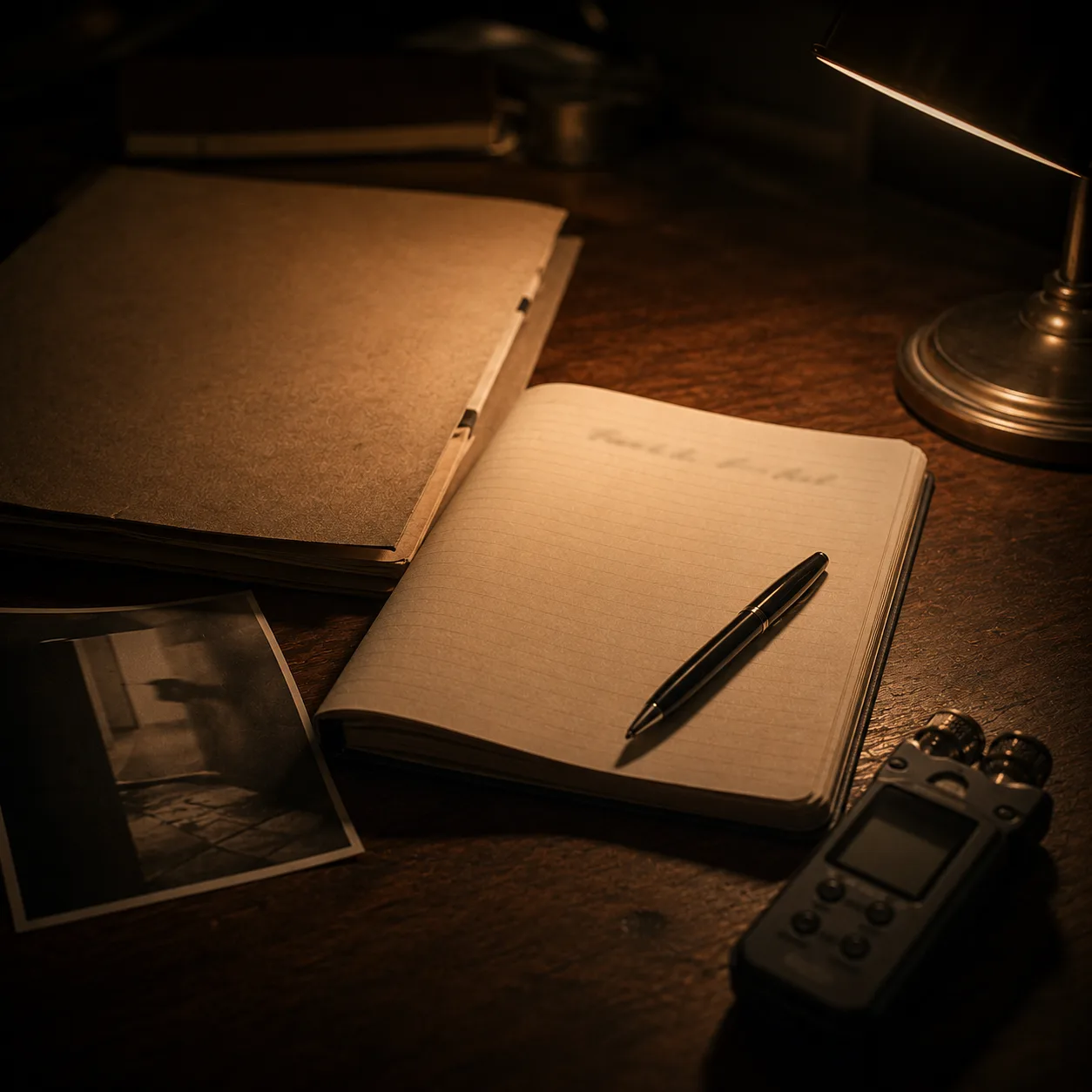
A person at a desk at night opens a closed folder and writes one careful question at the top of a blank page — the moment curiosity becomes a committed inquiry.
Narrative function: The library's opening-investigation cue: sets a serious, focused tone for the start of a documentary inquiry while refusing to prejudge the story or imply a suspect.
Emotional subtext: Disciplined attention — the quiet gravity of deciding to look, without fear, suspicion or danger.
Scene fit:
- Investigative documentary opening before the story unfolds
- Narrative podcast where a narrator sets up the central question
- Video essay opening beat for a careful examination
- Legal storytelling as a researcher opens the first document
- Political documentary committing to investigate a system or event
- Historical inquiry when a researcher notices the record is incomplete
- Family mystery, deciding to look into an unexplained past
What this music should do
Recommend as an opening cue for investigative, legal, political and historical documentary and podcast that must feel serious but not suspenseful; loop stages 2-4 under narration over documents, keep at -24 to -28 LUFS and reduce (never swell) as the central question is spoken. Steer away from true-crime/thriller scoring, trailer climax and motivational uses.
What it must not do:
- Suspense, danger or thriller energy
- True-crime, detective or conspiracy atmosphere
- Implied guilt or making a subject feel like a suspect
- Chase, urgency or panic
- The satisfaction of a mystery being solved
Creator fit
Use for:
- Investigative documentary opening sequence
- Narrative podcast setting up the central question of a long-form inquiry
- Video essay opening beat for a careful examination
- Legal storytelling opening the first document in a case
- Political documentary committing to investigate a system or event
- Historical inquiry when the official record looks incomplete
- Journalistic series with a journalist alone with documents
- Family mystery, deciding to look into an unexplained past
- Biographical documentary beginning to research a life
Avoid for:
- trailer climax
- true-crime or thriller scoring
- detective or conspiracy mood
- action or chase sequence
- motivational or corporate
- social short-form
Preview & download
Behind the track
Scene ideas, musical character and editing guidance from the original MCM54 track documents.
In the edit
- Notes for editor
This is the library's opening-investigation cue. Unlike every available true-crime or detective cue, it is built around ethical curiosity rather than suspense or danger. Use it when the story is beginning to ask a question, not when a threat has been established. The loop window (stages 2–4) is especially useful for narration sequences over archival documents or photographs where the duration is unknown. Never swell this track at the moment the narrator poses the central question — reduce the level slightly so the spoken question lands clearly without musical underlining.
- Best for
investigative documentary — the opening sequence before the investigation unfolds
narrative podcast — a narrator sets up the central question of a long-form inquiry
YouTube essay — the opening beat of an essay that will examine something carefully
legal storytelling — a lawyer or researcher opening the first document in a case
political documentary — the moment a filmmaker commits to investigating a system or event
historical inquiry — a researcher noticing that the official record is incomplete
journalistic series — a journalist alone with documents at the start of a long investigation
family mystery — a person deciding to look into a story from the past that was never explained
biographical documentary — a filmmaker beginning to research a life that raises questions
- Works after
an establishing sequence showing the world before the investigation begins
context about why this story matters and who is asking the question
a title card announcing the documentary or series name
a brief statement of what is not yet known
- Works before
the first interview or piece of evidence presented in the investigation
archival footage or documents introduced as the investigation deepens
a chapter title marking the transition from setup to inquiry
INST-017 (The Chair Outside the Answer) — if the investigation leads to a waiting period
INST-016 (The Line That Changed the Story) — if the investigation leads to a revelation
INST-018 (The Chair Across From the Camera) — if the investigation leads to testimony
- Loop description
Stages 2–4 loopable for extended documentary opening sequences, extended narration over documents, or research montages of variable length.
- Loop friendly
Yes
- Intro friendly
Yes
- Ending friendly
No
- Voiceover friendly 1 5
5
- Dialogue friendly 1 5
5
Musical character
- Genre
Cinematic Documentary
- Subgenre
Inquiry Minimalism — Ethical Investigative Score
- Main instruments
felted piano (primary — sparse, precise, the written question)
nylon-string guitar (secondary — short thoughtful responses, never rhythmic)
muted chamber strings — violas and cellos (slow transparent harmonic focus, room widening)
soft upright bass (rare grounding tones — serious, never pulsing)
warm analog air and archival room resonance (the desk, the lamp, the night)
- Texture
Sparse and focused. The music has the quality of disciplined attention — it does not wander, does not rush, does not dramatize. Long silences between phrases. The texture of a person thinking carefully before writing the next word.
- Mix character
Warm analog realism. Intimate and close — the listener is at the desk, not in a theater. Transparent midrange for voiceover. Minimal compression. The archival stillness of a quiet night and an open file.
- Time signature
free / slow rubato — no rhythmic pulse, phrases breathe at the pace of thought
Emotional arc
- Primary emotion
Disciplined attention
- Secondary emotion
The gravity of beginning — the moment curiosity becomes responsibility
- Story position
The opening of inquiry — the first written question, the closed folder turning open, the decision to look
- Emotional arc
The music does not build toward revelation or catharsis. It gathers focus. It begins with the stillness of a blank page and widens, slowly, into the seriousness of a question that has been committed to. The ending leaves the question open — the investigation has started but answered nothing.
Original arrangement brief
Original creative intent. Timings, tonal targets and mix instructions describe the written brief; individual audio takes may differ.
- Emotional profile
- Primary
Disciplined attention
- Secondary
The gravity of the decision to look
- Arc type
Gathering focus — the arrangement widens from blank page to committed inquiry without building toward tension, catharsis or resolution.
- Listener journey
Uncertainty → Focused attention
- Emotional temperature
Cool and quiet at the start — the stillness of a desk at night. Slowly warmer as the investigation becomes real. Always restrained, never dramatic. The temperature of careful thought.
- Arrangement stages
- Stage
1
- Name
The Blank Page
- Duration approx
0:00–0:50
- Description
Felted piano alone. A few precise notes surrounded by silence. The music should feel like a blank page before the first question is written — the room quiet, the folder still closed, the decision to open it not yet made. No tension. Only concentration. The music is as still as a person pausing with a pen above a page.
- Instrumentation active
felted piano
- Density
near-zero
- Stage
2
- Name
The First Question Written
- Duration approx
0:50–1:45
- Description
Nylon guitar enters with short, restrained responses. Piano and guitar together should feel like thought beginning to organize itself — the first question has been written, and the mind is now tracing its edges. The harmony suggests incompleteness without suggesting darkness. There is no implied threat. There is only the sense of something that needs to be followed.
- Instrumentation active
felted piano
nylon guitar
- Density
sparse
- Stage
3
- Name
The Act of Looking Becomes Real
- Duration approx
1:45–2:55
- Description
Muted chamber strings slowly emerge beneath piano and guitar. The room widens. The music develops quiet momentum — the investigation has become real, the commitment has been made, the folder is open. But the momentum must never become suspense, accusation or investigative cliché. The music should feel like the act of looking becoming serious — not the discovery of something frightening, but the discovery that looking requires care.
- Instrumentation active
felted piano
nylon guitar
muted chamber strings
- Density
moderate-sparse
- Stage
4
- Name
The Mind Returns to the Question
- Duration approx
2:55–3:45
- Description
A minimal focused motif appears, repeated gently as the mind returns to the same question. Each repetition should feel more intentional, not more tense. This is not suspense repetition — it is the pattern of thought returning to an unresolved problem. The investigation has not answered the first question yet. The motif reflects this: it circles back to the same starting point, each time with slightly more commitment. The arrangement remains restrained, precise and fully voiceover-friendly throughout.
- Instrumentation active
felted piano
muted chamber strings
nylon guitar (fading)
upright bass (rare)
- Density
moderate
- Stage
5
- Name
The Folder Is Open
- Duration approx
3:45–4:15
- Description
Strings gradually thin. Guitar fades first — not as a conclusion but as a quiet disappearance, the way a second thought recedes when the central question becomes clear. Piano remains with one unresolved phrase. The ending should feel like the folder is open, the recorder has not yet been turned on, and the investigation is only beginning. The question is still on the table. Nothing has been answered.
- Instrumentation active
felted piano
muted chamber strings (fading)
warm analog air
- Density
near-zero
- Instrumentation roles
- Primary
- Instrument
Felted piano
- Role
The question written at the top of a blank page. The piano is not performing, not searching dramatically — it is thinking. Each phrase is as precise as a word chosen carefully. Sparse, measured, surrounded by silence.
- Priority
always-on
- Melodic content
Precise sparse phrases in mid and low register. Deliberate touch. No melodic development — the phrases return to the same question rather than advancing to an answer.
- Forbidden
Suspense piano, atmospheric moody playing, sentimental voicings, lyrical runs, emotional performance, anything that sounds like detective music or film noir
- Secondary
- Instrument
Nylon-string guitar
- Role
The thought beginning to organize itself. Short responses that are not conclusions — qualified observations, second thoughts, the mind testing an idea before committing to it. The guitar is the investigator thinking, not the investigation revealing.
- Priority
enters stage 2
- Melodic content
Short restrained responses — a few notes, a harmonic, then space. Never melodic, never rhythmic, never warm in a way that would reduce the gravity of the moment.
- Forbidden
Rhythmic playing, groove, warm melodic accompaniment, fingerpicking patterns that sound like music rather than thought, anything that creates comfort rather than focus
- Space
- Instrument
Muted chamber strings — violas and cellos
- Role
The room widening as the investigation becomes real. The strings create the harmonic space in which a serious question can exist — they do not answer it, point toward it or dramatize it. They make the room serious enough to hold it.
- Priority
enters stage 3
- Melodic content
Slow sustained harmonics — transparent, focused, without direction. Open intervals preferring Em7, Em sus2, Am. No harmonic movement toward resolution or darkness.
- Forbidden
String swells, accusatory dissonance, thriller harmonics, vibrato, expressive playing, any string gesture that implies danger or imminent revelation
- Grounding
- Instrument
Soft upright bass
- Role
The seriousness of the decision to look. A single rare sustained tone that anchors the investigation in something real — not a threat, not a pulse, but the weight of a commitment made. The body at the desk. The gravity of responsibility.
- Priority
rare — one or two appearances in stage 4 only
- Melodic content
Single sustained low tone only. No movement. No rhythm. No pulse.
- Forbidden
Grooved bass movement, investigative rhythm, thriller pulse, ticking implication, any sense of forward momentum created by the bass rather than by the overall arrangement
- Room
- Instrument
Warm analog air and archival room resonance
- Role
The desk at night. The small pool of lamplight. The closed folder before it is opened. The recorder not yet on. The atmosphere is not theatrical or mysterious — it is the quiet intimacy of a person alone with a question.
- Priority
constant and very subtle
- Melodic content
n/a
- Forbidden
Literal sound effects (paper sounds, clock ticking, typing), atmospheric textures that imply conspiracy or danger, reverb that makes the space feel large or theatrical
- Harmonic philosophy
- Key center
E minor
- Modal inflections
Primarily natural minor / Aeolian. The Dorian mode (raised sixth, C# over E) is permissible here — unlike INST-017 and INST-018 where Dorian implies relief or optimism, in an inquiry context the raised sixth creates a sense of analytic clarity rather than emotional hope. Use sparingly. Avoid Phrygian (flat second creates threat). Avoid harmonic minor (raised seventh creates too much direction and drama).
- Chord movement
Slow and deliberate. Em — Em7 — Em sus2 — Am — Em. Movement is unhurried and circular, not directional. The harmony keeps returning to the same starting point, reflecting the mind returning to the first unanswered question.
- Resolution policy
Never fully resolve. The investigation has not concluded. If a take produces harmonic resolution — reject.
- Forbidden intervals
tritone B–F natural (too thriller-coded — this interval signals danger in conventional scoring)
diminished seventh chord (conspiracy and horror convention)
descending chromatic bass line (classic thriller cliché)
perfect authentic cadence B–Em with full resolution (too final — the investigation is still open)
ascending octave leap in high piano register (too declarative, too heroic)
- Preferred intervals
open fifth E–B (spacious, patient, unresolved)
minor seventh Em7 (focus without darkness)
suspended second Em sus2 (the question held open)
minor fourth E–A (gravity without threat)
Dorian sixth C# used sparingly (analytic clarity)
- Key production note
E minor must feel like a focused mind, not a dangerous room. Any take where E minor sounds like a thriller has failed. The harmonic language should suggest that something requires careful attention — not that something frightening is about to happen. If a listener hearing only the harmony would say 'something bad is coming,' the generation failed.
- Mix philosophy
- Stereo field
Moderate — the intimate width of a quiet office or study at night. Not wide ambient. Not mono. The listener is at the desk, not in a large space.
- Reverb character
Short to medium — 1.0 to 1.5 seconds. The acoustic of a quiet room with books and papers. Not a large reverberant space. Close, still, interior.
- Frequency balance
Transparent midrange for voiceover. Warm low-mid presence. The mix should feel close and intelligent — like a well-lit desk rather than a dark room. This is the only investigative track in the library with a 'lit' feeling — it is not dark or atmospheric.
- Dynamic range
Wide. Quiet moments must be genuinely quiet. Loudness target: -18 LUFS integrated. Under narration: -24 to -28 LUFS.
- Headroom for narration
High. This track is used under investigative narration — the voice of a journalist, narrator or filmmaker introducing the central question. The voice must always lead.
- Dynamics philosophy
- Overall level
Quiet but present. Unlike INST-018, which is the quietest track in the library, INST-019 has a slightly more present feel — the investigation requires focus, and the music reflects this by being slightly more audible. The listener should be aware of the music while still being led by the narration.
- Movement type
Gradually gathering. The arrangement builds focus rather than tension — each stage adds slightly more presence without adding drama.
- Peak policy
No peaks. Forward momentum must come from accumulating focus, not from dynamic peaks. The highest point of the track should still feel quiet and disciplined.
- Silence policy
Essential but less absolute than INST-018. The silences in this track have the quality of deliberate pauses in thought — not the deep silence of honoring a voice, but the productive silence of a mind considering a question.
- Compression policy
Minimal. Preserve the natural dynamic range of the felted piano. The quiet moments must feel genuinely still.
- Listener outcome
- Intended feeling
Focused attention — the quiet seriousness of beginning to ask a question that may not let the story stay simple.
- Not intended
Suspense or anticipation of danger
Excitement or thriller energy
The feeling that a guilty party is about to be named
The pleasure of a mystery being solved
Fear or unease directed at anyone in the story
- Best descriptor
The investigation has not answered anything yet — it has only begun to look.
License
Use any track in your videos, podcasts, films and narrated projects — including monetized ones. Credit MCM54 where your platform allows: video description, show notes, end credits or project credits. Do not resell, re-upload, or register the tracks with Content ID. Downloads you have already made keep their license even if these terms later change.
Credit line: Music: MCM54 — mcm54.com