The Last Thing I Put Down
Music for the quiet moment someone stops carrying what cannot be changed.
The moment
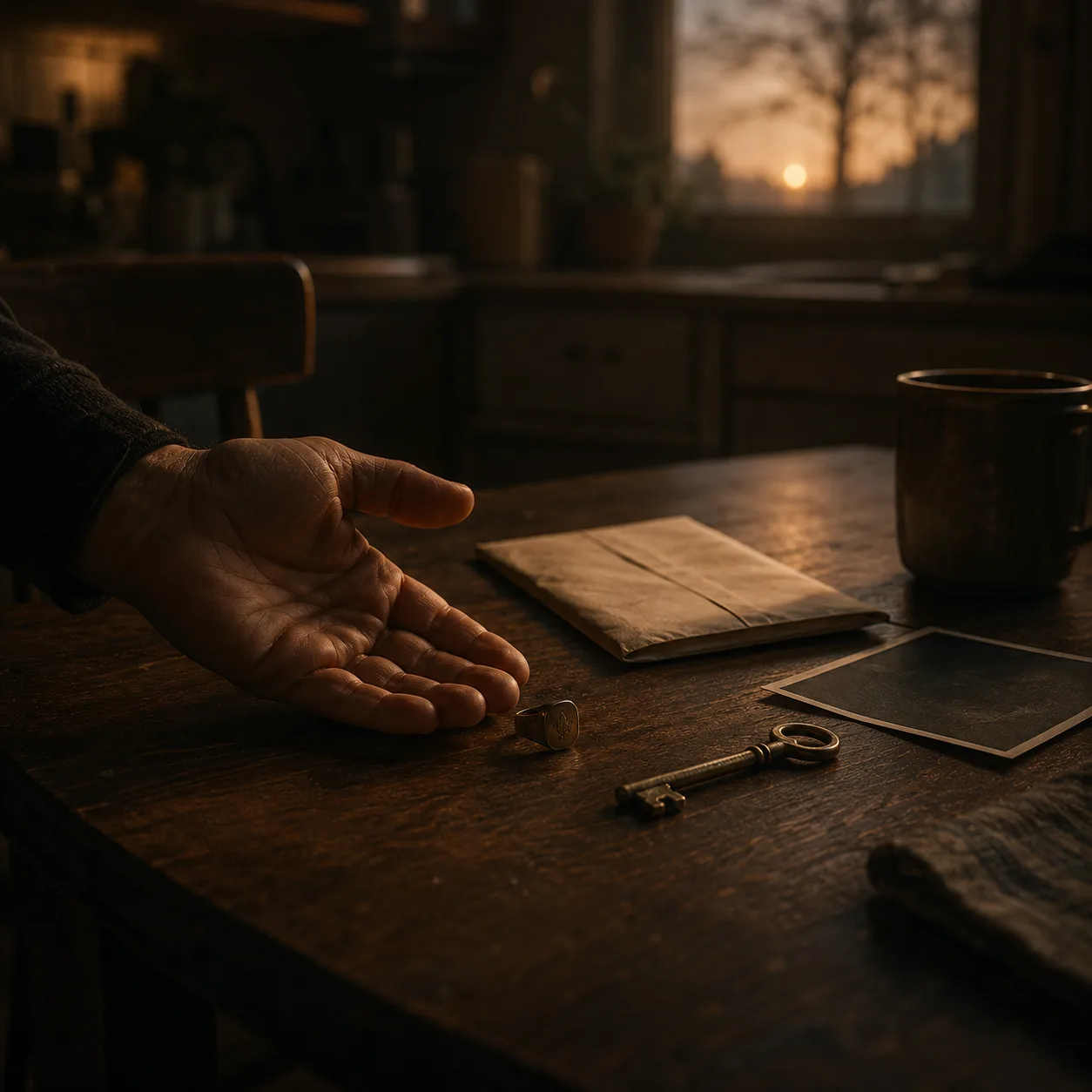
A private moment at a kitchen table before sunrise when a person stops carrying what cannot be changed — the hand opening, the object placed down and left there.
Narrative function: The library's dedicated closing-scene cue: ends a scene, chapter or film on release without resolution, holding a complex final statement without interpreting it.
Emotional subtext: Quiet release and unfinished acceptance — the weight is down, the past remains real, only the grip has changed.
Scene fit:
- Documentary ending where a subject has accepted what cannot be changed
- Memoir film closing sequence that ends in release rather than resolution
- Personal essay documentary arriving at an honest, un-peaceful place
- Survivor-centered narrative final scene of choosing not to live in anger
- Legal or investigation aftermath reflection after a case ends
- Family-history closing about a loss or decision accepted
- Biography final chapter of a life ending in settled truth
What this music should do
Recommend as a closing beat for documentary, memoir and personal-essay endings that must feel released but not resolved; align the stage 1 to stage 3 opening with a narrator moving from what was carried to what was put down, keep near-inaudible (-24 to -28 LUFS) under final narration, and let the closing silence play. Do not use mid-documentary or loop it. Steer away from inspirational, triumphant, sentimental, spiritual and motivational uses.
What it must not do:
- Inspiration, healing complete or recovery
- Triumph, victory or heroic uplift
- Sentimental farewell or clean closure
- Spiritual transcendence or peace arriving
- Sad-piano loss as the point, or forced forgiveness
Creator fit
Use for:
- Documentary ending where a subject accepts what cannot be changed
- Memoir film closing sequence ending in release, not resolution
- Personal essay documentary final reflection
- Survivor-centered narrative final scene
- Legal or investigation aftermath reflection
- Family-history closing about a relationship, loss or decision accepted
- Biography last chapter ending in settled truth
- Relationship documentary honest ending
- Video essay narrator's final reflection on something put down
Avoid for:
- trailer climax
- inspirational or triumphant payoff
- sentimental farewell or clean closure
- spiritual or self-help uplift
- mid-documentary underlay
- motivational or corporate
- social short-form
Preview & download
Behind the track
Scene ideas, musical character and editing guidance from the original MCM54 track documents.
In the edit
- Notes for editor
This is the library's first dedicated closing-scene cue. The ending_friendly flag is true — it is specifically designed to end a scene, a chapter or a film. It should not be used in the middle of a documentary. The dynamic arc moves from held to open — if used as an underlay, the transition from stage 1 to stage 3 should align with the narrator moving from 'what I was carrying' to 'what I finally put down.' The ending (stage 5) should play fully, including the silence after the final piano note — this silence is part of the piece, not empty space before the next thing.
- Best for
documentary ending — the final scene where a subject has accepted what cannot be changed
memoir film — the closing sequence of a personal story that ends not with resolution but with release
personal essay documentary — a narrator arriving at the honest place that is not peace but is no longer carrying
survivor-centered narrative — a final scene where a person chooses not to live inside anger anymore
legal or investigation aftermath — a narrator reflecting after a case ends, whether justly or not
family-history storytelling — a closing sequence about a relationship, a loss, or a decision accepted
biography film — the last chapter of a life that ends not in triumph but in settled truth
relationship documentary — the honest ending that does not claim everything is now fine
YouTube personal essay — a narrator's final reflection on something they carried and now put down
- Works after
INST-018 (The Chair Across From the Camera) — testimony has been given; now the speaker can rest
INST-016 (The Line That Changed the Story) — the revelation has landed; now begins its integration
INST-019 (The First Question on the Table) — as the final track of an investigation sequence
Any sequence of testimony, investigation, waiting or revelation that needs a closing beat
A narration that ends with 'I don't know if I've forgiven them. But I've put it down.'
- Works before
Silence — this is the library's closing track for Chapter 1. It ends the sequence.
A title card acknowledging the subject of the documentary
Credits
- Loop description
Not loop-designed. This track is built as a closing beat — the arrangement is linear, moving from held weight to open release. Looping would undermine the directional quality of the release.
- Loop friendly
No
- Intro friendly
No
- Ending friendly
Yes
- Voiceover friendly 1 5
5
- Dialogue friendly 1 5
5
Musical character
- Genre
Cinematic Documentary
- Subgenre
Release Minimalism — Quiet Closing Scene Score
- Main instruments
felted piano (primary — tired, weighted, memory placed on the table)
nylon-string guitar (secondary — small gestures of acceptance, never romantic)
muted chamber strings — violas and cellos (slow warmth widening, never swelling)
soft upright bass (rare — the body exhaling, one tone that does not return)
warm analog air and natural room resonance (kitchen before sunrise, stillness around release)
- Texture
Weighted at the start; gradually opening. The texture shifts from 'held close' to 'left on the table' — the difference between a clenched hand and an open palm. Long silences become more essential as the piece unfolds. By the end, silence is the primary texture.
- Mix character
Warm analog realism. Intimate and close. The listener is at the kitchen table with the person. No theatrical reverb. No cinematic distance. The closeness is important — this is a private moment, not a public statement.
- Time signature
free / slow rubato — breathing at the pace of release, no pulse, no grid
Emotional arc
- Primary emotion
Quiet release
- Secondary emotion
Unfinished acceptance — the dignity of letting go without erasing what happened
- Story position
The closing moment — the hand opening, the object placed on the table, the past still real but no longer gripped
- Emotional arc
The music begins with weight. It does not arrive at peace — it arrives at unburdened presence. The difference matters: peace implies resolution; unburdened presence simply means the weight is down. The arrangement does not brighten or lift. It opens — like a hand that has been closed for a long time slowly unclenching, not to reach for something else but to stop holding what cannot be changed.
Original arrangement brief
Original creative intent. Timings, tonal targets and mix instructions describe the written brief; individual audio takes may differ.
- Emotional profile
- Primary
Quiet release
- Secondary
Unfinished acceptance — the dignity of letting go without erasing what happened
- Arc type
Weighted to open — the arrangement begins with the feeling of having carried something for a long time and gradually allows more space, without arriving at peace or resolution. The arc ends at 'unburdened presence,' not at 'healed.'
- Listener journey
Holding → Unburdened presence
- Emotional temperature
Warm but weighted at the start. Slowly less heavy. Never bright. Never light. The temperature of a kitchen before sunrise where something that cannot be fixed has been quietly placed down.
- Arrangement stages
- Stage
1
- Name
The Hand Still Closed
- Duration approx
0:00–0:50
- Description
Felted piano alone. Low and mid-register phrases feel held, close and slightly tired — as though the music has been carrying something for a long time before the piece begins. Silence between phrases should feel like weight, not like emptiness. Nothing opens yet. The hand is still closed around the object. This is not sadness, not grief, not darkness — it is the specific heaviness of something that has been held for too long.
- Instrumentation active
felted piano
- Density
near-zero
- Stage
2
- Name
The Grip Begins to Loosen
- Duration approx
0:50–1:45
- Description
Nylon guitar enters quietly with short, gentle responses. The music does not lift or relieve — it simply loosens slightly. The guitar's gestures are small: a brief harmonic, a two-note response, a gentle acknowledgment that something is shifting. But there is no hopefulness here, no emotional announcement, no sense that the difficult part is over. The feeling is still carrying, but less tightly. The guitar is the first sign that the hand may open.
- Instrumentation active
felted piano
nylon guitar
- Density
sparse
- Stage
3
- Name
The Room Becomes a Little Larger
- Duration approx
1:45–2:55
- Description
Muted chamber strings slowly emerge beneath piano and guitar. The harmony widens — not because the pain has lessened but because the act of beginning to let go creates a little more acoustic space. This is the stage where the music almost opens, but does not. The room is a little larger. The weight is still present but the grip is no longer the whole shape of the moment. Dynamics increase only slightly. No swell. No catharsis. No moment of release yet — only the room being a little more able to hold what is happening.
- Instrumentation active
felted piano
nylon guitar
muted chamber strings
- Density
moderate-sparse
- Stage
4
- Name
The Object Is Placed Down
- Duration approx
2:55–3:45
- Description
A simple incomplete motif appears — shaped like a hand opening rather than a melody resolving. Piano, guitar and strings allow more space between phrases than in any previous stage. Silences become the primary material. One low upright bass tone sounds once, grounding the moment in the physical reality of the body and the table. Then it does not return. This absence — the note placed down and not picked up — is the central production event of the entire piece. Something has been put on the table.
- Instrumentation active
felted piano
muted chamber strings
nylon guitar (fading)
upright bass (once, then absent)
- Density
sparse-to-open
- Stage
5
- Name
The Table Holds It Now
- Duration approx
3:45–4:20
- Description
Strings gradually thin. Guitar fades softly — not as a farewell gesture but simply as a quiet disappearance, the way attention naturally moves away from something after it has been set down. Piano remains with a final open unresolved phrase. The ending should feel like the object is still on the table — not destroyed, not denied, not resolved. Simply no longer in the hand. The silence after the last piano note is part of the piece. The room is quiet. The palms are open. This is not peace. This is the first moment after the grip has changed. As the closing track of Chapter 1, this silence is also the silence between the end of the first chapter and whatever comes next.
- Instrumentation active
felted piano
muted chamber strings (near-absent)
warm analog air
- Density
near-zero to silence
- Instrumentation roles
- Primary
- Instrument
Felted piano
- Role
Memory being placed carefully on a table. The piano is not performing — it is sitting with something. Each phrase carries the weight of having held on for too long. Sparse, tired, honest. Never sentimental. Never expressive in the way that draws attention to the music.
- Priority
always-on
- Melodic content
Low and mid-register phrases with a slightly tired touch. No melodic development, no arc toward resolution. The phrases begin held and gradually allow more space around them. By stage 5 there is more silence than sound.
- Forbidden
Sentimental piano, emotional farewell playing, lyrical warm runs, inspirational or bright phrasing, anything that sounds like a film's emotional climax music, anything that implies healing or triumph
- Secondary
- Instrument
Nylon-string guitar
- Role
Small gestures of acceptance — not comfort, not hope, not reassurance. The guitar acknowledges what is happening without interpreting it. Short, delicate responses. Present like a person sitting quietly beside someone who is working through something.
- Priority
enters stage 2
- Melodic content
Short, restrained gestures. A harmonic, two notes, then silence. Never melodic, never warm in a way that implies comfort or safety. The guitar should sound like it has nothing to add except quiet presence.
- Forbidden
Romantic or lyrical playing, warm comforting melody, sentimental fingerpicking, anything that sounds like it is telling the person that things will be okay
- Space
- Instrument
Muted chamber strings — violas and cellos
- Role
The room becoming a little larger to hold what is being put down. The strings do not name the emotion — they make space for it. Slow, transparent, muted. The warmth they add is the warmth of a room that has become slightly more able to hold a complex truth.
- Priority
enters stage 3
- Melodic content
Slow sustained harmonics without direction. Open voicings — Gm, Gm7, Gm sus2, Bb. No harmonic movement toward resolution or brightness. The strings widen the harmonic space without declaring a destination.
- Forbidden
String swells of any size, cathartic passages, bright or hopeful harmonics, vibrato that sounds expressive or emotional, anything that creates a musical climax
- Grounding
- Instrument
Soft upright bass
- Role
The body finally exhaling — and then the weight placed on the table. The bass sounds once in stage 4 to ground the moment in physical reality: a body, a table, an object, a hand. Then it does not return. The absence of the bass is as important as its presence. The note placed down stays down.
- Priority
once only — stage 4 only, then absent
- Melodic content
One sustained low G or D. No movement. No rhythm. Presence and then deliberate absence.
- Forbidden
Multiple bass appearances, any rhythmic bass movement, groove, pulse, continued presence through stage 5 — the bass must be placed down in stage 4 and not return
- Room
- Instrument
Warm analog air and natural room resonance
- Role
The kitchen table before sunrise. The stillness of a private moment. Not theatrical. Not atmospheric in a cinematic way. The intimate acoustic presence of a small room where something is being quietly worked through.
- Priority
constant and very subtle
- Melodic content
n/a
- Forbidden
Literal household sounds, cinematic ambient textures, reverb that makes the space feel large or theatrical, atmospheric warmth that would make the scene feel peaceful before peace has arrived
- Harmonic philosophy
- Key center
G minor
- Modal inflections
Natural minor / Aeolian throughout. No Dorian (raised sixth E natural over G — would imply the situation has analytic clarity or optimism; this is a moment of release, not analysis). No Phrygian (Ab creates darkness and threat — wrong for a moment of putting something down). Stay in pure Gm Aeolian but avoid every conventional G minor cliché.
- Arc
The harmony begins with more tension — Gm7 and Gm with added weight (avoid consonant open voicings at the start). Gradually moves toward more open: Gm sus2, Gm add9, Bb over G, open fifths. The harmonic arc mirrors the physical arc: clenched → loosening → open palm.
- Chord movement
Very slow. Stage 1: Gm — Gm7 held for many bars. Stage 2: Gm — Cm — Gm. Stage 3: Gm — Bb — Gm sus2. Stage 4: Gm add9 — F — Gm open. Stage 5: Gm sus2 or Gm add9, held and decaying.
- Resolution policy
Never fully resolve. The final chord is open and held. The piece does not conclude the story — it concludes the grip on the story. These are different.
- Forbidden intervals
Major third B natural over G (too bright — would suggest the outcome is positive)
Raised seventh F# over G (harmonic minor — too directional, too much forward drive, implies an arrival that does not come)
Perfect authentic cadence D–Gm with full resolution (too final — the story has not ended, only the carrying of it)
Ascending sixth or octave leap (too declarative — this is not a declaration, it is a release)
Any major chord used as a destination (no landing on Bb major, Eb major or D major as a 'bright' resolution)
- Preferred intervals
Open fifth G–D (spacious, unresolved, present)
Minor seventh Gm7 (weight without darkness — the appropriate starting quality)
Suspended second Gm sus2 (the open palm at the end)
Added ninth Gm add9 (unresolved completeness — present with what is, not reaching for what isn't)
Bb major as a passing warmth, not as a destination
- Key production note
G minor must feel weighted at the start and open at the end — but neither sad nor triumphant at any point. A sad G minor implies the story is a tragedy. A triumphant G minor implies it ends in victory. Neither is true. The release is honest and incomplete — G minor that says 'I've stopped gripping this' rather than 'this was terrible' or 'this has passed.'
- Mix philosophy
- Stereo field
Intimate — the width of a small kitchen. Not a large reverberant space. The listener is at the table with the person. Close.
- Reverb character
Very short — 0.6 to 1.0 seconds. The acoustic of a small residential room before sunrise. Soft surfaces, enclosed space, close walls. Nothing cinematic or theatrical.
- Frequency balance
Warm low-mid presence (the weight of what is being held). Transparent midrange for voiceover (the narrator's final words). Gentle rolloff in the high end — this is a quiet moment, nothing is bright or sharp. This is the most intimate mix in the library.
- Dynamic range
Very wide. The track begins very quiet (the weight of holding) and becomes quieter as it opens (the silence of release). Loudness target: -18 LUFS integrated. Under final narration: -24 to -28 LUFS. The final silence after the last piano note should be genuine silence — not a faded ending but a natural decay into stillness.
- Headroom for narration
Maximum. The final narration of a documentary must be fully exposed — the music under a narrator's last words should be nearly inaudible, allowing the voice the space it needs to be the last thing the audience hears.
- Dynamics philosophy
- Overall level
Very quiet throughout — quieter at the start than at the middle, quieter again at the end. The arc is: held quiet → slightly more present → returning to silence. The track's dynamics trace the arc of the hand: tense → loosening → open.
- Movement type
Directional but imperceptibly slow. The opening of the hand takes time. Nothing happens quickly.
- Peak policy
No peaks. If there is a moment in stage 3 where the strings + piano + guitar are all present, that is the densest point of the track. It should still feel quiet. Reduce the strings if they create anything that could be described as a swell.
- Silence policy
Silence becomes progressively more important. In stage 1 silence feels heavy. In stage 4 silence feels like space. In stage 5 silence IS the music. Never fill the silence in stage 5.
- Compression policy
Minimal. No limiting. The natural quiet of the felted piano and the gradual thinning of the arrangement must be preserved. No artificial evening of dynamics.
- Listener outcome
- Intended feeling
Unburdened presence — not peace, not healing, not closure. The weight is down. The past remains. Only the grip has changed.
- Not intended
Inspiration from the act of letting go
The sense that healing is complete or imminent
The sense that what happened was worth what it cost
Spiritual resolution or transcendence
The pleasure of a sad scene well-scored
Any feeling produced by the music that was not already in the person watching
- Best descriptor
The object is still on the table. The hand is open. The past has not changed. Only the holding has.
License
Use any track in your videos, podcasts, films and narrated projects — including monetized ones. Credit MCM54 where your platform allows: video description, show notes, end credits or project credits. Do not resell, re-upload, or register the tracks with Content ID. Downloads you have already made keep their license even if these terms later change.
Credit line: Music: MCM54 — mcm54.com